


惯性聚合 高效追踪和阅读你感兴趣的博客、新闻、科技资讯
阅读原文 在惯性聚合中打开

推荐订阅源

U
Unit 42
Google DeepMind News
Stack Overflow Blog
Stack Overflow Blog
H
Help Net Security
MongoDB | Blog
MongoDB | Blog
I
InfoQ
N
Netflix TechBlog - Medium
T
Tailwind CSS Blog
量子位
博客园 - 叶小钗
月光博客
月光博客
IT之家
IT之家
G
Google Developers Blog
钛媒体:引领未来商业与生活新知
钛媒体:引领未来商业与生活新知
小众软件
小众软件
S
SegmentFault 最新的问题
Engineering at Meta
Engineering at Meta
奇客Solidot–传递最新科技情报
奇客Solidot–传递最新科技情报
aimingoo的专栏
aimingoo的专栏
云风的 BLOG
云风的 BLOG
Vercel News
Vercel News
爱范儿
爱范儿
让小产品的独立变现更简单 - ezindie.com
宝玉的分享
宝玉的分享

Futurism

Man Creates Tiny Submarine for His Parakeet to Experience Life Underwater The Effects of AI-Generated Code Tearing Through Corporations Is Actually Kind of Funny Trump Hires Orbital Towing Company to Build Space Interceptors Psychologists Found Something Horrible About the Kind of Men Seeking Trad Wives To Get Swole, Teens Are Pumping Themselves Full of Drugs Meant for Fattening Cows for the Slaughterhouse Foolish Pollsters Are Now Just Asking AI What Voters Would Say in Response to Questions and Publishing It at Face Value OpenAI Says It’s Already Made $100 Million by Stuffing ChatGPT With Ads Man Punished for Breaking Into Moo Deng’s Zoo Enclosure AI Is Causing Healthcare Costs to Surge There’s a Mass Rebellion Against AI in the Workplace People Who Lose Their Job to AI Are in for a World of Pain, Goldman Sachs Report Finds OpenAI Says Not to Worry About UBI, Because It Has Another Idea Police Officer Helplessly Waves Arms at Waymo That Careened Wrong Way Through Whataburger Drive-Thru Someone Just Threw a Molotov Cocktail At Sam Altman’s House New York Times Makes Substantial Changes to Article That Glazed a Sleazy AI Startup: “Our Piece Should Have Included That Information” Space Scientists Wince as Astronauts’ Lives Depend on Artemis 2’s Controversial Heat Shield During Plunge Back to Earth The Moon Astronauts Have Been Working Out With a NASA Rowing Machine in Space First AI Model From Zuckerberg’s Wildly Expensive Superintelligence Lab Flops Compared to Virtually All Rivals Economists Starting to Admit They May Have Been Wrong About AI Never Replacing Human Jobs AI-Powered Drug Marketer Medvi Responds After Allegations About Fake Doctors and Patients As Astronauts Visit the Moon, NASA Insider Says Agency Is in Shambles Behind the Scenes Man Lights 1.2 Million Square Foot Warehouse on Fire for Not Paying Him Enough NASA Scientists Screamed With Delight When They Saw Something Smashing Into the Moon Google Says Showing Polymarket Bets on Google News Was a Mistake Las Vegas Sphere Turns Into Huge Moon to Celebrate NASA Mission The New York Times Says It’s Identified the Creator of Bitcoin We Talked to a Writer Accused of Publishing An AI-Generated Essay in The New York Times Naked Man Bursts Into Tesla Service Center With a Shotgun Student Dies When Hospital Has No ICU Doctors, Calls One on Videochat Who Pronounces Him Dead Remotely, Lawsuit Claims Analysis Finds That Google’s AI Overviews Are Providing Misinformation at a Scale Possibly Unprecedented in the History of Human Civilization
Scientists Propose That Entire Universes Can Form Inside ...
Victor Tangermann · 2026-06-16 · via Futurism

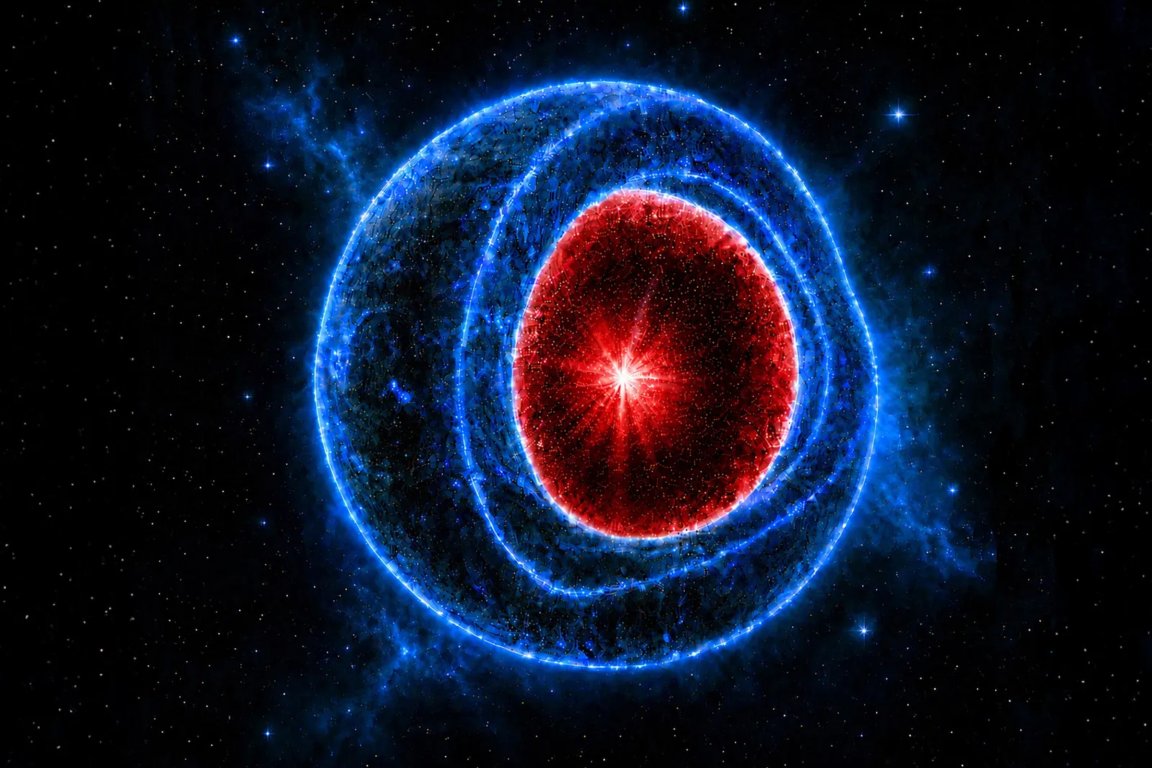
An expanding mini universe could counterbalance the collapsing matter of a star, thereby creating a stable gravastar.

Daniel Jampolski and Luciano Rezzolla, Goethe University Frankfurt

Sign up to see the future, today

Can’t-miss innovations from the bleeding edge of science and tech

Prevailing models of physics dictate that when an extremely massive star runs out of nuclear fuel, it collapses in on itself, leaving behind a black hole that prevents anything, even light, from escaping.

Or maybe not, a pair of physicists are proposing. Instead, Goethe University physics researchers Daniel Jampolski and Luciano Rezzolla suggest in a new study published in the journal Physical Review D, the demise of a large star can lead to something even stranger: a tiny, nascent universe that’s loaded with dark energy pushing outward, preventing the star from collapsing entirely.

“The Big Bang of the emerging universe can unfold once the star has already collapsed almost to the point of becoming a black hole,” explained Jampolski in a statement about the paper.

It’s a mind-bending theory that builds out an alternative path for gigantic dying stars. Instead of crumpling up into black hole of infinite density, the idea is that the star collapses almost all the way — but then reaches equilibrium as its dark energy pushes back against the final stage of collapse, like a brick preventing a garage door from shutting entirely.

Specifically, the new universe would exist at the core of a previously proposed class of objects called “gravastars,” which were already understood to contain a core made up of dark energy, the hypothetical cosmic force that scientists estimate accounts for around 68 percent of the total energy-mass content of the known universe.

The conditions as a gravastar comes into being, Jampolsi and Rezzolla suggest, are not unlike the ones present during the Big Bang, the moment at which our own universe seemingly sprang into existence billions of years ago.

The force from the dark energy would provides enough outward pressure to stabilize the gravastar, according to their model, stopping it from further collapsing. With sufficient dark energy, these gravitational forces can be equalized, resulting in a stable gravastar. This same type of outward pressure drives our own universe’s expansion, according to current models.

The researchers stressed that their theory surrounding the formation of stable gravastars doesn’t necessarily refute the existence of black holes completely.

“Looking for alternatives to black holes should not suggest a skepticism towards black holes, which still represent the most natural and simplest solution to the fate of gravitational collapse,” Rezzolla argued in the statement.

“However, as scientists in general, and as theoretical physicists in particular, it is essential to maintain an unbiased approach towards what we do not know and hence explore both the accepted wisdom and the more exotic interpretations,” he added. “History teaches us that it is not unusual for the latter to become the former.”

More on black holes: Scientists Discover Fearsome Wind That Destroys Entire Galaxies