

惯性聚合 高效追踪和阅读你感兴趣的博客、新闻、科技资讯
阅读原文 在惯性聚合中打开

推荐订阅源

D
Docker
Cyber Security Advisories - MS-ISAC
Last Week in AI
Last Week in AI
博客园_首页
Microsoft Security Blog
Blog — PlanetScale
Blog — PlanetScale
M
MIT News - Artificial intelligence
奇客Solidot–传递最新科技情报
奇客Solidot–传递最新科技情报
A
About on SuperTechFans
aimingoo的专栏
aimingoo的专栏
V
Visual Studio Blog
Jina AI
Jina AI
N
Netflix TechBlog - Medium
量子位
博客园 - 三生石上(FineUI控件)
让小产品的独立变现更简单 - ezindie.com
I
InfoQ
J
Java Code Geeks
T
Tailwind CSS Blog
博客园 - 司徒正美
Stack Overflow Blog
Stack Overflow Blog
阮一峰的网络日志
阮一峰的网络日志
Engineering at Meta
Engineering at Meta
腾讯CDC

Futurism

Man Creates Tiny Submarine for His Parakeet to Experience Life Underwater The Effects of AI-Generated Code Tearing Through Corporations Is Actually Kind of Funny Trump Hires Orbital Towing Company to Build Space Interceptors Psychologists Found Something Horrible About the Kind of Men Seeking Trad Wives To Get Swole, Teens Are Pumping Themselves Full of Drugs Meant for Fattening Cows for the Slaughterhouse Foolish Pollsters Are Now Just Asking AI What Voters Would Say in Response to Questions and Publishing It at Face Value OpenAI Says It’s Already Made $100 Million by Stuffing ChatGPT With Ads Man Punished for Breaking Into Moo Deng’s Zoo Enclosure AI Is Causing Healthcare Costs to Surge There’s a Mass Rebellion Against AI in the Workplace People Who Lose Their Job to AI Are in for a World of Pain, Goldman Sachs Report Finds OpenAI Says Not to Worry About UBI, Because It Has Another Idea Police Officer Helplessly Waves Arms at Waymo That Careened Wrong Way Through Whataburger Drive-Thru Someone Just Threw a Molotov Cocktail At Sam Altman’s House New York Times Makes Substantial Changes to Article That Glazed a Sleazy AI Startup: “Our Piece Should Have Included That Information” Space Scientists Wince as Astronauts’ Lives Depend on Artemis 2’s Controversial Heat Shield During Plunge Back to Earth The Moon Astronauts Have Been Working Out With a NASA Rowing Machine in Space First AI Model From Zuckerberg’s Wildly Expensive Superintelligence Lab Flops Compared to Virtually All Rivals Economists Starting to Admit They May Have Been Wrong About AI Never Replacing Human Jobs AI-Powered Drug Marketer Medvi Responds After Allegations About Fake Doctors and Patients As Astronauts Visit the Moon, NASA Insider Says Agency Is in Shambles Behind the Scenes Man Lights 1.2 Million Square Foot Warehouse on Fire for Not Paying Him Enough NASA Scientists Screamed With Delight When They Saw Something Smashing Into the Moon Google Says Showing Polymarket Bets on Google News Was a Mistake Las Vegas Sphere Turns Into Huge Moon to Celebrate NASA Mission The New York Times Says It’s Identified the Creator of Bitcoin We Talked to a Writer Accused of Publishing An AI-Generated Essay in The New York Times Naked Man Bursts Into Tesla Service Center With a Shotgun Student Dies When Hospital Has No ICU Doctors, Calls One on Videochat Who Pronounces Him Dead Remotely, Lawsuit Claims Analysis Finds That Google’s AI Overviews Are Providing Misinformation at a Scale Possibly Unprecedented in the History of Human Civilization
Tinder Scanning Users’ Eyeballs to Prove They Aren’t Creeps
Frank Landym · 2026-04-27 · via Futurism

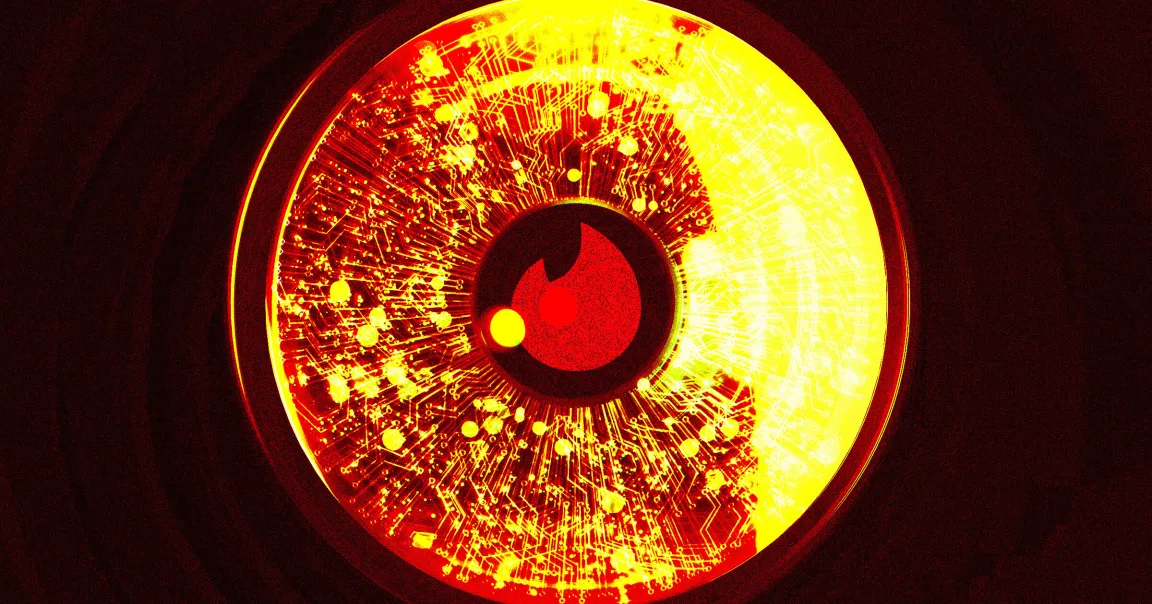
A close-up of a circular object resembling an eye with the Tinder logo at the center. The iris area contains intricate circuit-like patterns, and the overall design combines elements of technology and fire.

Getty / Futurism

Sign up to see the future, today

Can’t-miss innovations from the bleeding edge of science and tech

Tinder is partnering with Sam Altman’s World project to let its users prove they’re real humans, in just about the creepiest way possible: scanning their eyeballs with a Cyclops-looking orb.

The initiative, carried out by Altman’s startup Tools for Humanity, was announced last Friday, and represents a major foray for the biometric verification startup, which has struggled to catch on amid numerous controversies. 

The concept’s invasiveness notwithstanding, it does address a persistent problem. Dating apps like Tinder are rife with scammers, creeps, and bot accounts — so why not fork over your irises to a company with alleged data privacy violations and stand out among the hordes of suspicious profiles?

There will soon be “more stuff made by AI than is made by humans” online, Altman warned at the event, the BBC reported. “I’m not afraid for the future as long as we can tell between the two.”

Tinder is providing incentives to try out the verification scheme. After scanning their eyeballs and receiving a “World ID,” users will receive five “boosts,” which raises the visibility of their profile in an area for thirty minutes at time. These normally aren’t free, and cost up to $10 a pop.

World originally began as Worldcoin, a project that used the same Orb to scan people’s eyeballs in exchange for receiving a World ID and some cryptocurrency. The crypto it was peddling, however, was its own token, WLD. In effect, it was coaxing people into surrendering their biometric data in exchange for company scrip; today, a WLD token’s value is worth only 25 cents, while it launched at $7.50.

Moreover, an investigation by MIT Technology Review found that Worldcoin used predatory and deceptive practices to get people to submit to its scans, often targeting exploited workers in poor countries. Governments have struck back. In the EU, it was ordered to delete all iris scanning data taken from people living there. The Kenyan government suspended Worldcoin’s operations in 2023, and the UK’s data regulator said it would investigate its practices.

Given all the baggage it comes with, Tinder is really going out on a limb in partnering with Altman’s biometric startup, and World seemingly needs Tinder far more than Tinder needs World. So far, World boasts that 18 million people have obtained World IDs through eyeball scans and it will hope to raise those figures by tapping into Tinder’s giant pool of around 50 million actively weekly users.

More on privacy: Leak Shows ICE Planning to Use Facial Recognition Glasses to Identify Targets in Real Time