




惯性聚合 高效追踪和阅读你感兴趣的博客、新闻、科技资讯
阅读原文 在惯性聚合中打开

推荐订阅源

Google DeepMind News
F
Fortinet All Blogs
量子位
G
Google Developers Blog
J
Java Code Geeks
N
Netflix TechBlog - Medium
博客园 - 聂微东
宝玉的分享
宝玉的分享
Cyber Security Advisories - MS-ISAC
月光博客
月光博客
The Cloudflare Blog
Apple Machine Learning Research
爱范儿
爱范儿
雷峰网
雷峰网
M
MIT News - Artificial intelligence
T
Tailwind CSS Blog
V
Visual Studio Blog
阮一峰的网络日志
阮一峰的网络日志
博客园 - 三生石上(FineUI控件)
Microsoft Azure Blog
aimingoo的专栏
aimingoo的专栏
Martin Fowler
Martin Fowler
有赞技术团队
有赞技术团队
T
The Blog of Author Tim Ferriss

Futurism

Man Creates Tiny Submarine for His Parakeet to Experience Life Underwater The Effects of AI-Generated Code Tearing Through Corporations Is Actually Kind of Funny Trump Hires Orbital Towing Company to Build Space Interceptors Psychologists Found Something Horrible About the Kind of Men Seeking Trad Wives To Get Swole, Teens Are Pumping Themselves Full of Drugs Meant for Fattening Cows for the Slaughterhouse Foolish Pollsters Are Now Just Asking AI What Voters Would Say in Response to Questions and Publishing It at Face Value OpenAI Says It’s Already Made $100 Million by Stuffing ChatGPT With Ads Man Punished for Breaking Into Moo Deng’s Zoo Enclosure AI Is Causing Healthcare Costs to Surge There’s a Mass Rebellion Against AI in the Workplace People Who Lose Their Job to AI Are in for a World of Pain, Goldman Sachs Report Finds OpenAI Says Not to Worry About UBI, Because It Has Another Idea Police Officer Helplessly Waves Arms at Waymo That Careened Wrong Way Through Whataburger Drive-Thru Someone Just Threw a Molotov Cocktail At Sam Altman’s House New York Times Makes Substantial Changes to Article That Glazed a Sleazy AI Startup: “Our Piece Should Have Included That Information” Space Scientists Wince as Astronauts’ Lives Depend on Artemis 2’s Controversial Heat Shield During Plunge Back to Earth The Moon Astronauts Have Been Working Out With a NASA Rowing Machine in Space First AI Model From Zuckerberg’s Wildly Expensive Superintelligence Lab Flops Compared to Virtually All Rivals Economists Starting to Admit They May Have Been Wrong About AI Never Replacing Human Jobs AI-Powered Drug Marketer Medvi Responds After Allegations About Fake Doctors and Patients As Astronauts Visit the Moon, NASA Insider Says Agency Is in Shambles Behind the Scenes Man Lights 1.2 Million Square Foot Warehouse on Fire for Not Paying Him Enough NASA Scientists Screamed With Delight When They Saw Something Smashing Into the Moon Google Says Showing Polymarket Bets on Google News Was a Mistake Las Vegas Sphere Turns Into Huge Moon to Celebrate NASA Mission The New York Times Says It’s Identified the Creator of Bitcoin We Talked to a Writer Accused of Publishing An AI-Generated Essay in The New York Times Naked Man Bursts Into Tesla Service Center With a Shotgun Student Dies When Hospital Has No ICU Doctors, Calls One on Videochat Who Pronounces Him Dead Remotely, Lawsuit Claims Analysis Finds That Google’s AI Overviews Are Providing Misinformation at a Scale Possibly Unprecedented in the History of Human Civilization
Video Shows NASA Astronaut Struggling to Walk After Journ...
Victor Tange · 2026-04-28 · via Futurism

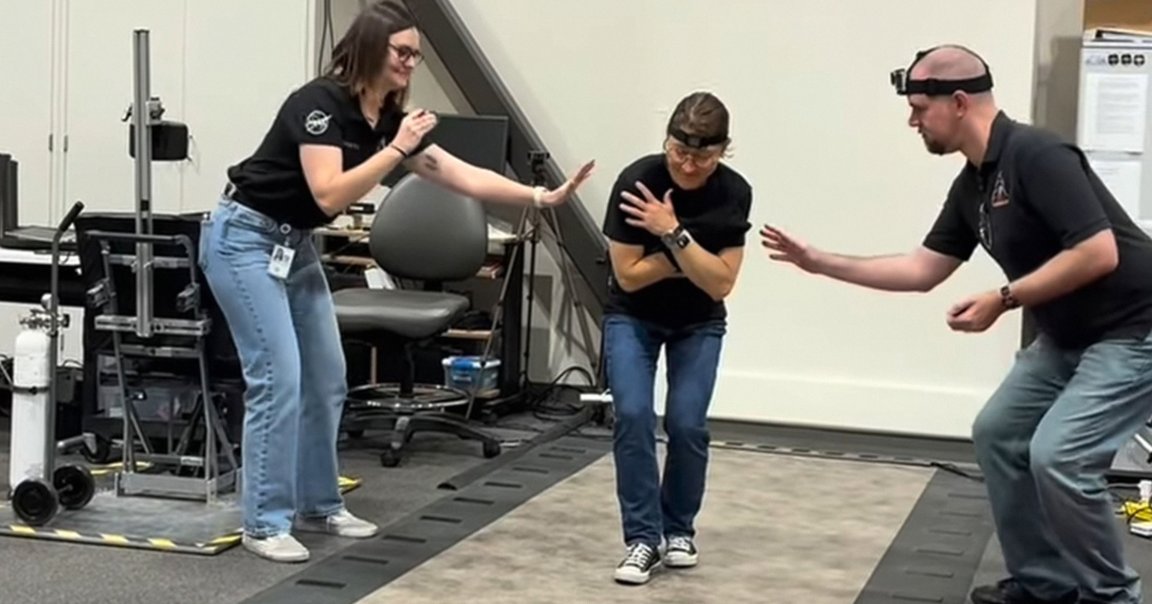
NASA astronaut Christina Koch, who traveled around the Moon and back, demonstrates that getting used to Earth's gravity isn't exactly easy.

Christina Koch via Instagram

Sign up to see the future, today

Can’t-miss innovations from the bleeding edge of science and tech

Spending prolonged periods of time in the microgravity of space can wreak havoc on our bodies. Scientists have found that astronauts can suffer from everything from accelerated bone loss and spinal health issues to swelling of the optical nerve that results in blurry vision. Some studies have even found space can alter astronauts’ DNA in ways that are still largely unknown.

At a high level, returning to our home planet can also throw space travelers’ sense of balance completely out of whack. As NASA astronaut Christina Koch — who traveled around the Moon and back alongside her fellow crew members earlier this month — demonstrated in a recent video, getting used to Earth’s gravity again isn’t exactly easy.

The clip she shared on Instagram roughly a week after splashing down in the Pacific Ocean shows her visibly struggling to put one front in front of the other while her eyes are closed.

“Guess I’ll be waiting a minute to surf again,” she wrote in the caption.

Her stumbling is the result of the brain no longer being able to rely on the vestibular system within the inner ear for knowing which way is up and which is down. In other words, Koch likely would’ve fared much better with her eyes open.

“When people live in microgravity, the systems in our body that have evolved to tell our brains how we’re moving, the vestibular organs, don’t work correctly,” Koch explained. “Our brains learn to ignore those signals and so when we first get back to gravity, we are heavily reliant on our eyes to orient ourselves visually.”

“A tandem walk with eyes closed can be quite the challenge!” she admitted. “Learning about this can help inform how we treat vertigo, concussions and other neuro-vestibular conditions on Earth.”

Koch is no stranger to spending prolonged periods of time in space. While this month’s Artemis 2 mission took place over just ten days, the NASA astronaut has previously spent almost a year on board the International Space Station.

While astronauts spend significant portions of their time in space exercising to stave off the detrimental effects microgravity has on their physical health, we have yet to find an effective way to help them restore their sense of balance once they’re Earthside — other than Father Time, that is.

“With eyes closed, it was almost impossible to walk in a straight line,” European Space Agency astronaut Andreas Mogensen told NASA after his journey to the ISS last year.

“I felt wobbly for the first two days,” added fellow crew member NASA astronaut Jasmin Moghbeli. “My neck was very tired from holding up my head.”

In short, stumbling over your own two feet with your eyes closed seems like a small price to pay considering Koch’s spectacular journey around the Moon, which provided some genuinely breathtaking views.

More on Artemis 2: Guess What This Creepy Underwater Thing Is That Was Photographed by US Navy Divers for NASA