


惯性聚合 高效追踪和阅读你感兴趣的博客、新闻、科技资讯
阅读原文 在惯性聚合中打开

推荐订阅源

量子位
博客园_首页
罗磊的独立博客
云风的 BLOG
云风的 BLOG
J
Java Code Geeks
Last Week in AI
Last Week in AI
D
DataBreaches.Net
Jina AI
Jina AI
博客园 - Franky
大猫的无限游戏
大猫的无限游戏
Apple Machine Learning Research
V
V2EX
D
Docker
MongoDB | Blog
MongoDB | Blog
B
Blog RSS Feed
让小产品的独立变现更简单 - ezindie.com
宝玉的分享
宝玉的分享
Engineering at Meta
Engineering at Meta
The Cloudflare Blog
博客园 - 三生石上(FineUI控件)
有赞技术团队
有赞技术团队
人人都是产品经理
人人都是产品经理
H
Help Net Security
T
The Blog of Author Tim Ferriss

Futurism

Man Creates Tiny Submarine for His Parakeet to Experience Life Underwater The Effects of AI-Generated Code Tearing Through Corporations Is Actually Kind of Funny Trump Hires Orbital Towing Company to Build Space Interceptors Psychologists Found Something Horrible About the Kind of Men Seeking Trad Wives To Get Swole, Teens Are Pumping Themselves Full of Drugs Meant for Fattening Cows for the Slaughterhouse Foolish Pollsters Are Now Just Asking AI What Voters Would Say in Response to Questions and Publishing It at Face Value OpenAI Says It’s Already Made $100 Million by Stuffing ChatGPT With Ads Man Punished for Breaking Into Moo Deng’s Zoo Enclosure AI Is Causing Healthcare Costs to Surge There’s a Mass Rebellion Against AI in the Workplace People Who Lose Their Job to AI Are in for a World of Pain, Goldman Sachs Report Finds OpenAI Says Not to Worry About UBI, Because It Has Another Idea Police Officer Helplessly Waves Arms at Waymo That Careened Wrong Way Through Whataburger Drive-Thru Someone Just Threw a Molotov Cocktail At Sam Altman’s House New York Times Makes Substantial Changes to Article That Glazed a Sleazy AI Startup: “Our Piece Should Have Included That Information” Space Scientists Wince as Astronauts’ Lives Depend on Artemis 2’s Controversial Heat Shield During Plunge Back to Earth The Moon Astronauts Have Been Working Out With a NASA Rowing Machine in Space First AI Model From Zuckerberg’s Wildly Expensive Superintelligence Lab Flops Compared to Virtually All Rivals Economists Starting to Admit They May Have Been Wrong About AI Never Replacing Human Jobs AI-Powered Drug Marketer Medvi Responds After Allegations About Fake Doctors and Patients As Astronauts Visit the Moon, NASA Insider Says Agency Is in Shambles Behind the Scenes Man Lights 1.2 Million Square Foot Warehouse on Fire for Not Paying Him Enough NASA Scientists Screamed With Delight When They Saw Something Smashing Into the Moon Google Says Showing Polymarket Bets on Google News Was a Mistake Las Vegas Sphere Turns Into Huge Moon to Celebrate NASA Mission The New York Times Says It’s Identified the Creator of Bitcoin We Talked to a Writer Accused of Publishing An AI-Generated Essay in The New York Times Naked Man Bursts Into Tesla Service Center With a Shotgun Student Dies When Hospital Has No ICU Doctors, Calls One on Videochat Who Pronounces Him Dead Remotely, Lawsuit Claims Analysis Finds That Google’s AI Overviews Are Providing Misinformation at a Scale Possibly Unprecedented in the History of Human Civilization
Astronomers Create Entire Synthetic Universe “Indistingui...
Frank Landym · 2026-04-23 · via Futurism

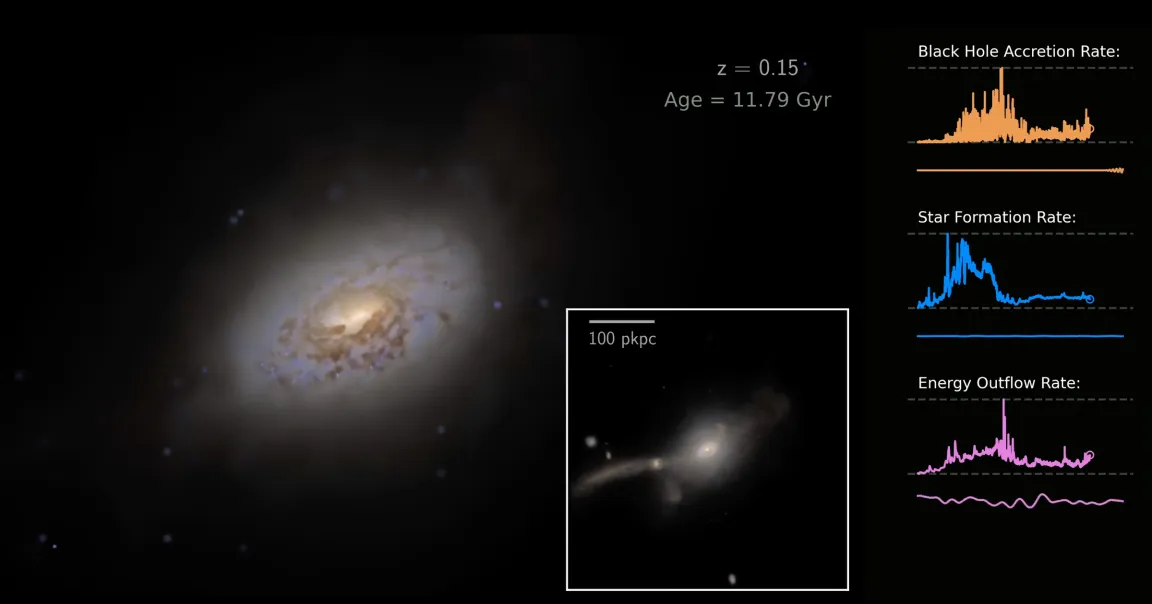
A spiral galaxy with a bright core and faint spiral arms is shown against a dark background. To the right, there are three graphs.

Colibre Simulations via YouTube

Sign up to see the future, today

Can’t-miss innovations from the bleeding edge of science and tech

Astronomers say they’ve created an entire synthetic universe which uncannily reproduces the properties of our real one. 

The point of the feat, which was detailed in a new study published in the journal Monthly Notices of the Royal Astronomical Society, wasn’t to play god, but to test the standard cosmological model. Nonetheless, the researchers couldn’t resist basking in the glory of their impressive creation, dubbed the COLIBRE project.

“It is exhilarating to see ‘galaxies’ come out of our computer that look indistinguishable from the real thing and share many of the properties that astronomers measure in real data such as their number, luminosities, colors and sizes,” said coauthor Carlos Frenk, a physicist at Durham University, in a statement about the work.

“What is most remarkable is that we are able to produce this synthetic universe purely by solving the relevant equations of physics in the expanding universe,” Frenk added.

The similarities here are a good thing for cosmologists, who can let out a sigh of relief. The researchers say their virtual universe demonstrates that the standard model can explain galaxy formation even better than previously thought — a welcome source of respite, as recent discoveries, including those made with the James Webb Space Telescope, have poked holes in the prevailing model.

The team says its synthetic universe is the first large volume simulation to model cold gases and cosmic dust inside galaxies, the free-floating material that coalesces to form stars. Previous simulations imposed a hard cut off on gasses colder than 10,000 degrees Fahrenheit, because at these low temperatures they were too complex to model.

But with enough brain and computing power, the researchers overcame this obstacle. The international team spent nearly ten years building the COLIBRE model, which they ran on the COSMA8 supercomputer at Durham University, taking 72 million CPU hours to complete the largest simulation. It will take several more years to deeply analyze the troves of data the simulations have yielded.

So far, the simulations closely align with observations of both the early and our present day universe, which crucially includes the masses of some of the first galaxies. But the researchers concede the model doesn’t explain the James Webb’s discovery of what’s come to be known as the “Little Red Dots,” a class of luminous and apparently mega-massive objects spotted peppering the cosmos when it was less than a billion years old, but are nowhere to be found today. Theories range from unprecedentedly compact galaxies to a previously unseen stage of supermassive black hole evolution.

“Some early JWST results were thought to challenge the standard cosmological model,” coauthor Evgenii Chaikin of Leiden University acknowledged in the statement. But “COLIBRE shows that, once key physical processes are represented more realistically, the model is consistent with what we see.”

More on space: Physicists Have a Major Problem With the Universe