

惯性聚合 高效追踪和阅读你感兴趣的博客、新闻、科技资讯
阅读原文 在惯性聚合中打开

推荐订阅源

G
Google Developers Blog
博客园 - 司徒正美
Last Week in AI
Last Week in AI
Recent Announcements
Y
Y Combinator Blog
博客园 - 聂微东
M
MIT News - Artificial intelligence
博客园_首页
Jina AI
Jina AI
博客园 - 叶小钗
酷 壳 – CoolShell
酷 壳 – CoolShell
H
Hackread – Cybersecurity News, Data Breaches, AI and More
J
Java Code Geeks
F
Fortinet All Blogs
aimingoo的专栏
aimingoo的专栏
小众软件
小众软件
Vercel News
Vercel News
The Cloudflare Blog
钛媒体:引领未来商业与生活新知
钛媒体:引领未来商业与生活新知
云风的 BLOG
云风的 BLOG
N
Netflix TechBlog - Medium
B
Blog
Google DeepMind News
freeCodeCamp Programming Tutorials: Python, JavaScript, Git & More

Futurism

Man Creates Tiny Submarine for His Parakeet to Experience Life Underwater The Effects of AI-Generated Code Tearing Through Corporations Is Actually Kind of Funny Trump Hires Orbital Towing Company to Build Space Interceptors Psychologists Found Something Horrible About the Kind of Men Seeking Trad Wives To Get Swole, Teens Are Pumping Themselves Full of Drugs Meant for Fattening Cows for the Slaughterhouse Foolish Pollsters Are Now Just Asking AI What Voters Would Say in Response to Questions and Publishing It at Face Value OpenAI Says It’s Already Made $100 Million by Stuffing ChatGPT With Ads Man Punished for Breaking Into Moo Deng’s Zoo Enclosure AI Is Causing Healthcare Costs to Surge There’s a Mass Rebellion Against AI in the Workplace People Who Lose Their Job to AI Are in for a World of Pain, Goldman Sachs Report Finds OpenAI Says Not to Worry About UBI, Because It Has Another Idea Police Officer Helplessly Waves Arms at Waymo That Careened Wrong Way Through Whataburger Drive-Thru Someone Just Threw a Molotov Cocktail At Sam Altman’s House New York Times Makes Substantial Changes to Article That Glazed a Sleazy AI Startup: “Our Piece Should Have Included That Information” Space Scientists Wince as Astronauts’ Lives Depend on Artemis 2’s Controversial Heat Shield During Plunge Back to Earth The Moon Astronauts Have Been Working Out With a NASA Rowing Machine in Space First AI Model From Zuckerberg’s Wildly Expensive Superintelligence Lab Flops Compared to Virtually All Rivals Economists Starting to Admit They May Have Been Wrong About AI Never Replacing Human Jobs AI-Powered Drug Marketer Medvi Responds After Allegations About Fake Doctors and Patients As Astronauts Visit the Moon, NASA Insider Says Agency Is in Shambles Behind the Scenes Man Lights 1.2 Million Square Foot Warehouse on Fire for Not Paying Him Enough NASA Scientists Screamed With Delight When They Saw Something Smashing Into the Moon Google Says Showing Polymarket Bets on Google News Was a Mistake Las Vegas Sphere Turns Into Huge Moon to Celebrate NASA Mission The New York Times Says It’s Identified the Creator of Bitcoin We Talked to a Writer Accused of Publishing An AI-Generated Essay in The New York Times Naked Man Bursts Into Tesla Service Center With a Shotgun Student Dies When Hospital Has No ICU Doctors, Calls One on Videochat Who Pronounces Him Dead Remotely, Lawsuit Claims Analysis Finds That Google’s AI Overviews Are Providing Misinformation at a Scale Possibly Unprecedented in the History of Human Civilization
Scientists Scan Gigantic Structure Hiding Behind Our Galaxy
Victor Tange · 2026-04-29 · via Futurism

Researchers say it has mapped a supercluster of galaxies hiding behind the Milky Way ten years after it was first discovered.

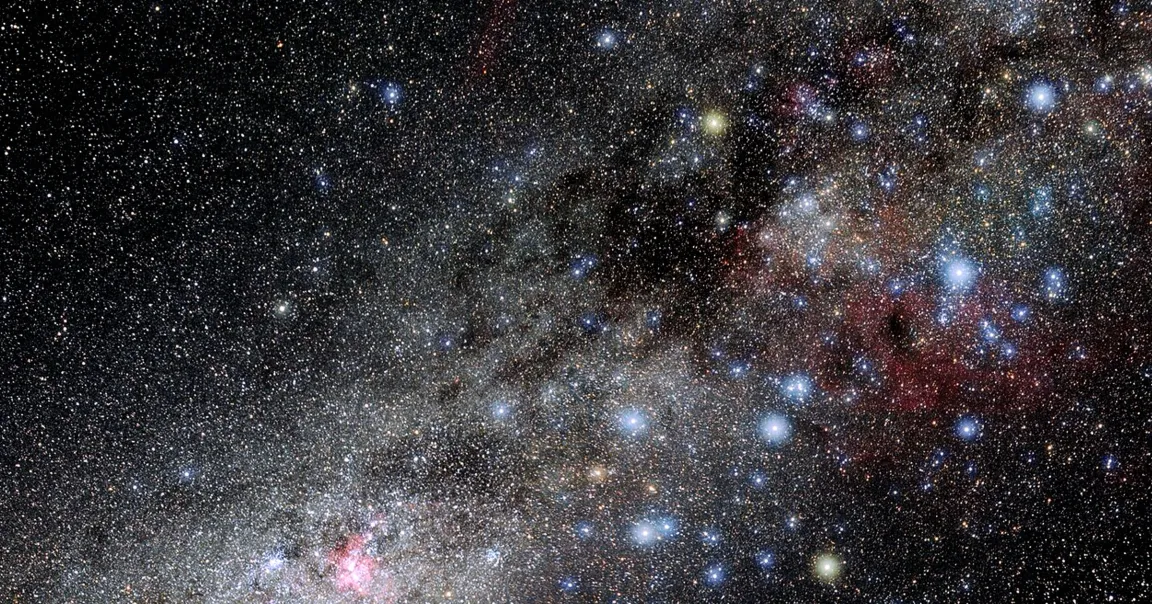
E. Slawik/NOIRLab/NSF/AURA/M. Zamani

Sign up to see the future, today

Can’t-miss innovations from the bleeding edge of science and tech

In 2016, researchers discovered an enormous supercluster of galaxies in the constellation of Vela that had been hiding in plain sight.

The collection of at least 20 galaxy clusters, each of which is believed to contain hundreds of thousands of galaxies, is located roughly 800 million light-years from Earth within a region called the “Zone of Avoidance.” The region got its name because it’s obscured by our own Milky Way galaxy’s dense dust, gas, and stars — a “dead zone” occupying around 20 percent of the night sky that makes it almost impossible for astronomers to peer beyond it.

Now, ten years after it was first discovered, an international team of researchers says it’s mapped this awe-inspiring Vela Supercluster. As detailed in a yet-to-be-peer-reviewed paper, researchers concluded that the structure is roughly 300 million light-years across, making it around 3,000 times wider than the Milky Way itself, as Live Science explains — far more massive than previously thought.

The findings could allow us to get a better understanding of the largest structures that dominate the universe and how they inform our current models of cosmology, including the age of the universe itself.

The researchers studied the behavior of galaxies at the Vela Supercluster’s edge to determine its size, using observations by two South Africa-based facilities, the Southern African Large Telescope (SALT) and the MeerKAT radio telescope, to detect galaxies deep within the Zone of Avoidance.

The latter can detect the presence of hydrogen gas at radio wavelengths which pass through the Milky Way’s dense cloud of dust, allowing them to uncover previously hidden cosmic structures behind it, according to a statement about the research.

“The millions/billions of stars forming the disk are so dense [and so] close to the galactic plane that we cannot easily see through it,” coauthor and University of Cape Town astronomer Renee Kraan-Korteweg told Live Science. “Moreover, where we have stars, we also have lots of minuscule dust particles, and like the stars, this dust layer gets thicker and thicker as you approach the plane.”

The newly-observed supercluster is a “coherent large-scale structure comparable in size and mass to some of the largest and well-known superclusters in the local universe,” according to Kraan-Korteweg. In terms of mass alone, it contains the equivalent of 30 quadrillion (that’s a million billions) of our Suns, according to the statement.

In terms of size, the Vela Supercluster now neatly fits between other previously mapped superclusters, such as Laniākea, which contains the Milky Way itself, and even larger superclusters, such as Hercules-Corona Borealis Great Wall, the largest known structure in the observable universe.

While it’s a notable advancement in our understanding of what lurks beyond the Milky Way itself, the researchers suggest more powerful radio telescopes could allow us to create even more detailed maps of the Vela Supercluster, allowing us to fine tune our models of the universe even further.

More on the supercluster: Meet Vela, the Huge Supercluster Just Detected by Astronomers