

惯性聚合 高效追踪和阅读你感兴趣的博客、新闻、科技资讯
阅读原文 在惯性聚合中打开

推荐订阅源

让小产品的独立变现更简单 - ezindie.com
U
Unit 42
Google DeepMind News
博客园 - 司徒正美
Y
Y Combinator Blog
F
Fortinet All Blogs
云风的 BLOG
云风的 BLOG
T
Tailwind CSS Blog
G
Google Developers Blog
酷 壳 – CoolShell
酷 壳 – CoolShell
罗磊的独立博客
D
DataBreaches.Net
T
The Blog of Author Tim Ferriss
Cyber Security Advisories - MS-ISAC
MyScale Blog
MyScale Blog
N
Netflix TechBlog - Medium
Microsoft Security Blog
GbyAI
GbyAI
P
Proofpoint News Feed
Jina AI
Jina AI
B
Blog RSS Feed
腾讯CDC
阮一峰的网络日志
阮一峰的网络日志
D
Docker

Futurism

Man Creates Tiny Submarine for His Parakeet to Experience Life Underwater The Effects of AI-Generated Code Tearing Through Corporations Is Actually Kind of Funny Trump Hires Orbital Towing Company to Build Space Interceptors Psychologists Found Something Horrible About the Kind of Men Seeking Trad Wives To Get Swole, Teens Are Pumping Themselves Full of Drugs Meant for Fattening Cows for the Slaughterhouse Foolish Pollsters Are Now Just Asking AI What Voters Would Say in Response to Questions and Publishing It at Face Value OpenAI Says It’s Already Made $100 Million by Stuffing ChatGPT With Ads Man Punished for Breaking Into Moo Deng’s Zoo Enclosure AI Is Causing Healthcare Costs to Surge There’s a Mass Rebellion Against AI in the Workplace People Who Lose Their Job to AI Are in for a World of Pain, Goldman Sachs Report Finds OpenAI Says Not to Worry About UBI, Because It Has Another Idea Police Officer Helplessly Waves Arms at Waymo That Careened Wrong Way Through Whataburger Drive-Thru Someone Just Threw a Molotov Cocktail At Sam Altman’s House New York Times Makes Substantial Changes to Article That Glazed a Sleazy AI Startup: “Our Piece Should Have Included That Information” Space Scientists Wince as Astronauts’ Lives Depend on Artemis 2’s Controversial Heat Shield During Plunge Back to Earth The Moon Astronauts Have Been Working Out With a NASA Rowing Machine in Space First AI Model From Zuckerberg’s Wildly Expensive Superintelligence Lab Flops Compared to Virtually All Rivals Economists Starting to Admit They May Have Been Wrong About AI Never Replacing Human Jobs AI-Powered Drug Marketer Medvi Responds After Allegations About Fake Doctors and Patients As Astronauts Visit the Moon, NASA Insider Says Agency Is in Shambles Behind the Scenes Man Lights 1.2 Million Square Foot Warehouse on Fire for Not Paying Him Enough NASA Scientists Screamed With Delight When They Saw Something Smashing Into the Moon Google Says Showing Polymarket Bets on Google News Was a Mistake Las Vegas Sphere Turns Into Huge Moon to Celebrate NASA Mission The New York Times Says It’s Identified the Creator of Bitcoin We Talked to a Writer Accused of Publishing An AI-Generated Essay in The New York Times Naked Man Bursts Into Tesla Service Center With a Shotgun Student Dies When Hospital Has No ICU Doctors, Calls One on Videochat Who Pronounces Him Dead Remotely, Lawsuit Claims Analysis Finds That Google’s AI Overviews Are Providing Misinformation at a Scale Possibly Unprecedented in the History of Human Civilization
You’ll Gasp When You Hear How Many Chinese EVs You Can Bu...
Frank Landym · 2026-05-03 · via Futurism

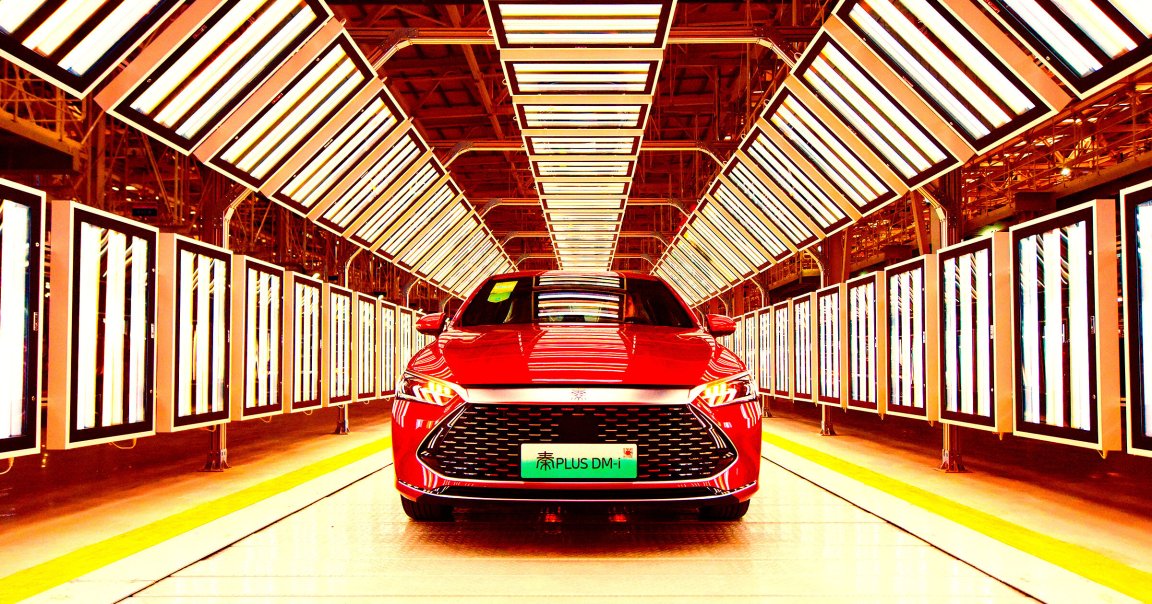
A red BYD Qin PLUS DM-i car is positioned centrally in a brightly lit inspection tunnel, surrounded by numerous rectangular light panels on the walls and ceiling, creating a symmetrical and futuristic atmosphere. The car's front grille and headlights are prominently visible, with the license plate displaying "PLUS DM-i."

VCG/VCG via Getty Images/Futurism

Sign up to see the future, today

Can’t-miss innovations from the bleeding edge of science and tech

American automakers have some explaining to do.

According to new reporting from Reuters, you could buy up to five Chinese electric vehicles for the average price of a single new car in the US.

It’s a startling comparison that encapsulates China’s unquestionable dominance in the EV space, and indeed its position as the largest car manufacturing nation in the world. The other side of that equation is how US automakers have rested on their laurels, content to push overly large and expensive cars on their customers — not to mention the US’s foremost EV company, Tesla, still being caught in a downward spiral under Elon Musk’s erratic leadership.

Let’s break down that headline-fueling comparison. Reuters cites Kelley Blue Book data showing that the average price of a new set of wheels in the US in March was $51,456. (Go figure that the percentage of Americans taking out predatory 84 month car loans is higher than ever.)

In China, meanwhile, there’re more than 200 EVs and hybrids for sale at less than $25,000 according to data from DCar cited by Reuters.

Of this category, the five best selling Chinese EVs that start under $12,000 could all be bought for around that beefy $51,456 price tag. These cars won’t match up in size to behemoth US vehicles, but they’re more than capable — and arguably just as stylish as well.

The crème de la crème among this Cheap Five is the Geely EX2, a subcompact hatchback that was the top-selling car of any kind in China last year. It sells for just $10,060, and for that you get all the bells and whistles you’d expect from a modern car — giant infotainment screen and all — and a surprisingly roomy interior. The top trim has a battery range of 314 miles, based on Chinese testing standards.

“When you get in, you don’t feel like you are in a small car,” ​auto analyst Felipe Munoz told Reuters. “It feels better in terms of quality and bigger in terms of size.”

Mike Floyd at Motor Trend agreed. “We can say anecdotally that it’s borderline huge inside for a car of its exterior dimensions,” Floyd wrote. “I’m six feet tall, and I sat in the back during one of the autocross runs and had several inches of legroom and a couple of inches of headroom. Super impressive.”

In other words, it’s almost mindblowing how much new car you’re getting in China for just ten grand. Stateside, $10,000 might get you a ten year old, gas guzzling sedan with over 100,000 miles under its belt.

It’s also a testament to the diversity of sizes on offer from Chinese automakers, whereas American automakers have narrowed their fleets to comprising ever larger cars. The US big three automakers have almost entirely abandoned selling sedans; Ford and Chevy don’t sell any sedan models at all.

Caution should be taken not to breathlessly pour praise on Chinese automakers, since they also have their ups and downs — though the numbers here speak for themselves — but it’s a sobering reality for US companies nonetheless.

More on EVs: Tesla Quietly Buys Mysterious $2 Billion Entity