



惯性聚合 高效追踪和阅读你感兴趣的博客、新闻、科技资讯
阅读原文 在惯性聚合中打开

推荐订阅源

大猫的无限游戏
大猫的无限游戏
aimingoo的专栏
aimingoo的专栏
I
InfoQ
B
Blog RSS Feed
D
DataBreaches.Net
S
SegmentFault 最新的问题
P
Proofpoint News Feed
A
About on SuperTechFans
WordPress大学
WordPress大学
Hugging Face - Blog
Hugging Face - Blog
博客园 - 司徒正美
小众软件
小众软件
博客园 - Franky
有赞技术团队
有赞技术团队
D
Docker
T
Tailwind CSS Blog
雷峰网
雷峰网
让小产品的独立变现更简单 - ezindie.com
Blog — PlanetScale
Blog — PlanetScale
酷 壳 – CoolShell
酷 壳 – CoolShell
B
Blog
V
Visual Studio Blog
宝玉的分享
宝玉的分享
爱范儿
爱范儿

Futurism

Man Creates Tiny Submarine for His Parakeet to Experience Life Underwater The Effects of AI-Generated Code Tearing Through Corporations Is Actually Kind of Funny Trump Hires Orbital Towing Company to Build Space Interceptors Psychologists Found Something Horrible About the Kind of Men Seeking Trad Wives To Get Swole, Teens Are Pumping Themselves Full of Drugs Meant for Fattening Cows for the Slaughterhouse Foolish Pollsters Are Now Just Asking AI What Voters Would Say in Response to Questions and Publishing It at Face Value OpenAI Says It’s Already Made $100 Million by Stuffing ChatGPT With Ads Man Punished for Breaking Into Moo Deng’s Zoo Enclosure AI Is Causing Healthcare Costs to Surge There’s a Mass Rebellion Against AI in the Workplace People Who Lose Their Job to AI Are in for a World of Pain, Goldman Sachs Report Finds OpenAI Says Not to Worry About UBI, Because It Has Another Idea Police Officer Helplessly Waves Arms at Waymo That Careened Wrong Way Through Whataburger Drive-Thru Someone Just Threw a Molotov Cocktail At Sam Altman’s House New York Times Makes Substantial Changes to Article That Glazed a Sleazy AI Startup: “Our Piece Should Have Included That Information” Space Scientists Wince as Astronauts’ Lives Depend on Artemis 2’s Controversial Heat Shield During Plunge Back to Earth The Moon Astronauts Have Been Working Out With a NASA Rowing Machine in Space First AI Model From Zuckerberg’s Wildly Expensive Superintelligence Lab Flops Compared to Virtually All Rivals Economists Starting to Admit They May Have Been Wrong About AI Never Replacing Human Jobs AI-Powered Drug Marketer Medvi Responds After Allegations About Fake Doctors and Patients As Astronauts Visit the Moon, NASA Insider Says Agency Is in Shambles Behind the Scenes Man Lights 1.2 Million Square Foot Warehouse on Fire for Not Paying Him Enough NASA Scientists Screamed With Delight When They Saw Something Smashing Into the Moon Google Says Showing Polymarket Bets on Google News Was a Mistake Las Vegas Sphere Turns Into Huge Moon to Celebrate NASA Mission The New York Times Says It’s Identified the Creator of Bitcoin We Talked to a Writer Accused of Publishing An AI-Generated Essay in The New York Times Naked Man Bursts Into Tesla Service Center With a Shotgun Student Dies When Hospital Has No ICU Doctors, Calls One on Videochat Who Pronounces Him Dead Remotely, Lawsuit Claims Analysis Finds That Google’s AI Overviews Are Providing Misinformation at a Scale Possibly Unprecedented in the History of Human Civilization
New York City Installing Sensors to Detect Pedestrians, V...
Joe Wilkins · 2026-06-08 · via Futurism

A photo illustration featuring a pedestrian crossing sign in Manhattan.

Illustration by Tag Hartman-Simkins / Futurism. Source: Getty Images

Sign up to see the future, today

Can’t-miss innovations from the bleeding edge of science and tech

It may sound like yet another rollout of a dystopian surveillance state network of facial recognition cameras — but the New York Department of Transportation’s latest initiative has a far more tame goal in mind: tracking modes of transport to improve street design.

According to the Gothamist, the New York Department of Transportation has added 100 roadside sensors across the city in order to pick up data on vehicle, bike, and pedestrian traffic.

The effort is an expansion of a 2023 sensor pilot meant to gather data on city traffic, which saw 20 such devices installed on signposts in various locations. The machine-learning sensors — explained as a tool to help improve pedestrian crossings and bicycle infrastructure — are trained to anonymize faces and license plates, DOT deputy commissioner Eric Beaton told the Gothamist.

An image shared by the DOT shows the sensor in action: a hazy blur obscures some details, but a machine learning algorithm ensures each pedestrian and vehicle is visually tracked in color-coded boxes, each with their own label.
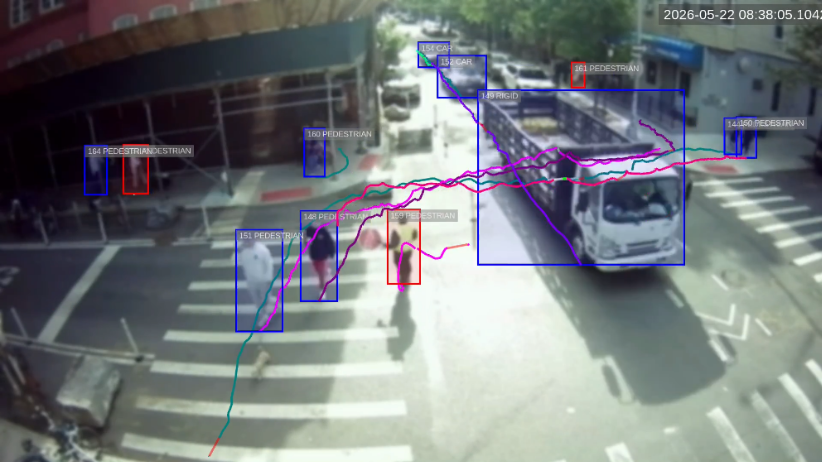
A view from the New York City Department of Transportation's traffic sensors, with various traffic elements highlighted and labeled in color-coordinated boxes.

“There’s nothing that we ever touch or that anyone could ever touch that has anything identifying to any person or any vehicle,” the DOT’s Beaton claimed. “These sensors provide a much richer set of data for us to work with.”

As part of the surveillance move, the DOT said it will share a portion of the data collected with the community. Accountability watchdogs, however, are demanding all of it.

“If they’re collecting this data on behalf of the public, as a taxpayer-funded agency, we deserve to know what it says and so there should be regular reporting,” transit advocate and former policy director for the DOT Jon Orcutt told the Gothamist.

Still, the situation highlights the tricky position city officials find themselves in, where collecting enough data to make informed decisions about better transit options necessitates an expansion of municipal surveillance.

As Orcutt explains: “there are [currently] 20 or 25 sites where bikes are counted. You get a very small data set from that. You know we have 6,000 miles of streets.”

More on New York City: Authorities Alarmed as Mysterious Figures Emerge From Sewers