



惯性聚合 高效追踪和阅读你感兴趣的博客、新闻、科技资讯
阅读原文 在惯性聚合中打开

推荐订阅源

freeCodeCamp Programming Tutorials: Python, JavaScript, Git & More
V
Visual Studio Blog
IT之家
IT之家
博客园 - 聂微东
The Cloudflare Blog
月光博客
月光博客
阮一峰的网络日志
阮一峰的网络日志
S
SegmentFault 最新的问题
Apple Machine Learning Research
酷 壳 – CoolShell
酷 壳 – CoolShell
爱范儿
爱范儿
H
Help Net Security
博客园 - 叶小钗
V
V2EX
WordPress大学
WordPress大学
J
Java Code Geeks
Hugging Face - Blog
Hugging Face - Blog
OSCHINA 社区最新新闻
OSCHINA 社区最新新闻
博客园_首页
C
Check Point Blog
B
Blog
D
DataBreaches.Net
美团技术团队
罗磊的独立博客

Futurism

Man Creates Tiny Submarine for His Parakeet to Experience Life Underwater The Effects of AI-Generated Code Tearing Through Corporations Is Actually Kind of Funny Trump Hires Orbital Towing Company to Build Space Interceptors Psychologists Found Something Horrible About the Kind of Men Seeking Trad Wives To Get Swole, Teens Are Pumping Themselves Full of Drugs Meant for Fattening Cows for the Slaughterhouse Foolish Pollsters Are Now Just Asking AI What Voters Would Say in Response to Questions and Publishing It at Face Value OpenAI Says It’s Already Made $100 Million by Stuffing ChatGPT With Ads Man Punished for Breaking Into Moo Deng’s Zoo Enclosure AI Is Causing Healthcare Costs to Surge There’s a Mass Rebellion Against AI in the Workplace People Who Lose Their Job to AI Are in for a World of Pain, Goldman Sachs Report Finds OpenAI Says Not to Worry About UBI, Because It Has Another Idea Police Officer Helplessly Waves Arms at Waymo That Careened Wrong Way Through Whataburger Drive-Thru Someone Just Threw a Molotov Cocktail At Sam Altman’s House New York Times Makes Substantial Changes to Article That Glazed a Sleazy AI Startup: “Our Piece Should Have Included That Information” Space Scientists Wince as Astronauts’ Lives Depend on Artemis 2’s Controversial Heat Shield During Plunge Back to Earth The Moon Astronauts Have Been Working Out With a NASA Rowing Machine in Space First AI Model From Zuckerberg’s Wildly Expensive Superintelligence Lab Flops Compared to Virtually All Rivals Economists Starting to Admit They May Have Been Wrong About AI Never Replacing Human Jobs AI-Powered Drug Marketer Medvi Responds After Allegations About Fake Doctors and Patients As Astronauts Visit the Moon, NASA Insider Says Agency Is in Shambles Behind the Scenes Man Lights 1.2 Million Square Foot Warehouse on Fire for Not Paying Him Enough NASA Scientists Screamed With Delight When They Saw Something Smashing Into the Moon Google Says Showing Polymarket Bets on Google News Was a Mistake Las Vegas Sphere Turns Into Huge Moon to Celebrate NASA Mission The New York Times Says It’s Identified the Creator of Bitcoin We Talked to a Writer Accused of Publishing An AI-Generated Essay in The New York Times Naked Man Bursts Into Tesla Service Center With a Shotgun Student Dies When Hospital Has No ICU Doctors, Calls One on Videochat Who Pronounces Him Dead Remotely, Lawsuit Claims Analysis Finds That Google’s AI Overviews Are Providing Misinformation at a Scale Possibly Unprecedented in the History of Human Civilization
Guess What This Creepy Underwater Thing Is That Was Photo...
Victor Tangermann · 2026-04-21 · via Futurism

An intriguing photo shows the charred heat shield of NASA's Artemis 2 Orion capsule right after splashdown in the Pacific on April 10.

NASA

Sign up to see the future, today

Can’t-miss innovations from the bleeding edge of science and tech

It may look like the underwater remains of a church that’s been submerged for hundreds of years following a dam break, or a tunnel boring machine that just broke through a mound of rubble.

But if those were your guesses, you’d be sorely mistaken. An intriguing photo taken by US Navy divers and shared by NASA on Monday shows the charred heat shield of the space agency’s Artemis 2 Orion capsule, right after it took a plunge in the Pacific Ocean upon landing on April 10.

While the subsequent post flight analysis may drag on for quite some time, it’s an intriguing first glimpse at one of the more controversial aspects of NASA’s triumphant crewed return to the Moon. The tiled heat shield is designed to keep astronauts safe as their spacecraft slams into the Earth’s atmosphere at over 23,000 mph, a maneuver that causes it to heat up to thousands of degrees Fahrenheit.

A photo taken by US Navy divers and shared by NASA on Monday, showing the charred heat shield of the space agency's Artemis 2 Orion capsule right after it took a plunge in the Pacific Ocean upon landing on April 10.

During NASA’s inaugural 2022 Artemis 1 mission, which saw the Orion spacecraft travel around the Moon and back without a crew on board, the heat shield endured major damage upon reentry, including cracking and pieces of charred remains breaking off.

For comparison, the photo embedded below shows the significant damage the heat shield received following the Artemis 1 mission in 2022.
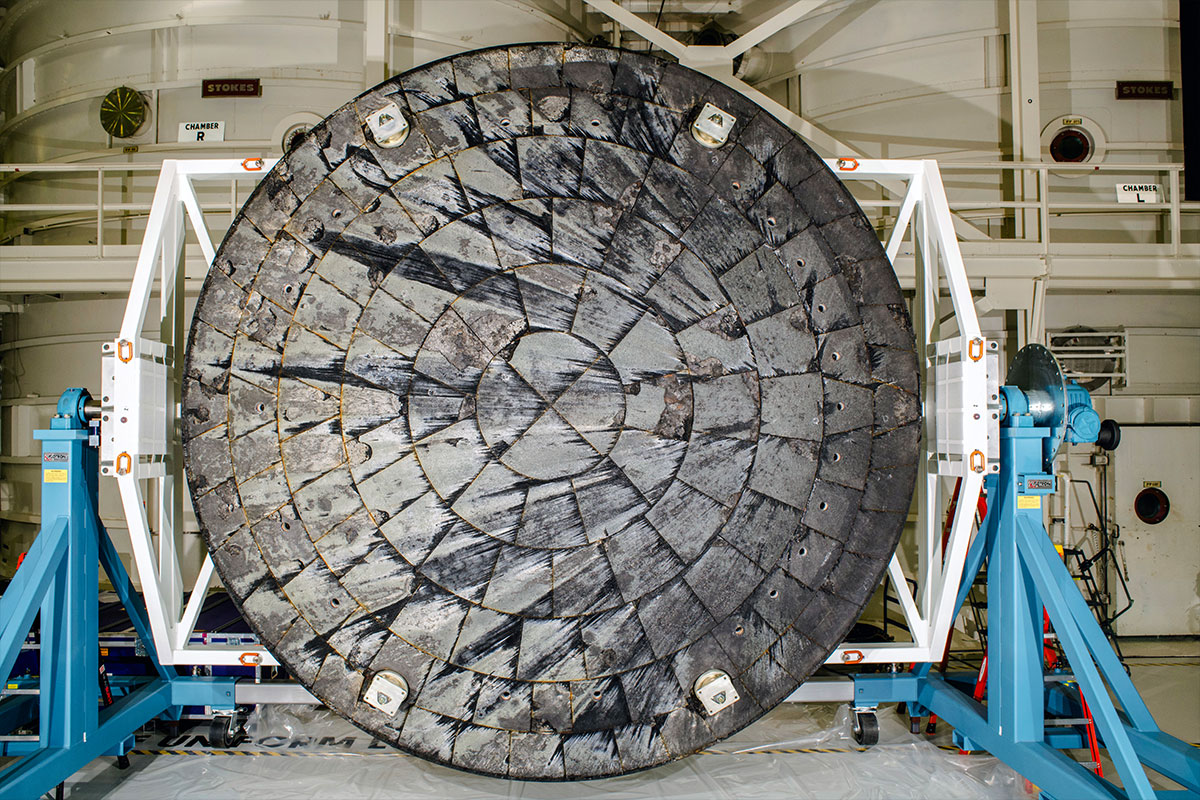
This photo shows the charred heat shield of the Orion capsule after NASA's uncrewed Artemis 1 mission.

Ahead of the mission’s launch, several experts warned that flying the same design, albeit with an adjusted trajectory to minimize the amount of heat build-up, could put the crew of the Artemis 2 mission in danger. (The Artemis 2 heat shield was installed on the Orion capsule even before NASA launched Artemis 1.)

However, early impressions suggest the heat shield appears to have done a tremendous job in keeping the four astronauts safe this month. In other words, NASA’s plans to adjust the reentry path may have paid off, which bodes well for future Artemis missions, including Artemis 4, the first planned mission to the lunar surface, tentatively scheduled for 2028.

According to NASA, “the crew and spacecraft were safeguarded by Orion’s thermal protection system as they traveled nearly 35 times the speed of sound during reentry.”

“Initial inspections of the system found it performed as expected, with no unusual conditions identified,” the agency noted. “Diver imagery of the spacecraft’s heat shield initially taken after splashdown and further inspections on the recovery ship found the char loss behavior observed on Artemis I was significantly reduced, both in terms of quantity and size.”

Even reflective tape, designed to control vehicle temperatures in space, survived reentry in “numerous locations,” NASA noted.

The entire crew module will be returned to NASA’s Kennedy Space Center before the end of the month for “additional examination of the heat shield.” It will then be taken to the Marshall Space Flight Center for further testing, including “sample extraction and internal x-ray scans.”

Beyond the heat shield, NASA also noted that it would be carefully examining the capsule’s space toilet — which turned out to be a major pain point throughout the astronauts’ ten-day adventure around the Moon after frozen urine clogged up the commode’s vent lines.

“Teams will work to identify root cause and initiate corrective action for Artemis 3,” NASA vowed.

More on the heat shield: Space Scientists Wince as Astronauts’ Lives Depend on Artemis 2’s Controversial Heat Shield During Plunge Back to Earth