

惯性聚合 高效追踪和阅读你感兴趣的博客、新闻、科技资讯
阅读原文 在惯性聚合中打开

推荐订阅源

Recent Announcements
雷峰网
雷峰网
让小产品的独立变现更简单 - ezindie.com
Hugging Face - Blog
Hugging Face - Blog
博客园 - 司徒正美
人人都是产品经理
人人都是产品经理
博客园 - 【当耐特】
量子位
有赞技术团队
有赞技术团队
博客园 - 三生石上(FineUI控件)
博客园 - Franky
M
MIT News - Artificial intelligence
U
Unit 42
Last Week in AI
Last Week in AI
酷 壳 – CoolShell
酷 壳 – CoolShell
The Cloudflare Blog
J
Java Code Geeks
V
Visual Studio Blog
Engineering at Meta
Engineering at Meta
奇客Solidot–传递最新科技情报
奇客Solidot–传递最新科技情报
MyScale Blog
MyScale Blog
T
Tailwind CSS Blog
T
The Blog of Author Tim Ferriss
V
V2EX

Futurism

Man Creates Tiny Submarine for His Parakeet to Experience Life Underwater The Effects of AI-Generated Code Tearing Through Corporations Is Actually Kind of Funny Trump Hires Orbital Towing Company to Build Space Interceptors Psychologists Found Something Horrible About the Kind of Men Seeking Trad Wives To Get Swole, Teens Are Pumping Themselves Full of Drugs Meant for Fattening Cows for the Slaughterhouse Foolish Pollsters Are Now Just Asking AI What Voters Would Say in Response to Questions and Publishing It at Face Value OpenAI Says It’s Already Made $100 Million by Stuffing ChatGPT With Ads Man Punished for Breaking Into Moo Deng’s Zoo Enclosure AI Is Causing Healthcare Costs to Surge There’s a Mass Rebellion Against AI in the Workplace People Who Lose Their Job to AI Are in for a World of Pain, Goldman Sachs Report Finds OpenAI Says Not to Worry About UBI, Because It Has Another Idea Police Officer Helplessly Waves Arms at Waymo That Careened Wrong Way Through Whataburger Drive-Thru Someone Just Threw a Molotov Cocktail At Sam Altman’s House New York Times Makes Substantial Changes to Article That Glazed a Sleazy AI Startup: “Our Piece Should Have Included That Information” Space Scientists Wince as Astronauts’ Lives Depend on Artemis 2’s Controversial Heat Shield During Plunge Back to Earth The Moon Astronauts Have Been Working Out With a NASA Rowing Machine in Space First AI Model From Zuckerberg’s Wildly Expensive Superintelligence Lab Flops Compared to Virtually All Rivals Economists Starting to Admit They May Have Been Wrong About AI Never Replacing Human Jobs AI-Powered Drug Marketer Medvi Responds After Allegations About Fake Doctors and Patients As Astronauts Visit the Moon, NASA Insider Says Agency Is in Shambles Behind the Scenes Man Lights 1.2 Million Square Foot Warehouse on Fire for Not Paying Him Enough NASA Scientists Screamed With Delight When They Saw Something Smashing Into the Moon Google Says Showing Polymarket Bets on Google News Was a Mistake Las Vegas Sphere Turns Into Huge Moon to Celebrate NASA Mission The New York Times Says It’s Identified the Creator of Bitcoin We Talked to a Writer Accused of Publishing An AI-Generated Essay in The New York Times Naked Man Bursts Into Tesla Service Center With a Shotgun Student Dies When Hospital Has No ICU Doctors, Calls One on Videochat Who Pronounces Him Dead Remotely, Lawsuit Claims Analysis Finds That Google’s AI Overviews Are Providing Misinformation at a Scale Possibly Unprecedented in the History of Human Civilization
Tension Flared on Space Station as Russia Threatened to D...
Victor Tangermann · 2026-06-19 · via Futurism

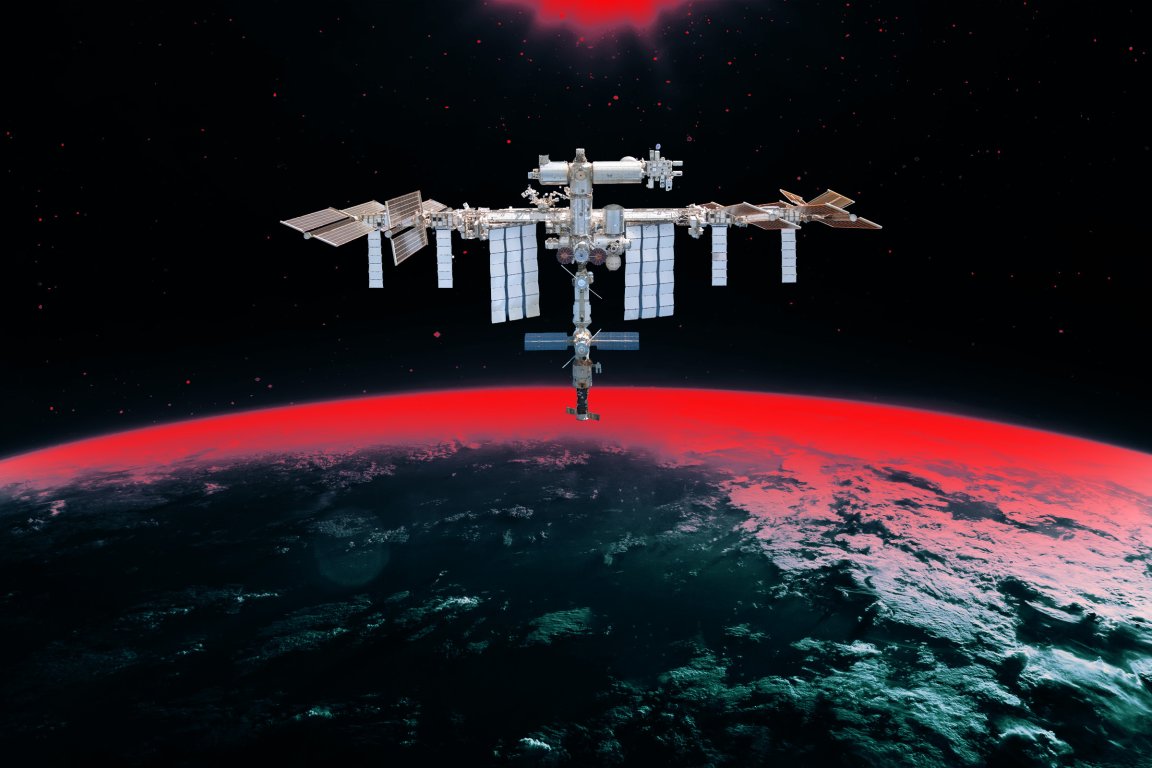
An illustration of the ISS floating above earth backed by an eerie red gradient descending from space.

Illustration by Tag Hartman-Simkins / Futurism. Source: Shutterstock

Sign up to see the future, today

Can’t-miss innovations from the bleeding edge of science and tech

For many years, both NASA and its Russian counterpart Roscosmos have struggled to contain persistent leaks plaguing the International Space Station. The aging orbital output has been through two decades of continuous habitation, and it’s really starting to show its age.

In particular, a short tunnel section dubbed PrK, which connects the Russian Zvezda module to the station’s aft docking port, has been leaking air on and off since at least 2019, alarming officials.

The situation once again came to a head on June 5, when NASA press secretary Bethany Stevens noted in an update that five astronauts would be taking shelter in a docked Dragon spacecraft “out of an abundance of caution” due to Russia’s “mitigation measures” to repair “cracks.”

Both NASA and Roscosmos have been quiet about what exactly occurred that day. But according to officials, who have since spoken to Ars Technica and The Register on condition of anonymity, Roscosmos was looking to take drastic measures to fix the leak — which had NASA rattled.

Tensions flared as both agencies butted heads over what to do, highlighting an international relationship that hasn’t always fostered peaceful cooperation in space.

According to The Register, one initial plan involved a handsaw, while another involved a “drill” and a “drill stop,” a device designed to punch a hole all the way through the wall of the module, per Ars.

“We threatened we would put astronauts in suits, in Dragon, to send a message to the world that we disagreed,” one NASA official told Ars. “They didn’t care.”

The situation escalated even further, with cosmonauts approaching the “PrK module with a saw and the intent to remove a load-bearing bracket,” according to Ars‘ sourcing.

After communications broke down between the two agencies, NASA decided to play it safe, directing all four crew members of the Crew-12 mission, as well as NASA astronaut Chris Williams, who had arrived at the station on board a Soyuz capsule in November, to shelter inside the Dragon spacecraft.

“We felt there was a very high probability of a bad outcome happening if they sawed that bracket off,” a NASA source told Ars.

NASA’s drastic decision to have its astronauts shelter in place was reportedly enough to convince Roscosmos to stand down.

The implications of the tesnse incident could be significant for the ISS. According to Ars, the PrK module will be decommissioned and no longer pressurized until that happens, which could greatly limit the use of its attached dock.

Whether that will be the end of the years-long debate over how to address the risk of a leak — or worse, a sudden depressurization — remains to be seen.

“So, yeah, worst case, you could seal it off,” ESA astronaut Andreas Mogensen told The Register in 2024, referring to the PrK module, “and I think the Space Station could continue.”

“But of course, you never know what other problems might arise,” he added.

More on the leak: ISS Astronauts Ordered to Enter Evacuation Mode