


惯性聚合 高效追踪和阅读你感兴趣的博客、新闻、科技资讯
阅读原文 在惯性聚合中打开

推荐订阅源

C
Check Point Blog
J
Java Code Geeks
H
Hackread – Cybersecurity News, Data Breaches, AI and More
D
Docker
腾讯CDC
The GitHub Blog
The GitHub Blog
大猫的无限游戏
大猫的无限游戏
Microsoft Security Blog
GbyAI
GbyAI
Stack Overflow Blog
Stack Overflow Blog
博客园 - 司徒正美
T
The Blog of Author Tim Ferriss
Vercel News
Vercel News
P
Proofpoint News Feed
雷峰网
雷峰网
博客园_首页
B
Blog RSS Feed
Microsoft Azure Blog
爱范儿
爱范儿
V
V2EX
F
Fortinet All Blogs
酷 壳 – CoolShell
酷 壳 – CoolShell
MyScale Blog
MyScale Blog
S
SegmentFault 最新的问题

Futurism

Man Creates Tiny Submarine for His Parakeet to Experience Life Underwater The Effects of AI-Generated Code Tearing Through Corporations Is Actually Kind of Funny Trump Hires Orbital Towing Company to Build Space Interceptors Psychologists Found Something Horrible About the Kind of Men Seeking Trad Wives To Get Swole, Teens Are Pumping Themselves Full of Drugs Meant for Fattening Cows for the Slaughterhouse Foolish Pollsters Are Now Just Asking AI What Voters Would Say in Response to Questions and Publishing It at Face Value OpenAI Says It’s Already Made $100 Million by Stuffing ChatGPT With Ads Man Punished for Breaking Into Moo Deng’s Zoo Enclosure AI Is Causing Healthcare Costs to Surge There’s a Mass Rebellion Against AI in the Workplace People Who Lose Their Job to AI Are in for a World of Pain, Goldman Sachs Report Finds OpenAI Says Not to Worry About UBI, Because It Has Another Idea Police Officer Helplessly Waves Arms at Waymo That Careened Wrong Way Through Whataburger Drive-Thru Someone Just Threw a Molotov Cocktail At Sam Altman’s House New York Times Makes Substantial Changes to Article That Glazed a Sleazy AI Startup: “Our Piece Should Have Included That Information” Space Scientists Wince as Astronauts’ Lives Depend on Artemis 2’s Controversial Heat Shield During Plunge Back to Earth The Moon Astronauts Have Been Working Out With a NASA Rowing Machine in Space First AI Model From Zuckerberg’s Wildly Expensive Superintelligence Lab Flops Compared to Virtually All Rivals Economists Starting to Admit They May Have Been Wrong About AI Never Replacing Human Jobs AI-Powered Drug Marketer Medvi Responds After Allegations About Fake Doctors and Patients As Astronauts Visit the Moon, NASA Insider Says Agency Is in Shambles Behind the Scenes Man Lights 1.2 Million Square Foot Warehouse on Fire for Not Paying Him Enough NASA Scientists Screamed With Delight When They Saw Something Smashing Into the Moon Google Says Showing Polymarket Bets on Google News Was a Mistake Las Vegas Sphere Turns Into Huge Moon to Celebrate NASA Mission The New York Times Says It’s Identified the Creator of Bitcoin We Talked to a Writer Accused of Publishing An AI-Generated Essay in The New York Times Naked Man Bursts Into Tesla Service Center With a Shotgun Student Dies When Hospital Has No ICU Doctors, Calls One on Videochat Who Pronounces Him Dead Remotely, Lawsuit Claims Analysis Finds That Google’s AI Overviews Are Providing Misinformation at a Scale Possibly Unprecedented in the History of Human Civilization
NASA Satellite Images Show Huge Colored Plumes Staining t...
Frank Landymore · 2026-05-17 · via Futurism

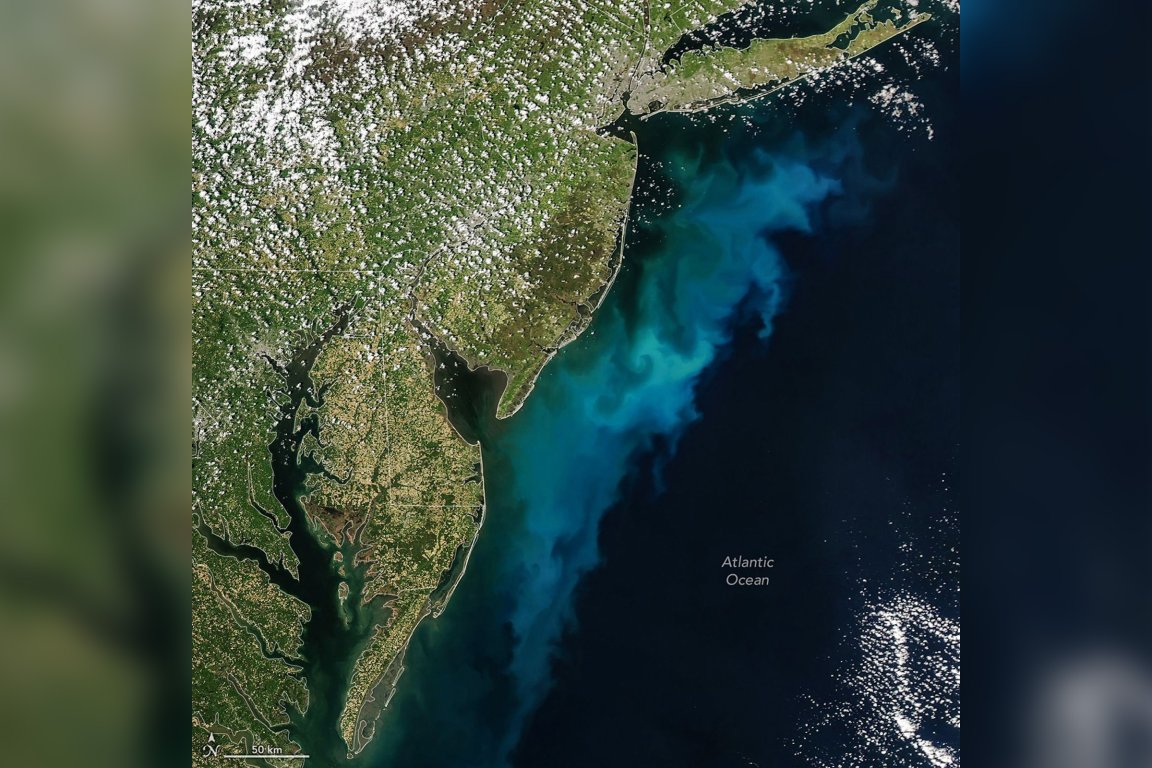
Satellite view of the mid-Atlantic region of the United States, showing a blue-green swirl pattern.

NASA Earth Observatory / Michala Garrison

Sign up to see the future, today

Can’t-miss innovations from the bleeding edge of science and tech

NASA satellites are tracking an intriguing patch of colored plumes in the waters off the US’s Mid-Atlantic coast.

Swirling with vivid hues of green and turquoise, and tinged with a little brown, the stained waters were first detected by orbital observatories in early April. But they were most intense in the Mid-Atlantic Bight, an area where the waters from several bays, including the Chesapeake, merge with the open ocean, according to an update from the space agency.

Discerning what’s swirling through these so-called “noisy” and “dirty” coastal waters is a challenge to scientists, because they can be caused by a hodgepodge of phenomena, unlike in the open ocean, which is fairly uniform. The colorful plumes could be tinged by sediments, plant life, and other organic matter. They could also be the result of phytoplankton blooms, meaning periods when the microscopic algae rapidly explode in number. Or it could be a combination of all of the above.

Thanks to the latest NASA satellites like PACE — which stands for Plankton, Aerosol, Cloud, Ocean Ecosystem — oceanographers can make more confident conclusions than ever. Some of the colors in the images may be due to outflows from coastal rivers and sediment churned up by spring storms, but “there are likely phytoplankton blooms happening,” Anna Windle, a NASA research scientist supporting the PACE science team, said in an agency statement.

Windle added that diatoms — single-celled algae —  “typically dominate blooms early in the spring, but we are seeing some signs of coccolithophores mixed in as well.”

Diatom-dominated blooms tend to happen in the spring and look greenish in natural-color satellite imagery, according to NASA. Coccolithophores, which are phytoplankton clad in a sort of limestone armor plating, produce a milkier, turquoise colored bloom, and typically occur in late spring or summer.

Scientists don’t track these colorful plumes as mere curiosities. They serve as a barometer of phytoplankton populations, and as such, a health check of the ocean’s ecosystems at large. Phytoplankton are the ocean’s main carbon recycles and produce at least half of the Earth’s oxygen, and are a source of food for other aquatic creatures. Scientists worry that fluctuations in phytoplankton populations could be changing the color of the ocean and affecting the depth that light can penetrate its surface.

Phytoplankton blooms often dissipate as quickly as they appear, though this is normally part of a healthy cycle. Initially, they feast on an abundance of nutrients present in the water after cold winter winds bring the nutrients to the surface.

“But over time, as big spring phytoplankton blooms grow, they deplete the nutrients,” Oscar Schofield, an oceanographer Rutgers University, said in the NASA release. “Unless big river outflows or storms replenish the nutrients, we’ll likely see this bloom start to decline in the coming weeks.” 

More on biology: Scientists Say They’ve Figured Out What That Golden Orb Found at the Bottom of the Pacific Ocean Actually Was