
惯性聚合 高效追踪和阅读你感兴趣的博客、新闻、科技资讯
阅读原文 在惯性聚合中打开

推荐订阅源

宝玉的分享
宝玉的分享
酷 壳 – CoolShell
酷 壳 – CoolShell
让小产品的独立变现更简单 - ezindie.com
S
Security @ Cisco Blogs
小众软件
小众软件
D
Docker
博客园_首页
A
About on SuperTechFans
P
Privacy International News Feed
freeCodeCamp Programming Tutorials: Python, JavaScript, Git & More
A
Arctic Wolf
Spread Privacy
Spread Privacy
有赞技术团队
有赞技术团队
T
Tailwind CSS Blog
Latest news
Latest news
WordPress大学
WordPress大学
CTFtime.org: upcoming CTF events
T
The Exploit Database - CXSecurity.com
C
Cybersecurity and Infrastructure Security Agency CISA
大猫的无限游戏
大猫的无限游戏
cs.CV updates on arXiv.org
OSCHINA 社区最新新闻
OSCHINA 社区最新新闻
K
Kaspersky official blog
V2EX - 技术
V2EX - 技术
SecWiki News
SecWiki News
U
Unit 42
GbyAI
GbyAI
H
Hackread – Cybersecurity News, Data Breaches, AI and More
L
LINUX DO - 热门话题
S
Security Affairs
Y
Y Combinator Blog
aimingoo的专栏
aimingoo的专栏
Blog — PlanetScale
Blog — PlanetScale
MongoDB | Blog
MongoDB | Blog
博客园 - 【当耐特】
The GitHub Blog
The GitHub Blog
T
Tenable Blog
W
WeLiveSecurity
Cloudbric
Cloudbric
Cyber Security Advisories - MS-ISAC
G
Google Developers Blog
Application and Cybersecurity Blog
N
Netflix TechBlog - Medium
F
Full Disclosure
N
News and Events Feed by Topic
D
DataBreaches.Net
P
Proofpoint News Feed
B
Blog RSS Feed
B
Blog
cs.CL updates on arXiv.org

NVIDIA Newsroom

Claude Meets Blackwell Ultra: Anthropic’s Models Now Run on NVIDIA GB300 in Azure Firefly Aerospace Operates NVIDIA Jetson in Lunar Orbit for the First Time Open Models, Closed Environments: Palantir Brings Secure AI to US Agencies With NVIDIA Nemotron The Ultimate Summer Sale Pairing: Steam Sale Meets GeForce NOW Discounts NVIDIA and AWS Collaborate to Bring AI to Production at Scale How Businesses Are Building Specialized AI They Can Trust NVIDIA Announces BioNeMo Agent Toolkit — Tools for Agents to Accelerate Scientific Discovery NVIDIA Powers Over 400 of the World’s 500 Fastest Supercomputers NVIDIA Brings Trusted, 24/7 AI Agents to Telecom Operations At ISC, JUPITER Shows What Exascale Science Looks Like NAIRR Science Program Reshapes Scientific Research, Powered by NVIDIA AI Infrastructure From Materials Simulation to Experimental Astronomy, New NVIDIA AI Software Unlocks Scientific Discoveries NVIDIA Vera CPU Opens the Way for Agentic Scientific AI at Los Alamos National Laboratory Eco Wave Power Turns Waves Into Watts With NVIDIA AI Infrastructure and Digital Twins NVIDIA Vera Rubin Delivers World-Class Supercomputers for Science Europe Unveils a Record 35 New NVIDIA AI Supercomputers NVIDIA Announces Halos for Robotics, the Industry’s First Full-Stack Safety System for Physical AI Hotter Than a Hot Tub: The 45°C Breakthrough to Cool AI’s Biggest Machines How FERC’s Large-Load Interconnection Actions Help Address Grid Stress, Improve Affordability At Cannes Lions, NVIDIA Partners Reshape Advertising and Marketing With AI Sync and Stream: GeForce NOW Connects to Members’ Game Libraries Across Devices France Advances Europe’s AI Future With NVIDIA Technologies Hands Free, AIs Forward: NVIDIA XR AI Brings Agents to AR Glasses Coherent Breaks Ground on Expanded Texas Facility, Scaling AI’s Optical Backbone HPE AI Factory With NVIDIA Expands for the Era of Agents Fastest, Largest, Strongest: NVIDIA Blackwell Sweeps MLPerf Training 6.0 NVIDIA Blackwell Leads on First Agentic AI Infrastructure Benchmark NVIDIA Stockholder Meeting Set for June 24; Individuals Can Participate Online Save Big and Play Bigger: GeForce NOW Summer Sale Brings Major Membership Savings For Robotaxis, Safety Must Be Built In, Not Bolted On NVIDIA Accelerates Google DeepMind’s DiffusionGemma for Local AI NVIDIA Confidential Computing to Help Expand Apple’s Private Cloud Compute How the UK Is Turning Sovereign AI Ambition Into Action With NVIDIA Technologies NVIDIA and LG Group Build an AI Factory to Advance Physical AI, Mobility and AI Infrastructure NVIDIA and Doosan Group Collaborate to Advance Physical AI and AI Factory Infrastructure NVIDIA and SK hynix Announce Multiyear Technology Partnership to Advance Memory for AI Factories SK Telecom and NVIDIA Build AI Infrastructure to Power Korea’s AI Innovation NAVER Expands AI Infrastructure With NVIDIA to Serve Surging Global AI Demand NVIDIA, KRAFTON, NC and Reigning ‘League of Legends’ Champions T1 Celebrate RTX Spark at Korea’s PC Bangs Seoul Purpose: How NVIDIA and South Korea Are Building the Future of AI Forecast: Fun Ahead — 18 Games Join in June to Stream on GeForce NOW NVIDIA Research Unlocks Advanced Grasping, Smarter Autonomous Driving and Agent Training at Scale NVIDIA Enables the Next Era Of Physical AI Research With Agent Skills For Autonomous Vehicles, Robotics And Vision AI Industrial Software Leaders Build Secure, Autonomous AI Engineers With NVIDIA NemoClaw NVIDIA Partners With Microsoft on Unified Stack for Agentic AI Deployment, From Windows Devices to Cloud to Local Why Financial Institutions Are Converging on Transaction Foundation Models to Build Their Own Intelligence NVIDIA Jetson Brings Agentic AI to the Physical World NVIDIA AI Cloud Ecosystem Expands Worldwide to Meet Global AI Compute Demand NVIDIA Factory Operations Blueprint Gives Factories a New AI Brain Taiwan’s Industry Titans Turbocharge World’s AI Infrastructure Buildout With NVIDIA NVIDIA and TSMC Bring AI Into Fabs to Advance Semiconductor Design and Manufacturing NVIDIA, Foxconn and Taiwan Medical Centers Bring Agentic and Physical AI to ‘Healthy Taiwan’ NVIDIA Releases Major Collection of Open Source Agent Tools and Skills for Physical AI NVIDIA Announces NVIDIA Isaac GR00T Reference Humanoid Robot for Academic Research NVIDIA DRIVE Hyperion Becomes the Global Platform for a Robotaxi-Ready World NVIDIA Launches Alpamayo 2 Super Open Reasoning Model for Robotaxis How Cosmos 3 Helps Physical AI Think Before It Acts NVIDIA Launches Cosmos 3, the Open Frontier Foundation Model for Physical AI NVIDIA DGX Station for Windows Puts a Trillion-Parameter AI Supercomputer on Every Enterprise Desk NVIDIA Levels Up Local AI Agents Across RTX PCs and DGX Spark NVIDIA and Microsoft Reinvent Windows PCs for the Age of Personal AI Enterprise Software Leaders Build AI Agents With NVIDIA NVIDIA Unveils Vera, the CPU for Agents NVIDIA Vera BlueField-4 STX Brings Agentic AI Storage Processing With In-Silicon Security NVIDIA Vera Rubin Ramps Into Full Production to Power Agentic AI Factories Worldwide NVIDIA DSX Gives Infrastructure Builders the Playbook for AI Factories The Name’s Gaming … Cloud Gaming: ‘007 First Light’ Launches on GeForce NOW NVIDIA GTC Taipei at COMPUTEX: Live Updates on What’s Next in AI NVIDIA CEO Jensen Huang at Dell Technologies World: ‘Demand Is Going Parabolic, Utterly Parabolic’ Linked and Loaded: Gaijin Single Sign-On Now Available on GeForce NOW NVIDIA and ServiceNow Partner on New Autonomous AI Agents for Enterprises It’s Gonna Be May: 16 Games Hit the Cloud This Month, With More NVIDIA GeForce RTX 5080 Power NVIDIA Launches Nemotron 3 Nano Omni Model, Unifying Vision, Audio and Language for up to 9x More Efficient AI Agents Into the Omniverse: Manufacturing’s Simulation-First Era Has Arrived Tag, You’re It: GeForce NOW Levels Up Game Discovery With Xbox Game Pass and Ubisoft+ Labels Making Sense of the Early Universe From Rainforests to Recycling Plants: 5 Ways NVIDIA AI Is Protecting the Planet NVIDIA and Google Cloud Collaborate to Advance Agentic and Physical AI Autonomous AI at Scale: Adobe Agents Unlock Breakthrough Creative Intelligence With NVIDIA and WPP No Need for Space Gear — Capcom’s ‘PRAGMATA’ Joins GeForce NOW on Launch Day Rethinking AI TCO: Why Cost per Token Is the Only Metric That Matters New Adobe Premiere Color Grading Mode Accelerated on NVIDIA GPUs Strength and Destiny Collide: ‘Samson: A Tyndalston Story’ Arrives in the Cloud National Robotics Week — Latest Physical AI Research, Breakthroughs and Resources From RTX to Spark: NVIDIA Accelerates Gemma 4 for Local Agentic AI Press Start on April: GeForce NOW Brings 10 Games to the Cloud Efficiency at Scale: NVIDIA, Energy Leaders Accelerating Power‑Flexible AI Factories to Fortify the Grid Into the Omniverse: NVIDIA GTC Showcases Virtual Worlds Powering the Physical AI Era Game On: Five New Titles Now Streaming on GeForce NOW The Future of AI Is Open and Proprietary Blowing Off Steam: How Power-Flexible AI Factories Can Stabilize the Global Energy Grid Advancing Open Source AI, NVIDIA Donates Dynamic Resource Allocation Driver for GPUs to Kubernetes Community How Autonomous AI Agents Become Secure by Design With NVIDIA OpenShell NVIDIA's CEO Projects $1 Trillion in AI Chip Sales as New Computing Era Begins Nvidia CEO: We have the most energy efficient architecture in the world An Interview with Nvidia CEO Jensen Huang About Accelerated Computing NVIDIA GTC 2026: Live Updates on What’s Next in AI Smooth Moves: 90 Frames-Per-Second Virtual Reality Arrives on GeForce NOW From Simulation to Production: How to Build Robots With AI More Than Meets the Eye: NVIDIA RTX-Accelerated Computers Now Connect Directly to Apple Vision Pro
NVIDIA Research Advances Robotics From Simulation to the Real World
Katie Washabaugh · 2026-05-28 · via NVIDIA Newsroom

Robotics is entering a new phase: moving from controlled demos and scripted automation toward generalizable, reliable embodied autonomy in the real world. 

At the International Conference on Robotics and Automation (ICRA), eight of NVIDIA Research’s 28 accepted papers show how simulation-to-real transfer is becoming a foundation for that shift, helping robots perceive, reason, plan and act across dynamic, unpredictable environments.

Together, the papers span the full stack of challenges robot developers face: coordinating multiple arms in parallel, building policies that generalize across robot bodies, grasping novel objects in clutter, performing precise assembly and developing vision-language-action models that reason before they move. 

The throughline is clear: sim-to-real is becoming a foundation for robots that can adapt, generalize, and operate with greater reliability outside the lab.

Coordinating Arms, Navigating Bodies, Grasping Objects

Picture a pharmaceutical lab run by robotic arms: picking up tubes, transferring liquids, mixing reagents — each step taking different amounts of time, all requiring careful coordination. 

Traditional robot scheduling software handles those steps sequentially, one arm at a time. 

ScheduleStream changes that by running computations on GPUs, letting multiple arms plan movements and operate in parallel. The result — a 3x speedup across multi-arm planning scenarios, on hardware like the NVIDIA Jetson edge AI platform. Code for the framework is available on GitHub.

A robot that learns to navigate through a space — avoiding obstacles and finding its destination — usually learns to do it in one body. Put the same navigation software into a differently shaped robot and it often falls apart, because its parts all move differently. 

The COMPASS policy framework solves this by first building the baseline navigation functionality using imitation learning and then using residual reinforcement learning in NVIDIA Isaac Lab to build specialists for diverse robot embodiments. Crucially, no real-world robot data is involved at any stage: everything is trained in Isaac Lab simulation. 

Compared with an imitation learning baseline, COMPASS achieved a 4.5x improvement in average success rate. It also seamlessly transfers to real-world environments, demonstrating around 80% success across 20 real-world navigation trials on autonomous mobile robots and humanoids. 

COMPASS is agent-friendly, with dedicated skills — and developers can connect the pipeline with NVIDIA Omniverse NuRec to post-train and validate robots in a digital twin of a novel environment before deployment. 

Most grasping systems identify the object, predict a grasp, plan a path, then execute. But the last few centimeters are where small errors matter most.

Grasp-MPC adaptively computes robotic grasps, continuously correcting the robot’s motion as it closes in on the object, rather than carrying out a fixed plan — the way a person grabs something by feeling rather than calculating every joint angle in advance.

To build the policy, the researchers generated 2 million simulated trajectories across 8,000 objects using annotations from the GraspGen dataset and motion planning data from cuRobo, a CUDA-accelerated library for robot motion generation. 

After training on both successful and failed trajectories, Grasp-MPC learned to grasp novel objects in cluttered tabletops and shelves — achieving around 75% overall success on real robots, compared with a baseline of 41%.

Deformable Cluster Manipulation introduces a framework that tackles a parallel challenge: enabling systems to grasp not just one object, but a whole bundle of flexible, tangled material at once. 

The framework was motivated by a real-world task: clearing a mass of tree branches that have grown over a power line, where there’s no single clean object to grab. The system uses its entire arm, not just the gripper: wrapping it around the branch cluster and sweeping it aside, the way someone might gather an armful of cables or push a tangle of brush out of the way. 

The researchers built a tree generator using biological growth equations to create synthetic trees of many different shapes and sizes — then trained the system across thousands of them in NVIDIA Isaac open simulation frameworks. 

The policy deploys to real branches zero shot. Beyond power lines, the researchers see potential in cable management, agricultural inspection and anywhere robots need to handle a tangle rather than a single graspable item.
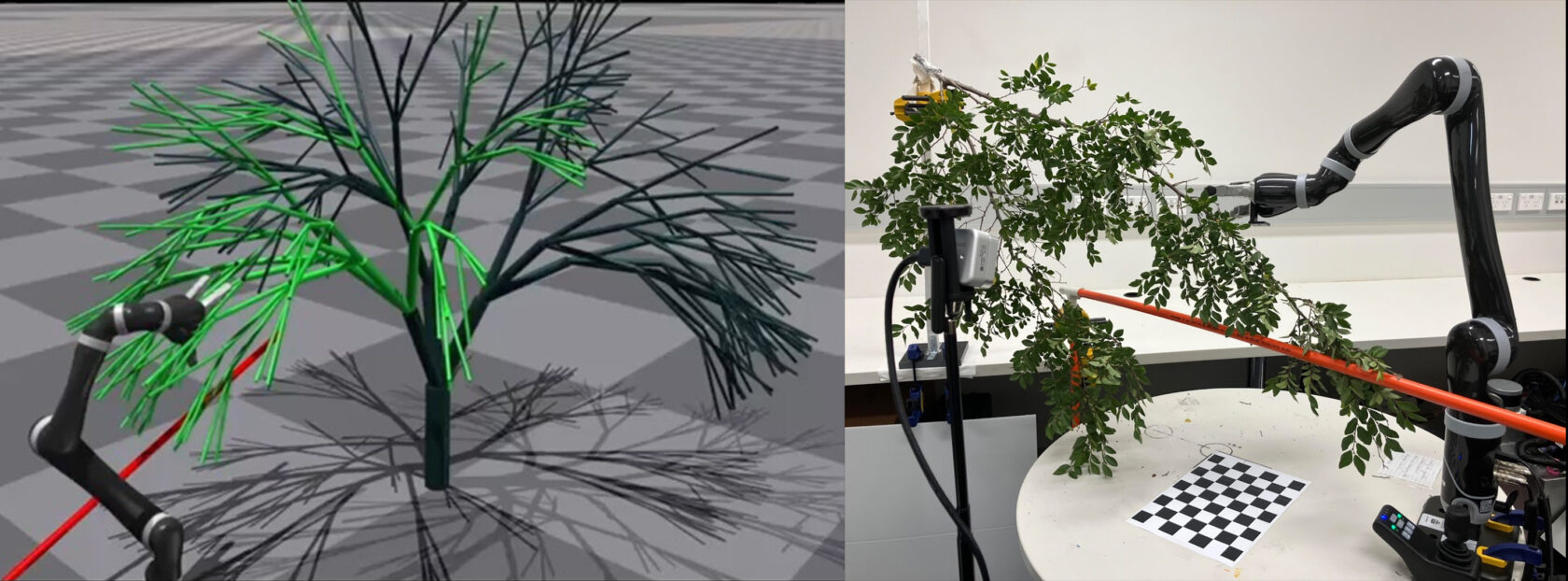
Clearing tree branches in zero-shot sim-to-real deployment.

Assembling With Precision

Precise assembly — threading a nut onto a bolt, inserting a gear onto a gearshaft, pressing a peg into a hole — is notoriously hard to get right with simulation alone. 

The real world is complex. Real surfaces aren’t perfectly smooth. Sensors don’t behave as specified. Tiny discrepancies that a simulator ignores can stop a robot in its tracks.

The SPARR method addresses this by splitting the job in two. A policy trained in Isaac Lab learns the general strategy for the assembly task in simulation. Then, on the actual hardware, a second layer learns to correct for whatever the simulator got wrong — using the robot’s own camera and without any human demonstrations or guidance. 

SPARR improves success rates by 38% and reduces cycle time by around 30% compared with zero-shot sim-to-real baselines. 

On National Institute of Standards and Technology (NIST) assembly tasks not seen during training, success improves by nearly 75% — approaching the results of methods that require a human in the loop.

The Refinery framework takes on the next layer of difficulty in assembly: tasks with multiple sequential steps, where how step one is finished determines whether step two is even possible. It’s like assembling furniture — leave a panel at the wrong angle, and the next fastener won’t go in. 

By understanding how success varies across initial conditions and training across hundreds of simulated assembly scenarios, Refinery learns how to complete each step and leave each component in a position that sets up the next. It achieves 91% simulation success and a nearly 11% mean improvement over baselines with comparable real-world results — and its policies can be chained to handle long, multi-part sequences.

Action Models That Keep Their Word

The PEEK pipeline helps robots see past the clutter. In a typical manipulation task, the robot’s camera picks up everything in the scene — but most of it is irrelevant noise. 

One task demonstrated on the PEEK project page is “give the banana to NVIDIA founder and CEO Jensen Huang”: a photo of Huang sits on a table alongside a photo of Michael Jordan, a collection of unrelated objects and other distractors. 

A human doing the task instantly focuses on the banana and the right photo; a standard robot policy has to process everything and often gets confused. PEEK solves this by having a vision language model read the task instruction and focus the robot’s line of vision accordingly — showing a movement path, and highlighting around the objects that matter, while fading out everything else. 

The policy then acts on that annotated view rather than the raw scene. For a policy trained purely in simulation, adding PEEK produced a 41x real-world improvement in accuracy. For large VLA models and smaller policies, gains range from 2-3.5x. Because it works at the image level, PEEK integrates with any camera-based policy without modification.

Do What You Say — a collaboration with researchers at Carnegie Mellon University, University of Utah and University of Sydney — addresses a specific failure mode that matters more as robots tackle longer, more complex tasks. 

Give a robot an instruction like “store everything on this table inside the cabinet” or “prepare a Manhattan,” and it has to break that down into individual steps and execute them in sequence. 

The problem is that the AI model can correctly reason through what it needs to do — and then execute something different. 

The method, called SEAL, fixes this at runtime without any retraining: the robot generates several candidate action sequences, thinks through where each one would actually lead and picks the outcome that matches what it said it would do. SEAL delivers up to 15% accuracy gains over prior work, with robustness against rephrased instructions, changed objects, scene clutter and shifted camera angles.

In addition to papers, NVIDIA is expanding robotics research infrastructure with large-scale open datasets for robotics. The NVIDIA Physical AI Dataset is the world’s largest open dataset for physical development, surpassing 15 million+ downloads, while NVIDIA Isaac GR00T X Embodiment Sim has become one of the most-downloaded robotics datasets.  

Universities Accelerate Physical AI Research With NVIDIA Technologies

Robotics teams from universities such as Carnegie Mellon University (CMU), ETH Zurich, MIT and University of Texas at Austin are tapping NVIDIA technologies to move physical AI research from simulation to real-world systems — with nearly 50 accepted papers referencing NVIDIA-accelerated simulation, robot learning and compute.

Examples include a paper from CMU demonstrating a robotic control framework trained in NVIDIA Isaac Lab and MIT work on large language model-guided reinforcement learning powered by NVIDIA GPUs.

Explore NVIDIA Research’s physical AI work. Developers can get started with Isaac Lab and Isaac Sim.

Stay up to date by subscribing to our newsletter, and following NVIDIA Robotics on LinkedIn, Instagram, X and Facebook.

To start your robotics journey, enroll in our free NVIDIA Robotics Fundamentals courses today.