
惯性聚合 高效追踪和阅读你感兴趣的博客、新闻、科技资讯
阅读原文 在惯性聚合中打开

推荐订阅源

Cisco Talos Blog
Cisco Talos Blog
V
V2EX
C
Check Point Blog
GbyAI
GbyAI
D
Docker
Cyber Security Advisories - MS-ISAC
B
Blog RSS Feed
H
Hackread – Cybersecurity News, Data Breaches, AI and More
N
Netflix TechBlog - Medium
T
Troy Hunt's Blog
博客园 - Franky
Threat Intelligence Blog | Flashpoint
Microsoft Security Blog
P
Privacy & Cybersecurity Law Blog
WordPress大学
WordPress大学
The Cloudflare Blog
S
SegmentFault 最新的问题
Latest news
Latest news
Microsoft Azure Blog
P
Proofpoint News Feed
I
InfoQ
博客园 - 【当耐特】
NISL@THU
NISL@THU
A
About on SuperTechFans
T
Tailwind CSS Blog
酷 壳 – CoolShell
酷 壳 – CoolShell
The Hacker News
The Hacker News
奇客Solidot–传递最新科技情报
奇客Solidot–传递最新科技情报
Scott Helme
Scott Helme
雷峰网
雷峰网
C
CXSECURITY Database RSS Feed - CXSecurity.com
Security Latest
Security Latest
V
Vulnerabilities – Threatpost
Security Archives - TechRepublic
A
Arctic Wolf
Hacker News: Ask HN
Hacker News: Ask HN
N
News and Events Feed by Topic
IT之家
IT之家
cs.CL updates on arXiv.org
aimingoo的专栏
aimingoo的专栏
T
Threat Research - Cisco Blogs
OSCHINA 社区最新新闻
OSCHINA 社区最新新闻
阮一峰的网络日志
阮一峰的网络日志
SecWiki News
SecWiki News
大猫的无限游戏
大猫的无限游戏
S
Security Affairs
The Register - Security
www.infosecurity-magazine.com
L
LINUX DO - 热门话题
T
Tor Project blog

NVIDIA Newsroom

Claude Meets Blackwell Ultra: Anthropic’s Models Now Run on NVIDIA GB300 in Azure Firefly Aerospace Operates NVIDIA Jetson in Lunar Orbit for the First Time Open Models, Closed Environments: Palantir Brings Secure AI to US Agencies With NVIDIA Nemotron The Ultimate Summer Sale Pairing: Steam Sale Meets GeForce NOW Discounts NVIDIA and AWS Collaborate to Bring AI to Production at Scale How Businesses Are Building Specialized AI They Can Trust NVIDIA Announces BioNeMo Agent Toolkit — Tools for Agents to Accelerate Scientific Discovery NVIDIA Powers Over 400 of the World’s 500 Fastest Supercomputers NVIDIA Brings Trusted, 24/7 AI Agents to Telecom Operations At ISC, JUPITER Shows What Exascale Science Looks Like NAIRR Science Program Reshapes Scientific Research, Powered by NVIDIA AI Infrastructure From Materials Simulation to Experimental Astronomy, New NVIDIA AI Software Unlocks Scientific Discoveries NVIDIA Vera CPU Opens the Way for Agentic Scientific AI at Los Alamos National Laboratory Eco Wave Power Turns Waves Into Watts With NVIDIA AI Infrastructure and Digital Twins NVIDIA Vera Rubin Delivers World-Class Supercomputers for Science Europe Unveils a Record 35 New NVIDIA AI Supercomputers NVIDIA Announces Halos for Robotics, the Industry’s First Full-Stack Safety System for Physical AI How FERC’s Large-Load Interconnection Actions Help Address Grid Stress, Improve Affordability At Cannes Lions, NVIDIA Partners Reshape Advertising and Marketing With AI Sync and Stream: GeForce NOW Connects to Members’ Game Libraries Across Devices France Advances Europe’s AI Future With NVIDIA Technologies Hands Free, AIs Forward: NVIDIA XR AI Brings Agents to AR Glasses Coherent Breaks Ground on Expanded Texas Facility, Scaling AI’s Optical Backbone HPE AI Factory With NVIDIA Expands for the Era of Agents Fastest, Largest, Strongest: NVIDIA Blackwell Sweeps MLPerf Training 6.0 NVIDIA Blackwell Leads on First Agentic AI Infrastructure Benchmark NVIDIA Stockholder Meeting Set for June 24; Individuals Can Participate Online Save Big and Play Bigger: GeForce NOW Summer Sale Brings Major Membership Savings For Robotaxis, Safety Must Be Built In, Not Bolted On NVIDIA Accelerates Google DeepMind’s DiffusionGemma for Local AI NVIDIA Confidential Computing to Help Expand Apple’s Private Cloud Compute How the UK Is Turning Sovereign AI Ambition Into Action With NVIDIA Technologies NVIDIA and LG Group Build an AI Factory to Advance Physical AI, Mobility and AI Infrastructure NVIDIA and Doosan Group Collaborate to Advance Physical AI and AI Factory Infrastructure NVIDIA and SK hynix Announce Multiyear Technology Partnership to Advance Memory for AI Factories SK Telecom and NVIDIA Build AI Infrastructure to Power Korea’s AI Innovation NAVER Expands AI Infrastructure With NVIDIA to Serve Surging Global AI Demand NVIDIA, KRAFTON, NC and Reigning ‘League of Legends’ Champions T1 Celebrate RTX Spark at Korea’s PC Bangs Seoul Purpose: How NVIDIA and South Korea Are Building the Future of AI Forecast: Fun Ahead — 18 Games Join in June to Stream on GeForce NOW NVIDIA Research Unlocks Advanced Grasping, Smarter Autonomous Driving and Agent Training at Scale NVIDIA Enables the Next Era Of Physical AI Research With Agent Skills For Autonomous Vehicles, Robotics And Vision AI Industrial Software Leaders Build Secure, Autonomous AI Engineers With NVIDIA NemoClaw NVIDIA Partners With Microsoft on Unified Stack for Agentic AI Deployment, From Windows Devices to Cloud to Local Why Financial Institutions Are Converging on Transaction Foundation Models to Build Their Own Intelligence NVIDIA Jetson Brings Agentic AI to the Physical World NVIDIA AI Cloud Ecosystem Expands Worldwide to Meet Global AI Compute Demand NVIDIA Factory Operations Blueprint Gives Factories a New AI Brain Taiwan’s Industry Titans Turbocharge World’s AI Infrastructure Buildout With NVIDIA NVIDIA and TSMC Bring AI Into Fabs to Advance Semiconductor Design and Manufacturing NVIDIA, Foxconn and Taiwan Medical Centers Bring Agentic and Physical AI to ‘Healthy Taiwan’ NVIDIA Releases Major Collection of Open Source Agent Tools and Skills for Physical AI NVIDIA Announces NVIDIA Isaac GR00T Reference Humanoid Robot for Academic Research NVIDIA DRIVE Hyperion Becomes the Global Platform for a Robotaxi-Ready World NVIDIA Launches Alpamayo 2 Super Open Reasoning Model for Robotaxis How Cosmos 3 Helps Physical AI Think Before It Acts NVIDIA Launches Cosmos 3, the Open Frontier Foundation Model for Physical AI NVIDIA DGX Station for Windows Puts a Trillion-Parameter AI Supercomputer on Every Enterprise Desk NVIDIA Levels Up Local AI Agents Across RTX PCs and DGX Spark NVIDIA and Microsoft Reinvent Windows PCs for the Age of Personal AI Enterprise Software Leaders Build AI Agents With NVIDIA NVIDIA Unveils Vera, the CPU for Agents NVIDIA Vera BlueField-4 STX Brings Agentic AI Storage Processing With In-Silicon Security NVIDIA Vera Rubin Ramps Into Full Production to Power Agentic AI Factories Worldwide NVIDIA DSX Gives Infrastructure Builders the Playbook for AI Factories NVIDIA Research Advances Robotics From Simulation to the Real World The Name’s Gaming … Cloud Gaming: ‘007 First Light’ Launches on GeForce NOW NVIDIA GTC Taipei at COMPUTEX: Live Updates on What’s Next in AI NVIDIA CEO Jensen Huang at Dell Technologies World: ‘Demand Is Going Parabolic, Utterly Parabolic’ Linked and Loaded: Gaijin Single Sign-On Now Available on GeForce NOW NVIDIA and ServiceNow Partner on New Autonomous AI Agents for Enterprises It’s Gonna Be May: 16 Games Hit the Cloud This Month, With More NVIDIA GeForce RTX 5080 Power NVIDIA Launches Nemotron 3 Nano Omni Model, Unifying Vision, Audio and Language for up to 9x More Efficient AI Agents Into the Omniverse: Manufacturing’s Simulation-First Era Has Arrived Tag, You’re It: GeForce NOW Levels Up Game Discovery With Xbox Game Pass and Ubisoft+ Labels Making Sense of the Early Universe From Rainforests to Recycling Plants: 5 Ways NVIDIA AI Is Protecting the Planet NVIDIA and Google Cloud Collaborate to Advance Agentic and Physical AI Autonomous AI at Scale: Adobe Agents Unlock Breakthrough Creative Intelligence With NVIDIA and WPP No Need for Space Gear — Capcom’s ‘PRAGMATA’ Joins GeForce NOW on Launch Day Rethinking AI TCO: Why Cost per Token Is the Only Metric That Matters New Adobe Premiere Color Grading Mode Accelerated on NVIDIA GPUs Strength and Destiny Collide: ‘Samson: A Tyndalston Story’ Arrives in the Cloud National Robotics Week — Latest Physical AI Research, Breakthroughs and Resources From RTX to Spark: NVIDIA Accelerates Gemma 4 for Local Agentic AI Press Start on April: GeForce NOW Brings 10 Games to the Cloud Efficiency at Scale: NVIDIA, Energy Leaders Accelerating Power‑Flexible AI Factories to Fortify the Grid Into the Omniverse: NVIDIA GTC Showcases Virtual Worlds Powering the Physical AI Era Game On: Five New Titles Now Streaming on GeForce NOW The Future of AI Is Open and Proprietary Blowing Off Steam: How Power-Flexible AI Factories Can Stabilize the Global Energy Grid Advancing Open Source AI, NVIDIA Donates Dynamic Resource Allocation Driver for GPUs to Kubernetes Community How Autonomous AI Agents Become Secure by Design With NVIDIA OpenShell NVIDIA's CEO Projects $1 Trillion in AI Chip Sales as New Computing Era Begins Nvidia CEO: We have the most energy efficient architecture in the world An Interview with Nvidia CEO Jensen Huang About Accelerated Computing NVIDIA GTC 2026: Live Updates on What’s Next in AI Smooth Moves: 90 Frames-Per-Second Virtual Reality Arrives on GeForce NOW From Simulation to Production: How to Build Robots With AI More Than Meets the Eye: NVIDIA RTX-Accelerated Computers Now Connect Directly to Apple Vision Pro
Hotter Than a Hot Tub: The 45°C Breakthrough to Cool AI’s Biggest Machines
Josh Parker · 2026-06-22 · via NVIDIA Newsroom

Hot tubs sit at about 38 to 40 degrees Celsius, warm enough that most people can only soak for about 15 minutes. NVIDIA’s newest AI servers can run their cooling liquid even hotter — up to 45 degrees Celsius, or 113 degrees Fahrenheit. That higher temperature limit is precisely what makes them more energy efficient.

The Rubin generation of NVIDIA AI infrastructure is the world’s first to achieve 100% liquid cooling — every chip, every networking component, cooled entirely by liquid in a closed loop with no fans anywhere in the system. This liquid cooling methodology is outlined in the NVIDIA DSX AI factory reference design, a guide that outlines best practices to design, build and operate the entire AI factory infrastructure stack.

Although each generation offers significantly more computing power for each watt, full liquid-cooled AI compute infrastructure enables data centers to dramatically reduce cooling energy consumption — making a meaningful difference to overall data center energy use at hyperscale.

“The NVIDIA DSX reference design for AI factories has zero water consumption — we have eliminated massive amounts of power usage and pretty much all water usage,” said Ali Heydari, director of data center cooling and infrastructure at NVIDIA. “With dry-cooler-based designs, it’s a closed-loop system with no evaporative water cooling — outside of maybe 1% of the year when we might need chillers in some climates.”

Historically, cooling alone has accounted for up to 40% of a data center’s electricity consumption, making it one of the most significant areas where efficiency improvements can drive down both operational expenses and energy demands.

Industry estimates suggest that raising chiller plant temperatures by just one degree can cut cooling energy costs by about 4%. At scale, those savings add up quickly. A 50-megawatt hyperscale facility can save over $4 million annually in cooling-related energy and water costs by moving to liquid-cooled infrastructure. 

In favorable climates, NVIDIA’s 45-degree liquid-cooling architecture can enable chiller-less operation with dry coolers, reducing facility cooling water consumption from roughly 2.6 million gallons per megawatt per year for conventional cooling-tower-based systems to near zero — up to a 100% reduction in water use. 

The reason: traditional air-cooled data centers depend on large volumes of cooled air to remove heat from IT equipment, often requiring energy-intensive cooling infrastructure during hot weather. With NVIDIA’s 45-degree liquid cooling, heat is captured directly at the chip and transported through liquid loops operating at much higher temperatures, allowing outdoor dry coolers to reject heat efficiently for much of the year while significantly reducing mechanical cooling requirements and facility water consumption. 

The data center ambient temperature is flexible — warm summer air is fine — because nothing in the server depends on cool air. The liquid does all the work — and the same liquid can be recirculated in a closed loop so no new water is consumed to cool the chips.

A New Standard for the Industry

Because the NVIDIA Rubin platform integrates 100% liquid-cooled infrastructure, every cloud provider and data center operator building for it is making the transition. 

The ecosystem is keeping pace. Motivair, the advanced cooling division of Schneider Electric, has worked alongside NVIDIA’s product roadmap for nearly a decade — and Richard Whitmore, its president and CEO, says the relationship only intensified as power densities crossed the threshold where air cooling was no longer a viable option.

“Once the watts per chip crossed a certain level, liquid cooling became mandatory,” said Whitmore.

Too Hot to Cool AI Infrastructure Is Hotter Than You’d Think

There’s a long-standing misconception in the industry that a cold data center is an efficient one. Decades ago, if a data center didn’t feel like a walk-in freezer, people would assume something was wrong. 

In reality, chips can sustain far warmer environments than that instinct suggests. Silicon processors generate enormous internal heat — the coolant entering a fully liquid-cooled chip at 45 degrees Celsius exits at roughly 55 degrees, having absorbed that heat load across the chip surface. Yet performance doesn’t degrade. 

The processors continue to operate at full performance because liquid-cooled cold plates keep device temperatures within validated operating limits, even with coolant entering the rack at 45 degrees Celsius. 

No Fans, No Cold Aisles — A Fundamentally Different Machine

Walk into a traditional data center and notice two things: the noise — cooling fans contribute to total noise levels at or above 85 decibels, loud enough to require ear protection — and the physical choreography of hot aisles and cold aisles, carefully managed to push cooled air across components. 

The Rubin architecture changes the picture.

Coolant — 75% water and 25% propylene glycol — flows through cold plates that sit directly on processors, pulling heat out at the source. Running that coolant at up to 45 degrees Celsius means that in many climates, the facility loop can reject heat without turning on mechanical chillers and noisy fans. 
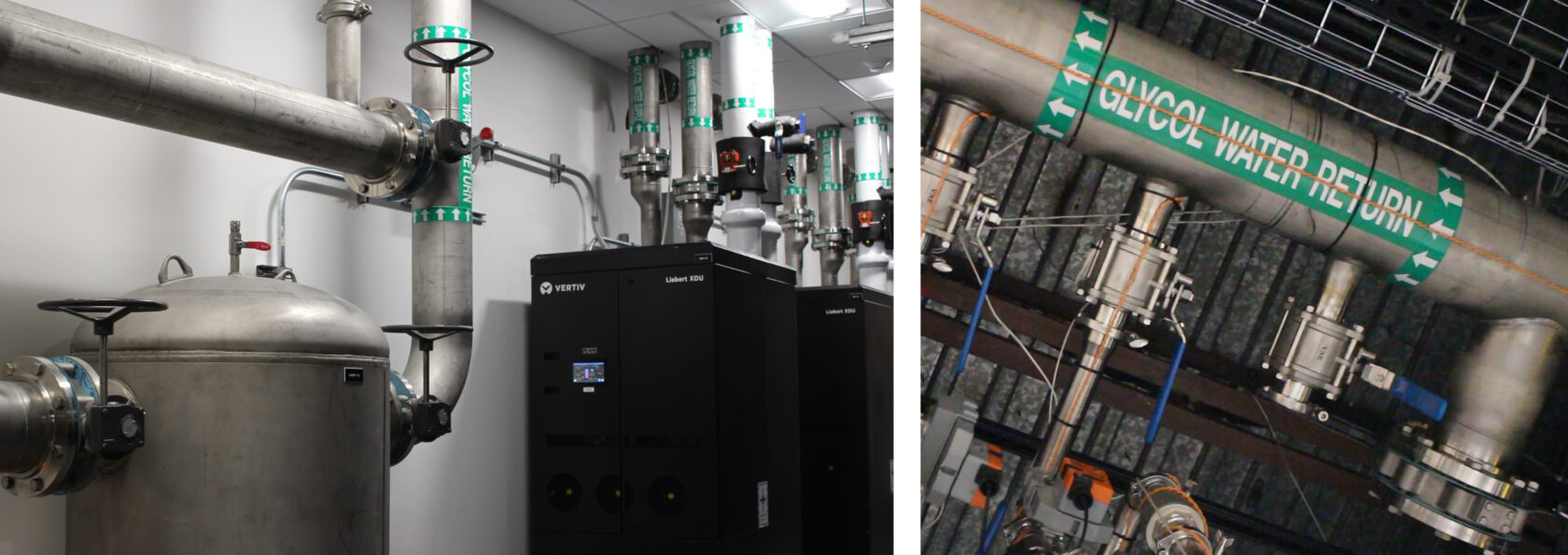
In an AI factory, coolant flows from a coolant distribution unit to the servers in a closed-loop cyle.

That unlocks something beyond energy savings: the possibility of eliminating water consumption entirely. 

In the right geography — somewhere with reliably cool outdoor air — a liquid-cooled data center can reject its heat through coolant distribution units that capture heat directly at the source and transport it to outdoor dry coolers, essentially large radiator coils positioned outside the building. 

The loop is filled once and runs closed for the life of the facility. And it takes dramatically less space in the AI factory compared to traditional air-cooling infrastructure.

“In the right geographic location, with the right system design, you don’t need any refrigeration equipment,” Whitmore said. “You can just put big radiator coils outside and use the air temperature for all your cooling. It’s incredibly efficient.”

The geography caveat matters. A data center in the Scottish Highlands and one in Phoenix, Arizona, face very different realities. But even in warmer climates, the shift toward 45-degrees-Celsius coolant moves operators significantly closer to that chiller-less ideal — where chillers may turn on just a few days a year when the outside air temperature demands it.

Another key benefit of this new model for AI factories is the potential for waste heat recovery, where residual heat from AI factory operations can be repurposed to heat commercial or residential buildings nearby. 

The Engineering Problem Nobody Had Solved

Previous liquid-cooled servers were hybrid: GPUs and CPUs got cold plates, but the rest of the system stayed air-cooled, with finned heat sinks designed to shed heat into moving air. In a fully liquid-cooled server, the cooling for these components needed to be completely redesigned to use liquid.

NVIDIA’s thermal engineering team reworked how those components handle heat, designing cooling loops that simplify how liquid is routed to multiple high-power chips on the board using a single inlet and outlet, resulting in a cleaner tray-level cooling architecture.

One visible outcome: Rubin servers have clean, sealed front panels where air-cooled servers have perforated bezels. Another: fully liquid cooled servers enable higher rack density than air-cooled servers, so a system that previously occupied six rack units now fits in two — more compute, less space, less noise.
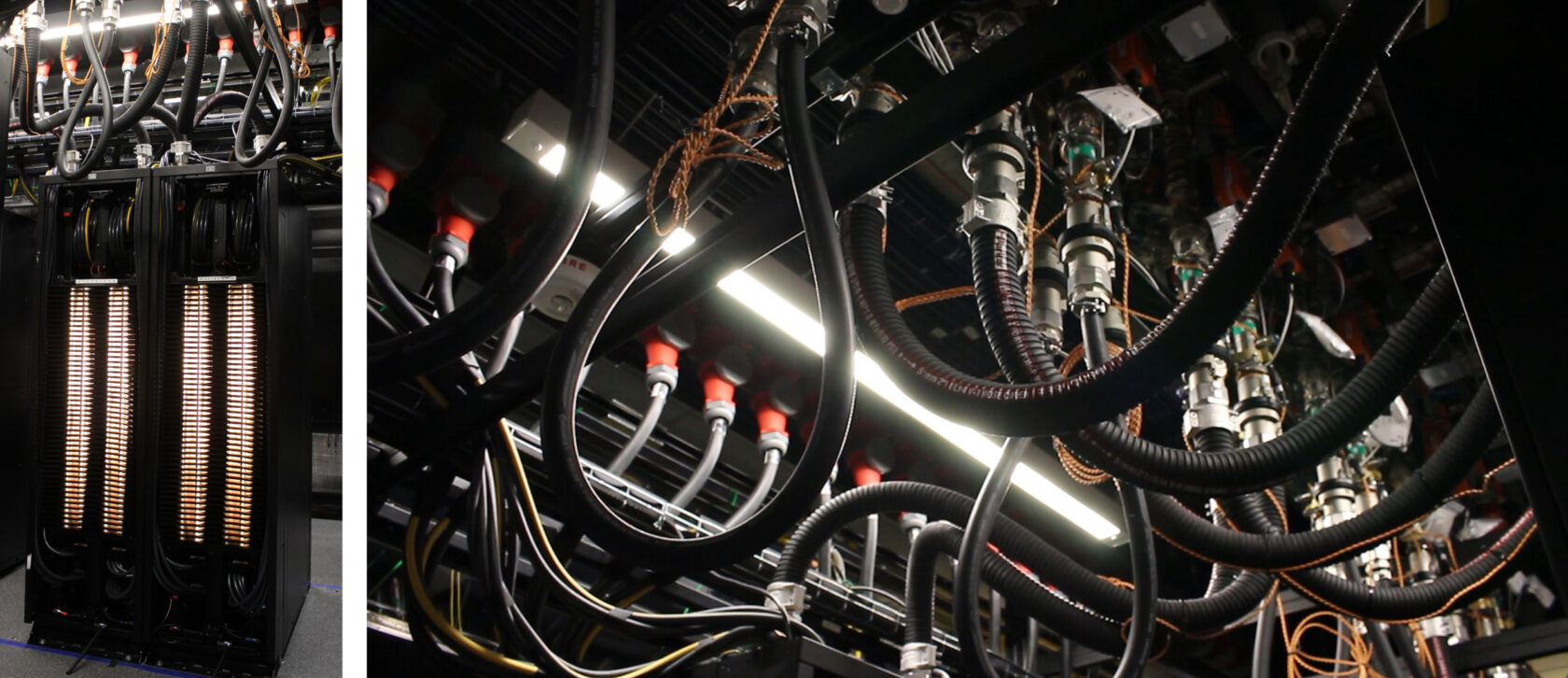
Liquid cooling infrastructure overhead pipes routes into powerful AI servers.

AI workloads are not getting lighter. The compute demand driving data center construction is growing faster than almost any other category of infrastructure investment. 

Without efficiency improvements in how that compute is cooled, the energy cost of running AI at scale would grow in lockstep with the hardware. Liquid cooling at up to 45 degrees Celsius — hotter than a hot tub, cooler for the planet — is one of the most important tools the industry has to close that gap.

Learn more about liquid cooling, the NVIDIA DSX platform for AI factories and NVIDIA’s approach to energy-efficient AI infrastructure.