惯性聚合 高效追踪和阅读你感兴趣的博客、新闻、科技资讯
阅读原文 在惯性聚合中打开

推荐订阅源

大猫的无限游戏
大猫的无限游戏
博客园 - 【当耐特】
Cloudbric
Cloudbric
H
Hackread – Cybersecurity News, Data Breaches, AI and More
Attack and Defense Labs
爱范儿
爱范儿
The Cloudflare Blog
腾讯CDC
Security Archives - TechRepublic
TaoSecurity Blog
TaoSecurity Blog
云风的 BLOG
云风的 BLOG
Recent Announcements
C
Check Point Blog
Schneier on Security
S
Schneier on Security
J
Java Code Geeks
B
Blog RSS Feed
Cisco Talos Blog
Cisco Talos Blog
Vercel News
Vercel News
Stack Overflow Blog
Stack Overflow Blog
博客园_首页
cs.AI updates on arXiv.org
A
About on SuperTechFans
Threat Intelligence Blog | Flashpoint
Google DeepMind News
阮一峰的网络日志
阮一峰的网络日志
罗磊的独立博客
A
Arctic Wolf
S
Secure Thoughts
P
Palo Alto Networks Blog
The Last Watchdog
The Last Watchdog
SecWiki News
SecWiki News
cs.CV updates on arXiv.org
博客园 - 三生石上(FineUI控件)
D
Darknet – Hacking Tools, Hacker News & Cyber Security
量子位
U
Unit 42
I
InfoQ
D
DataBreaches.Net
P
Privacy International News Feed
T
Troy Hunt's Blog
博客园 - 叶小钗
T
Threatpost
博客园 - Franky
K
Kaspersky official blog
Hugging Face - Blog
Hugging Face - Blog
IT之家
IT之家
www.infosecurity-magazine.com
CTFtime.org: upcoming CTF events
C
Cisco Blogs

Black Hills Information Security, Inc.

Bad Habits: An ANTISOC Operation Same Problem, Different Angles: When Red Team and Blue Team Actually Talk to Each Other How to Identify and Exploit New Vulnerabilities Swapper – A Pure Regex Match/Replace Burp Extension A Practical Guide to BloodHound Data Collection Network Engineering Basics Signed, Trusted, and Abused: Proxy Execution via WebView2 Getting Started In Pentesting – Advice From The BHIS Pentest Lead Cloud Security: Tips and Resources for Securing the Cloud Lessons From A Chatbot Incident How to Lead Effective Tabletops Understanding GRC: How to Navigate Risks and Compliance Standards The “P” in PAM is for Persistence: Linux Persistence Technique Malware Analysis: How to Analyze and Understand Malware OSINT: How to Find, Use, and Control Open-Source Intelligence What to Do with Your First Home Lab When the SOC Goes to Deadwood: A Night to Remember Social Engineering and Microsoft SSPR: The Road to Pwnage is Paved with Good Intentions Common Cyber Threats Finding the Right Penetration Testing Company Deceptive-Auditing: An Active Directory Honeypots Tool The Curious Case of the Comburglar How to Set Smart Goals (That Actually Work For You) Inside the BHIS SOC: A Conversation with Hayden Covington Abusing Delegation with Impacket (Part 3): Resource-Based Constrained Delegation Why You Got Hacked – 2025 Super Edition Abusing Delegation with Impacket (Part 2): Constrained Delegation Abusing Delegation with Impacket (Part 1): Unconstrained Delegation GoSpoof – Turning Attacks into Intel Model Context Protocol (MCP) Bypassing WAFs Using Oversized Requests Getting Started with AI Hacking Part 2: Prompt Injection Wrangling Windows Event Logs with Hayabusa & SOF-ELK (Part 2) DomCat: A Domain Categorization Tool Wrangling Windows Event Logs with Hayabusa & SOF-ELK (Part 1) Microsoft Store and WinGet: Security Risks for Corporate Environments Default Web Content MailFail Commonly Abused Administrative Utilities: A Hidden Risk to Enterprise Security Stop Spoofing Yourself! Disabling M365 Direct Send Bypassing CSP with JSONP: Introducing JSONPeek and CSP B Gone Offensive Tooling Cheatsheets: An Infosec Survival Guide Resource DNS Triage Cheatsheet GraphRunner Cheatsheet Burp Suite Cheatsheet Impacket Cheatsheet Wireshark Cheatsheet Hashcat Cheatsheet EyeWitness Cheatsheet Nmap Cheatsheet Netcat (nc) Cheatsheet Hunt for Weak Spots in Your Wireless Network with Airodump-ng from the Aircrack-ng Suite Detecting ADCS Privilege Escalation Vulnerability Scanning with Nmap Getting Started with NetExec: Streamlining Network Discovery and Access How to Use Dirsearch How to Design and Execute Effective Social Engineering Attacks by Phone Abusing S4U2Self for Active Directory Pivoting Why Use a Macro Pad? Espanso: Text Replacement, the Easy Way Caging Copilot: Lessons Learned in LLM Security Augmenting Penetration Testing Methodology with Artificial Intelligence – Part 2: Copilot Augmenting Penetration Testing Methodology with Artificial Intelligence – Part 1: Burpference Intercepting Traffic for Mobile Applications that Bypass the System Proxy How to Root Android Phones Communicating Security to the C-Suite: A Strategic Approach Offline Memory Forensics With Volatility Getting Started with AI Hacking: Part 1 Go-Spoof: A Tool for Cyber Deception How to Test Adversary-in-the-Middle Without Hacking Tools Canary in the Code: Alert()-ing on XSS Exploits How to Hack Wi-Fi with No Wi-Fi Why Your Org Needs a Penetration Test Program Burp Suite Extension: Copy For Light at the End of the Dark Web Wi-Fi Forge: Practice Wi-Fi Security Without Hardware Avoiding Dirty RAGs: Retrieval-Augmented Generation with Ollama and LangChain Gone Phishing: Installing GoPhish and Creating a Campaign 5 Things We Are Going to Continue to Ignore in 2025 John Strand’s 5 Phase Plan For Starting in Computer Security Questions From a Beginner Threat Hunter GRC for Security Managers: From Checklists to Influence AI Large Language Models and Supervised Fine Tuning Attack Tactics 9: Shadow Creds for PrivEsc w/ Kent & Jordan One Active Directory Account Can Be Your Best Early Warning Introduction to Zeek Log Analysis Indecent Exposure: Your Secrets are Showing Creating Burp Extensions: A Beginner’s Guide Pitting AI Against AI: Using PyRIT to Assess Large Language Models (LLMs) The Top Ten List of Why You Got Hacked This Year (2023/2024) ICS Hard Knocks: Mitigations to Scenarios Found in ICS/OT Backdoors & Breaches Intro to Data Analytics Using SQL Finding Access Control Vulnerabilities with Autorize The Detection Engineering Process Cyber Risk Lessons We Can Learn From Hurricane Preparedness Intro to Desktop Application Testing Methodology What Is Penetration Testing? Adversary in the Middle (AitM): Post-Exploitation Pentesting, Threat Hunting, and SOC: An Overview QEMU, MSYS2, and Emacs: Open-Source Solutions to Run Virtual Machines on Windows
Augmenting Penetration Testing Methodology with Artificial Intelligence – Part 3: Arcanum Cyber Security Bot
BHIS · 2025-06-25 · via Black Hills Information Security, Inc.

, , , , , , ,

Craig is a former software developer and red teamer. He has been pentesting at Black Hills Infosec since 2018.

Read more of this series here:
Part 1 – Burpference
Part 2 – Copilot

In my journey to explore how I can use artificial intelligence to assist in penetration testing, I experimented with a security-focused chat bot created by Jason Haddix called Arcanum Cyber Security Bot (available on https://chatgpt.com/gpts). Jason engineered this bot to leverage up-to-date technical information related to application security and penetration testing. One of the example prompts is to supply the chatbot with JavaScript source and have it analyze the code from a security perspective.

As with previous blogs in this series, I used OWASP’s intentionally vulnerable Juice Shop web application for this experimentation. Again, it is important to consider client confidentiality when performing penetration tests. So, take care not to send customer information to remote LLMs, and use local on-premises models instead for real penetration tests. At first, I tried to paste Juice Shop’s entire main.js file into the Arcanum chat bot’s prompt form. This resulted in a response indicating that the prompt was too large. I used parallel-prettier to make the file more readable so I could break it up and submit it to the chatbot in chunks.
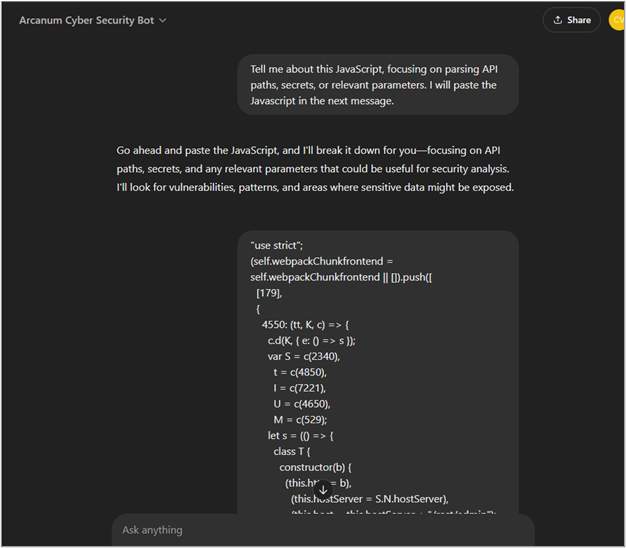
Submitting Beginning of JavaScript File to Arcanum Cyber Security Bot

The chatbot returned a list of API endpoints it discovered in the source code. It’s always a good idea to look for additional attack surface in JavaScript files, so it was really helpful for the chatbot to pull those out of the source code. It even attempted to provide some documentation for the API calls!
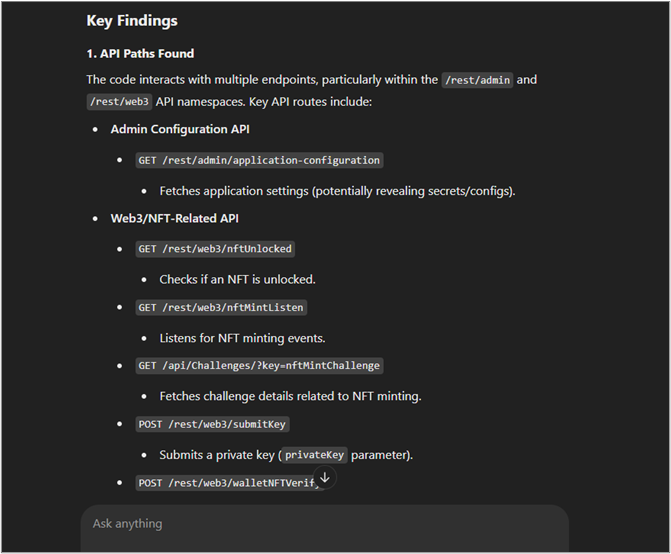
API Calls Identified in Source Code

The chatbot continued with its security analysis of the file. Interestingly, it identified hacking tutorial content in the source code and deduced that the code was part of an intentionally vulnerable web application, even calling out the application I was using by name.
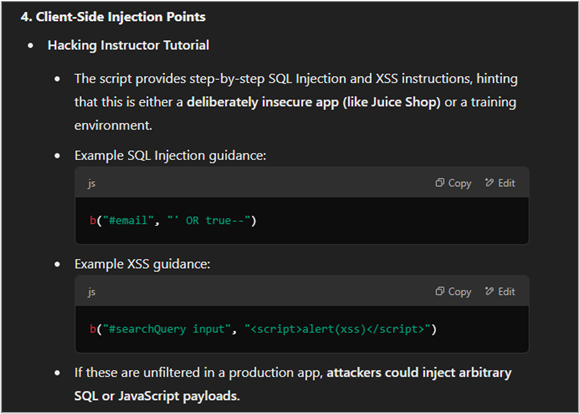
Additional Chatbot Source Code Analysis

The response continued with ideas for possible attack paths.
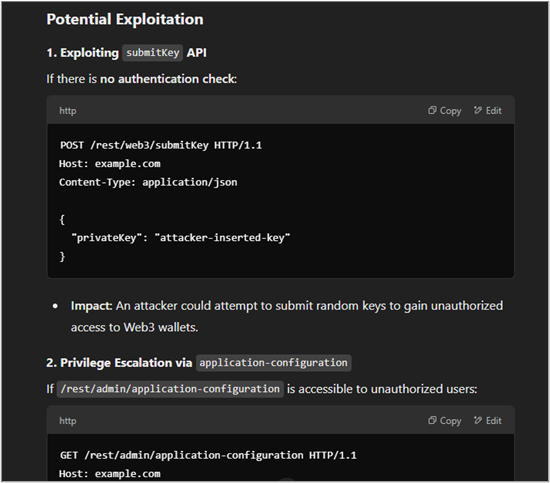
Chatbot Suggested Attack Paths

The chatbot response concluded with defensive recommendations and an overall summary of its findings. At this point, I’m already impressed. The speed at which the chatbot extracted API endpoints from the source code alone is a huge value in terms of time savings. But wait! There’s more! The bot asked if I wanted to provide proof-of-concept exploits for the potential vulnerabilities it identified. I told it “yes,” and it provided the PoCs.
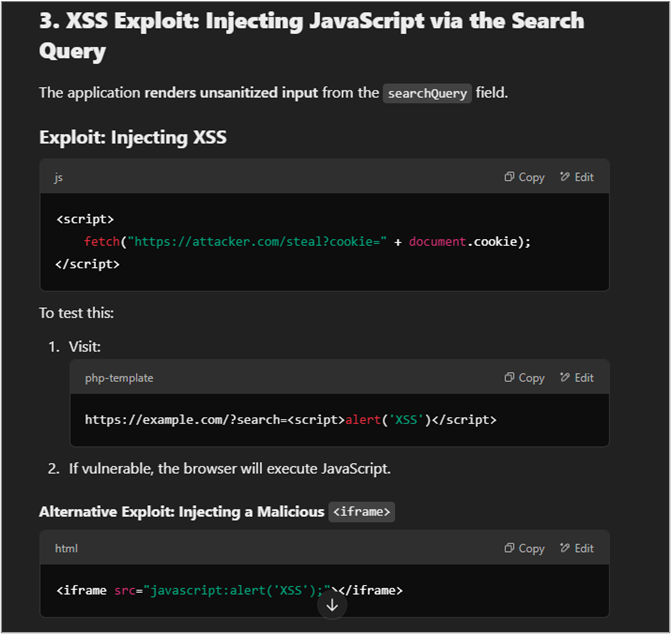
Chatbot Generated Proof of Concept Exploit

Again, this is where I would likely depart the AI and begin trying to exploit these things, but the chatbot was offering me more, and I wanted to see what else it had.

The chatbot next walked me through how to use Intruder to perform attacks against the different reported vulnerabilities, and it provided various payloads for each attack.
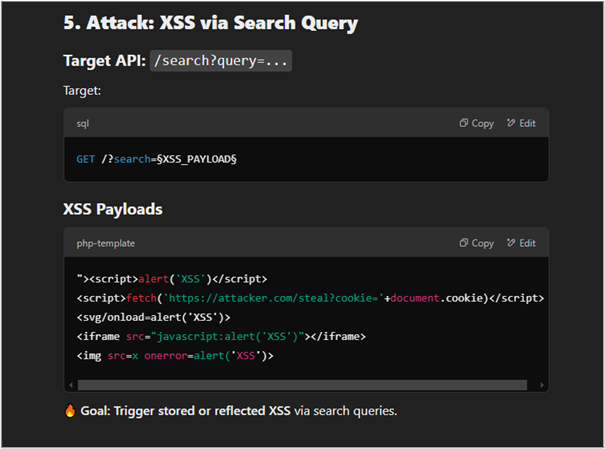
Chatbot Generated XSS Intruder Attack Configuration Details and Payloads

The chatbot proceeded by providing Python code to automate the attacks it had just described.
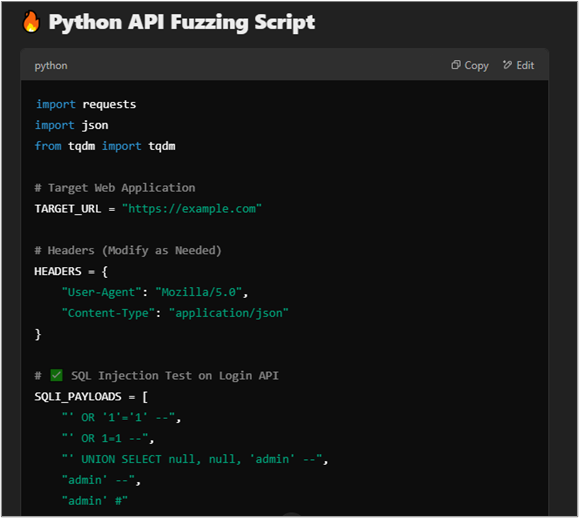
AI Generated Fuzzing Automation

Next, the chatbot offered up ideas about other more advanced vulnerabilities that I might check for in the context of its analysis, and provided payloads and automation for those vulnerabilities.
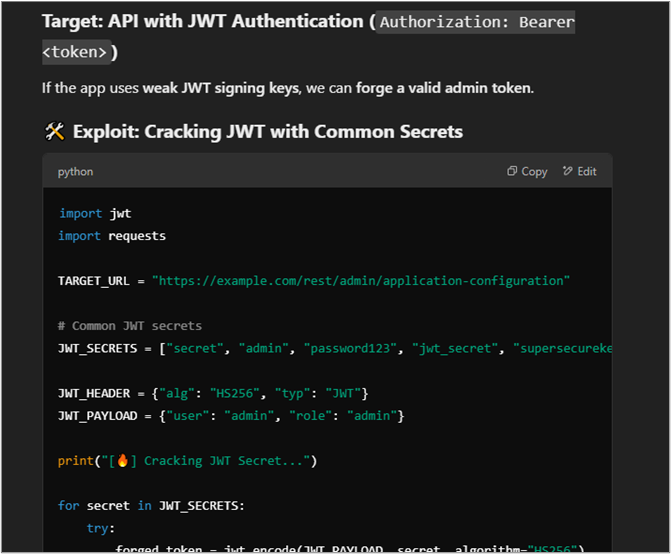
AI Generated Script for Attacking JWT Authentication

Eventually, the AI got a little off track and began offering up information on other unrelated offensive security topics such as post exploitation and cloud attacks. Overall, I found the Arcanum Cyber Security Bot to be helpful and easy to use.

Summary

“The article demonstrates practical applications of AI in security testing, showing both benefits (time savings, automated analysis) and limitations (context awareness, ethical restrictions) of current AI tools in penetration testing workflows.” – Copilot, when I asked it to summarize the blog posts in this series.

I like to think the AI generated summary is accurate. There are definitely opportunities for us to leverage AI to improve efficiency and performance in our work as penetration testers. There are also pitfalls to avoid like getting so bogged down fiddling with the AI that it becomes a hindrance to the work you’re actually trying to accomplish. Ensuring the confidentiality of client data is another concern that requires careful consideration if you choose to leverage AI in your methodology. Ultimately, I am excited to explore more ways to use AI to improve my work, and I hope this series has been helpful to anyone interested in using AI this way.


Ready to learn more?

Level up your skills with affordable classes from Antisyphon!

Pay-What-You-Can Training

Available live/virtual and on-demand