惯性聚合 高效追踪和阅读你感兴趣的博客、新闻、科技资讯
阅读原文 在惯性聚合中打开

推荐订阅源

Microsoft Azure Blog
Google Online Security Blog
D
Darknet – Hacking Tools, Hacker News & Cyber Security
Threat Intelligence Blog | Flashpoint
Simon Willison's Weblog
T
Threat Research - Cisco Blogs
C
CXSECURITY Database RSS Feed - CXSecurity.com
L
Lohrmann on Cybersecurity
www.infosecurity-magazine.com
Forbes - Security
Forbes - Security
P
Palo Alto Networks Blog
Schneier on Security
S
Schneier on Security
T
Tor Project blog
cs.CL updates on arXiv.org
WordPress大学
WordPress大学
The Hacker News
The Hacker News
Hacker News - Newest:
Hacker News - Newest: "LLM"
罗磊的独立博客
Application and Cybersecurity Blog
F
Fortinet All Blogs
博客园 - 三生石上(FineUI控件)
小众软件
小众软件
C
Check Point Blog
Stack Overflow Blog
Stack Overflow Blog
Blog — PlanetScale
Blog — PlanetScale
雷峰网
雷峰网
S
Security @ Cisco Blogs
PCI Perspectives
PCI Perspectives
Spread Privacy
Spread Privacy
W
WeLiveSecurity
SecWiki News
SecWiki News
A
About on SuperTechFans
H
Help Net Security
博客园 - 司徒正美
Recent Commits to openclaw:main
爱范儿
爱范儿
S
Securelist
M
MIT News - Artificial intelligence
云风的 BLOG
云风的 BLOG
月光博客
月光博客
Jina AI
Jina AI
博客园 - 叶小钗
Vercel News
Vercel News
阮一峰的网络日志
阮一峰的网络日志
Recent Announcements
S
Secure Thoughts
The Cloudflare Blog
美团技术团队
freeCodeCamp Programming Tutorials: Python, JavaScript, Git & More

Black Hills Information Security, Inc.

Bad Habits: An ANTISOC Operation Same Problem, Different Angles: When Red Team and Blue Team Actually Talk to Each Other How to Identify and Exploit New Vulnerabilities Swapper – A Pure Regex Match/Replace Burp Extension A Practical Guide to BloodHound Data Collection Network Engineering Basics Signed, Trusted, and Abused: Proxy Execution via WebView2 Getting Started In Pentesting – Advice From The BHIS Pentest Lead Cloud Security: Tips and Resources for Securing the Cloud Lessons From A Chatbot Incident How to Lead Effective Tabletops Understanding GRC: How to Navigate Risks and Compliance Standards The “P” in PAM is for Persistence: Linux Persistence Technique Malware Analysis: How to Analyze and Understand Malware OSINT: How to Find, Use, and Control Open-Source Intelligence What to Do with Your First Home Lab When the SOC Goes to Deadwood: A Night to Remember Social Engineering and Microsoft SSPR: The Road to Pwnage is Paved with Good Intentions Common Cyber Threats Finding the Right Penetration Testing Company Deceptive-Auditing: An Active Directory Honeypots Tool The Curious Case of the Comburglar How to Set Smart Goals (That Actually Work For You) Inside the BHIS SOC: A Conversation with Hayden Covington Abusing Delegation with Impacket (Part 3): Resource-Based Constrained Delegation Why You Got Hacked – 2025 Super Edition Abusing Delegation with Impacket (Part 2): Constrained Delegation Abusing Delegation with Impacket (Part 1): Unconstrained Delegation GoSpoof – Turning Attacks into Intel Model Context Protocol (MCP) Bypassing WAFs Using Oversized Requests Getting Started with AI Hacking Part 2: Prompt Injection Wrangling Windows Event Logs with Hayabusa & SOF-ELK (Part 2) DomCat: A Domain Categorization Tool Wrangling Windows Event Logs with Hayabusa & SOF-ELK (Part 1) Microsoft Store and WinGet: Security Risks for Corporate Environments Default Web Content MailFail Commonly Abused Administrative Utilities: A Hidden Risk to Enterprise Security Stop Spoofing Yourself! Disabling M365 Direct Send Bypassing CSP with JSONP: Introducing JSONPeek and CSP B Gone Offensive Tooling Cheatsheets: An Infosec Survival Guide Resource DNS Triage Cheatsheet GraphRunner Cheatsheet Burp Suite Cheatsheet Impacket Cheatsheet Wireshark Cheatsheet Hashcat Cheatsheet EyeWitness Cheatsheet Nmap Cheatsheet Netcat (nc) Cheatsheet Hunt for Weak Spots in Your Wireless Network with Airodump-ng from the Aircrack-ng Suite Detecting ADCS Privilege Escalation Vulnerability Scanning with Nmap Getting Started with NetExec: Streamlining Network Discovery and Access How to Use Dirsearch Augmenting Penetration Testing Methodology with Artificial Intelligence – Part 3: Arcanum Cyber Security Bot How to Design and Execute Effective Social Engineering Attacks by Phone Abusing S4U2Self for Active Directory Pivoting Why Use a Macro Pad? Espanso: Text Replacement, the Easy Way Caging Copilot: Lessons Learned in LLM Security Augmenting Penetration Testing Methodology with Artificial Intelligence – Part 2: Copilot Augmenting Penetration Testing Methodology with Artificial Intelligence – Part 1: Burpference Intercepting Traffic for Mobile Applications that Bypass the System Proxy How to Root Android Phones Communicating Security to the C-Suite: A Strategic Approach Offline Memory Forensics With Volatility Getting Started with AI Hacking: Part 1 Go-Spoof: A Tool for Cyber Deception How to Test Adversary-in-the-Middle Without Hacking Tools Canary in the Code: Alert()-ing on XSS Exploits How to Hack Wi-Fi with No Wi-Fi Why Your Org Needs a Penetration Test Program Burp Suite Extension: Copy For Light at the End of the Dark Web Wi-Fi Forge: Practice Wi-Fi Security Without Hardware Avoiding Dirty RAGs: Retrieval-Augmented Generation with Ollama and LangChain Gone Phishing: Installing GoPhish and Creating a Campaign 5 Things We Are Going to Continue to Ignore in 2025 John Strand’s 5 Phase Plan For Starting in Computer Security Questions From a Beginner Threat Hunter GRC for Security Managers: From Checklists to Influence AI Large Language Models and Supervised Fine Tuning Attack Tactics 9: Shadow Creds for PrivEsc w/ Kent & Jordan One Active Directory Account Can Be Your Best Early Warning Introduction to Zeek Log Analysis Indecent Exposure: Your Secrets are Showing Creating Burp Extensions: A Beginner’s Guide Pitting AI Against AI: Using PyRIT to Assess Large Language Models (LLMs) The Top Ten List of Why You Got Hacked This Year (2023/2024) ICS Hard Knocks: Mitigations to Scenarios Found in ICS/OT Backdoors & Breaches Intro to Data Analytics Using SQL Finding Access Control Vulnerabilities with Autorize The Detection Engineering Process Cyber Risk Lessons We Can Learn From Hurricane Preparedness Intro to Desktop Application Testing Methodology What Is Penetration Testing? Adversary in the Middle (AitM): Post-Exploitation Pentesting, Threat Hunting, and SOC: An Overview
Shenetworks Recommends: Using Nmap Like a Pro
BHIS · 2023-06-06 · via Black Hills Information Security, Inc.

shenetworks //

One day at work I received a case stating a client couldn’t connect to the management interface of a new server. I asked the client to change the IP address of the management interface and try to connect, and the test was successful. The client was confused and asked why the original IP address wouldn’t work. I asked them to ping the old address and the client was surprised to receive a response back. That IP address was assigned to a device somewhere else on the network. While there are new programs that can help manage your IP addresses and ranges, this is still a common issue in networks. Often caused by poor documentation and stale configurations. The client then had the task of tracking down this rogue IP. Where would you start this process? I would say Nmap is a perfect tool. 

Nmap is extremely popular for both defenders and attackers. It originally debuted in Phrack Magazine in 1997 by the author Gordon “Fyodor” Lyon. Nmap has grown into a more complex and powerful tool since its release.  

As a Network Engineer, I used Nmap to scan for inventory and to check availability and uptime. As a pentester, I use Nmap to gather information on my targets, and with some scripts, Nmap can be used for a lot more than reconnaissance.  

Since Nmap has so many options it might be overwhelming to parse through them to see which ones will be beneficial to you. The next section discusses Nmap options and scripts that I frequently use and recommend.  

A basic default Nmap scan will probe a target and check for a response. Once Nmap has verified the host is reachable Nmap will probe for open ports. The default Nmap scan is helpful but with a few options, we can get a lot more information.  

Nmap [scan types] [options] {target(s)} 
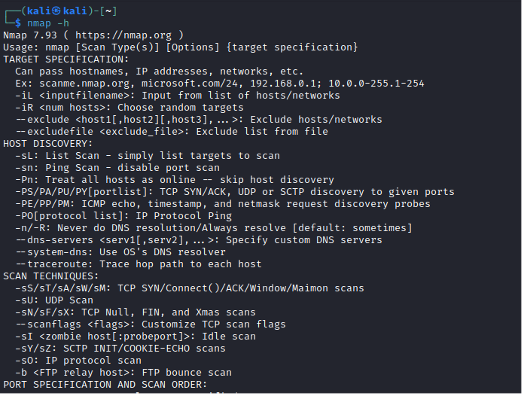
Figure 1: Nmap help page list of options 

-sL – List Scan

You might want to audit a range of IP addresses knowing some of those IP addresses are unused. Using Nmap with the -sL option will probe every IP address in the given range and do a reverse-DNS lookup. Domain names can often help identify valuable targets. The result will be a list of reachable hosts and their domain name if applicable.

-sV – Version Discovery

Nmap option -sV will attempt to discover the version information of every port open on a host. This information is extremely valuable on an engagement. This will help you identify what type of host you’re probing and the version number. Identifying the version helps prioritize interesting targets and identify available exploits.

-Pn – Skip host discovery

It’s common for network administrators to disable the ICMP protocol or filter traffic to certain hosts. The option -Pn skips host discovery and assumes every IP address is assigned to a host and online. Using this option Nmap can discover additional targets but increase the scan time significantly.

-p- – Scan every port

By default, Nmap scans 1000 ports. Some services may be open but not discoverable with a standard scan. Using the -p- option will scan *every* port 1-65535. This option will increase the duration of scan.

-T4 – Aggressive scan

-T4 will reduce the time for a scan to complete and should be used if you have a fast and reliable connection.

-oX {filepath, filename, and type} – output results into an XML file

I recommend saving your Nmap output into files that can be referenced later in the engagement. The -oX option will save the output in XML format. Saving in XML will allow you to easily parse through the results. This parsing is helpful when you are looking for hosts with specific ports open like SQL, or SMB.

-sC – script scan

Pentesters use a wide variety of specialized tools, however, some may be unaware that the same task can be accomplished with an additional Nmap script. Using Nmap scripts is quick and efficient. With the Nmap Scripting Engine (NSE), users can utilize a collection of scripts with various purposes like discovering additional details about an open port and protocol to further enumeration and brute forcing. 

Below are a few Nmap scripts and their descriptions. These are scripts I use regularly. You can find a full list of available scripts here: https://nmap.org/nsedoc/scripts/

sshv1: Checks if an SSH server supports the obsolete and less secure SSH Protocol Version 1.

DHCP discover: Sends a DHCPINFORM request to a host on UDP 67 to obtain all the local configuration parameters without allocating a new address.

ftp-anon: Checks if an FTP server allows anonymous logins.

ftp-brute: Performs brute force password auditing against FTP servers.

http-enum: Enumerates directories used by popular web applications and servers.

http-passwd: Checks if a webserver is vulnerable to directory traversal by attempting to retrieve etc/passwd or \boot(ini).

http-methods: Finds out what options are supported by an HTTP server by sending an OPTIONS request.

ms-sql-info: Attempts to determine configuration and version information for Microsoft SQL server instances.

mysql-enum: Performs valid-user enumeration against MySQL server using a bug.

NSF-showmount: Shows NFS exports, like the showmount -e command.

rdp-enum-encryption: Determines which encryption level is supposed by the RDP service.

smb-enum-shares: Attempts to list shares.

tftp-enum: Enumerates TFTP filenames by testing for a list of common ones.

Nmap is a Swiss army knife and can substitute some of your favorite tools when you’re in a pinch. There are even more Nmap scripts to explore and use. For more information related to Nmap check out their dedicated site and their GitHub https://github.com/nmap/nmap for information on contributing to the project. 


Ready to learn more?

Level up your skills with affordable classes from Antisyphon!

Pay-What-You-Can Training

Available live/virtual and on-demand