惯性聚合 高效追踪和阅读你感兴趣的博客、新闻、科技资讯
阅读原文 在惯性聚合中打开

推荐订阅源

W
WeLiveSecurity
博客园 - 【当耐特】
Microsoft Azure Blog
WordPress大学
WordPress大学
Stack Overflow Blog
Stack Overflow Blog
cs.AI updates on arXiv.org
IT之家
IT之家
Cloudbric
Cloudbric
The Register - Security
小众软件
小众软件
PCI Perspectives
PCI Perspectives
G
Google Developers Blog
AI
AI
OSCHINA 社区最新新闻
OSCHINA 社区最新新闻
Google DeepMind News
宝玉的分享
宝玉的分享
Recent Commits to openclaw:main
量子位
TaoSecurity Blog
TaoSecurity Blog
cs.CV updates on arXiv.org
F
Full Disclosure
N
Netflix TechBlog - Medium
博客园_首页
Last Week in AI
Last Week in AI
A
Arctic Wolf
B
Blog RSS Feed
J
Java Code Geeks
C
Cybersecurity and Infrastructure Security Agency CISA
I
InfoQ
aimingoo的专栏
aimingoo的专栏
云风的 BLOG
云风的 BLOG
NISL@THU
NISL@THU
MyScale Blog
MyScale Blog
H
Hackread – Cybersecurity News, Data Breaches, AI and More
Jina AI
Jina AI
有赞技术团队
有赞技术团队
S
Schneier on Security
L
Lohrmann on Cybersecurity
P
Privacy & Cybersecurity Law Blog
T
Threat Research - Cisco Blogs
P
Palo Alto Networks Blog
S
Security @ Cisco Blogs
Security Archives - TechRepublic
Security Latest
Security Latest
Vercel News
Vercel News
博客园 - 司徒正美
Webroot Blog
Webroot Blog
Hacker News: Ask HN
Hacker News: Ask HN
A
About on SuperTechFans

Black Hills Information Security, Inc.

Bad Habits: An ANTISOC Operation Same Problem, Different Angles: When Red Team and Blue Team Actually Talk to Each Other How to Identify and Exploit New Vulnerabilities Swapper – A Pure Regex Match/Replace Burp Extension A Practical Guide to BloodHound Data Collection Network Engineering Basics Signed, Trusted, and Abused: Proxy Execution via WebView2 Getting Started In Pentesting – Advice From The BHIS Pentest Lead Cloud Security: Tips and Resources for Securing the Cloud Lessons From A Chatbot Incident How to Lead Effective Tabletops Understanding GRC: How to Navigate Risks and Compliance Standards The “P” in PAM is for Persistence: Linux Persistence Technique Malware Analysis: How to Analyze and Understand Malware OSINT: How to Find, Use, and Control Open-Source Intelligence What to Do with Your First Home Lab When the SOC Goes to Deadwood: A Night to Remember Social Engineering and Microsoft SSPR: The Road to Pwnage is Paved with Good Intentions Common Cyber Threats Finding the Right Penetration Testing Company Deceptive-Auditing: An Active Directory Honeypots Tool The Curious Case of the Comburglar How to Set Smart Goals (That Actually Work For You) Inside the BHIS SOC: A Conversation with Hayden Covington Abusing Delegation with Impacket (Part 3): Resource-Based Constrained Delegation Why You Got Hacked – 2025 Super Edition Abusing Delegation with Impacket (Part 2): Constrained Delegation Abusing Delegation with Impacket (Part 1): Unconstrained Delegation GoSpoof – Turning Attacks into Intel Model Context Protocol (MCP) Bypassing WAFs Using Oversized Requests Getting Started with AI Hacking Part 2: Prompt Injection Wrangling Windows Event Logs with Hayabusa & SOF-ELK (Part 2) DomCat: A Domain Categorization Tool Wrangling Windows Event Logs with Hayabusa & SOF-ELK (Part 1) Microsoft Store and WinGet: Security Risks for Corporate Environments Default Web Content MailFail Commonly Abused Administrative Utilities: A Hidden Risk to Enterprise Security Stop Spoofing Yourself! Disabling M365 Direct Send Bypassing CSP with JSONP: Introducing JSONPeek and CSP B Gone Offensive Tooling Cheatsheets: An Infosec Survival Guide Resource DNS Triage Cheatsheet GraphRunner Cheatsheet Burp Suite Cheatsheet Impacket Cheatsheet Wireshark Cheatsheet Hashcat Cheatsheet EyeWitness Cheatsheet Nmap Cheatsheet Netcat (nc) Cheatsheet Hunt for Weak Spots in Your Wireless Network with Airodump-ng from the Aircrack-ng Suite Detecting ADCS Privilege Escalation Vulnerability Scanning with Nmap Getting Started with NetExec: Streamlining Network Discovery and Access How to Use Dirsearch Augmenting Penetration Testing Methodology with Artificial Intelligence – Part 3: Arcanum Cyber Security Bot How to Design and Execute Effective Social Engineering Attacks by Phone Abusing S4U2Self for Active Directory Pivoting Why Use a Macro Pad? Espanso: Text Replacement, the Easy Way Caging Copilot: Lessons Learned in LLM Security Augmenting Penetration Testing Methodology with Artificial Intelligence – Part 2: Copilot Augmenting Penetration Testing Methodology with Artificial Intelligence – Part 1: Burpference Intercepting Traffic for Mobile Applications that Bypass the System Proxy How to Root Android Phones Communicating Security to the C-Suite: A Strategic Approach Offline Memory Forensics With Volatility Getting Started with AI Hacking: Part 1 Go-Spoof: A Tool for Cyber Deception How to Test Adversary-in-the-Middle Without Hacking Tools Canary in the Code: Alert()-ing on XSS Exploits How to Hack Wi-Fi with No Wi-Fi Why Your Org Needs a Penetration Test Program Burp Suite Extension: Copy For Light at the End of the Dark Web Wi-Fi Forge: Practice Wi-Fi Security Without Hardware Avoiding Dirty RAGs: Retrieval-Augmented Generation with Ollama and LangChain Gone Phishing: Installing GoPhish and Creating a Campaign 5 Things We Are Going to Continue to Ignore in 2025 John Strand’s 5 Phase Plan For Starting in Computer Security Questions From a Beginner Threat Hunter GRC for Security Managers: From Checklists to Influence AI Large Language Models and Supervised Fine Tuning Attack Tactics 9: Shadow Creds for PrivEsc w/ Kent & Jordan One Active Directory Account Can Be Your Best Early Warning Introduction to Zeek Log Analysis Indecent Exposure: Your Secrets are Showing Creating Burp Extensions: A Beginner’s Guide Pitting AI Against AI: Using PyRIT to Assess Large Language Models (LLMs) The Top Ten List of Why You Got Hacked This Year (2023/2024) ICS Hard Knocks: Mitigations to Scenarios Found in ICS/OT Backdoors & Breaches Intro to Data Analytics Using SQL Finding Access Control Vulnerabilities with Autorize The Detection Engineering Process Cyber Risk Lessons We Can Learn From Hurricane Preparedness Intro to Desktop Application Testing Methodology What Is Penetration Testing? Adversary in the Middle (AitM): Post-Exploitation Pentesting, Threat Hunting, and SOC: An Overview
PNPT: Certification Review
Kassie Kimball · 2023-01-31 · via Black Hills Information Security, Inc.

, , , , , , , , , , ,

Daniel Pizarro //

What is the PNPT? 

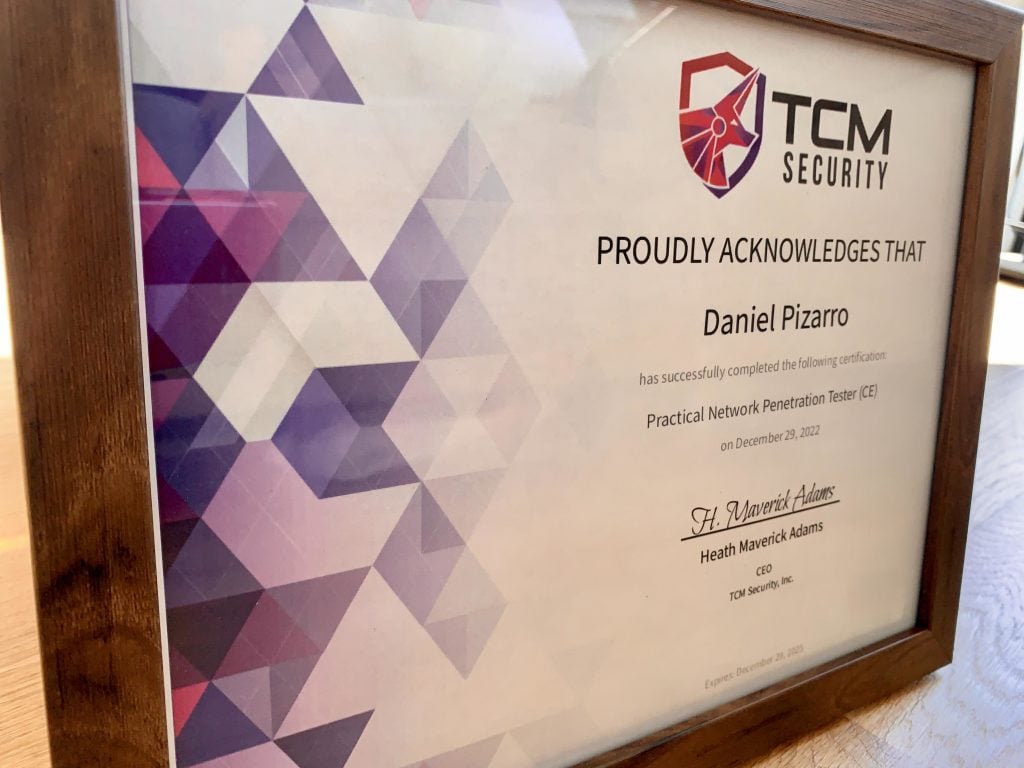
The Practical Network Penetration Tester (PNPT), created by TCM Security (TCMS), is a 5-day ethical hacking certification exam that assesses a pentester’s ability to perform an external and internal network penetration test. To complete the exam, pentesters must: 

  • Perform reconnaissance to gather intelligence 
  • Leverage common web server vulnerabilities to breach the perimeter  
  • Leverage Active Directory (AD) vulnerabilities to move laterally and vertically within the network 
  • Compromise the Domain Controller (DC) 
  • Produce a professionally written pentest report 
  • Deliver a live report debrief to TCMS assessors 

PNPT Exam Preparation & Tips 

The PNPT exam follows a series of training courses developed by TCMS and covers a range of methodologies and topics. A complete syllabus and exam overview is available on the TCMS website. Below are a few exam preparation tips and suggestions. 

As expected, tools pivotal to completing the exam include Nmap, Burp Suite, Nessus, Metasploit, Impacket scripts, hash crackers, and other software built into Kali Linux. 

  • Reconnaissance and Enumeration: Reconnaissance and enumeration are essential parts of any penetration test. Be patient. When performing recon, targeting a domain, and leveraging a newly compromised operating system, be thorough about gathering and pillaging information, as one piece of data may be utilized at different portions of the assessment. 
  • Active Directory: Active Directory stores information about objects on the network, making the information easy for administrators and users to find and use. A comfortable knowledge of AD and common network-based attacks is required to complete the PNPT exam. As mentioned, numerous tools built into Kali Linux were utilized during the exam. Understand what the tools do and how pentesters leverage them to advance their position within an Active Directory environment. 
  • Windows Credential Storages: Windows will store sensitive information in various parts of the operating system. Understand how Windows protects data and how pentesters may extract them. 
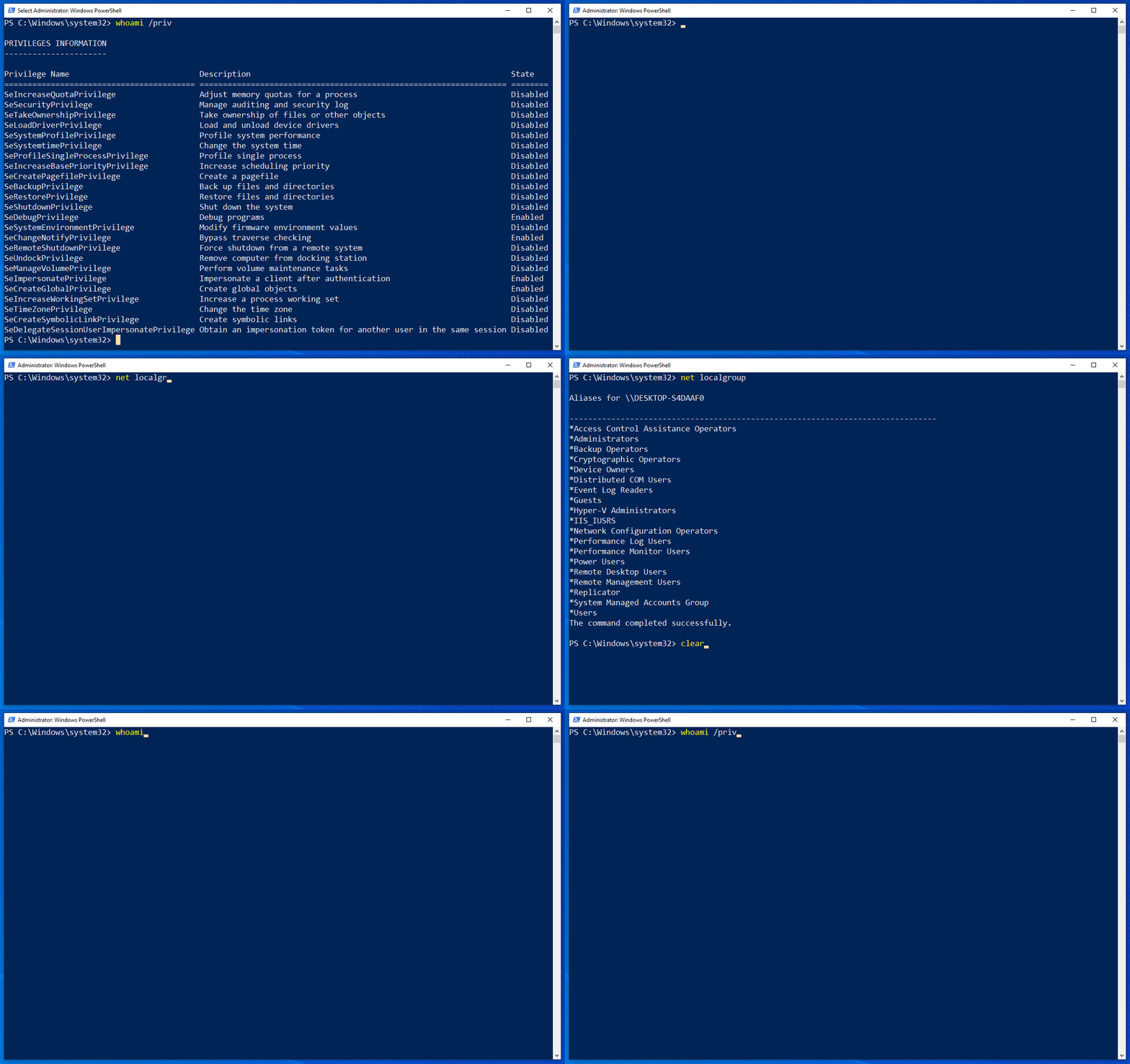
  • Windows Account Privileges: Windows environments will support different account types with specific user privileges and capabilities. Familiarity with the account types and their respective privileges is important (e.g., standard user, local administrator, service account, domain administrator). Understanding the differences and quickly identifying their capabilities will make the exam more navigable. 
As for general tips: 

  • Only follow rabbit holes for a few hours. If something seems too elaborate or complex, move on to other avenues. The PNPT exam is not a CTF and closely emulates a (small) real-world AD environment. 
  • Be patient with escalation points; don’t overthink. Think like an APT and focus on common attacks as seen in PNPT training labs and documented in the MITRE ATT&CK Framework
  • When stuck, take a step back. Reconsider the information discovered previously and other ways pentesters will leverage the data. 

In addition to the PNPT training labs, several HackTheBox labs are worth completing before attempting the exam, as they cover valuable topics and tool usage. 

  • Active: SMB null authentication, Active Directory queries, GPO and GPP, Bloodhound usage, and hash cracking. 
  • Monteverde: ADConnect, MSSQL databases, Windows post-exploitation, and spidering SMB shares. 
  • Search: User reconnaissance, Kerbrute usage, PFX certificate cracking, PowerShell web access, AV evasion, and Nishang scripts. 
  • Scrambled: Impacket scripts, TGT, KRB5CCNAME usage, LDAP queries, SID enumeration via PAC, and MSSQLClient usage. 

Reporting 

The PNPT certification sets itself apart from most offensive certifications by emphasizing the report quality and the post-engagement debrief. 

At BHIS, we take pride in the quality of the reports we deliver to clients. As a result, there’s no shortage of excellent content on the BHIS website dedicated to what makes a stellar pentest report. 

Debriefing

Upon submitting the report, the TCMS team will schedule an on-camera debrief via Zoom to review the Findings documented in the report. The debrief is straightforward. The TCMS assessor will ask for a photo ID as proof of identity, an overview of vulnerabilities discovered during the exam, and an explanation of how the domain controller was ultimately compromised. 

At this point, focus on creating a narrative; tell a story, and remember to highlight critical portions of the assessment. 

  • What vulnerabilities and security misconfigurations did you discover? 
  • Which tools and techniques did you utilize to exploit vulnerabilities? 
  • How might a security engineer defend against such attacks in the future? 

Walk the assessor through each crucial vulnerability leveraged during the exam from beginning to end. 

Conclusion 

As a learning tool, the PNPT exam and companion training courses provide enormous value for the price point. Unlike other cyber certifications, the PNPT did not feel like an unrealistic, gamified CTF, making it a fantastic resource for anyone interested in gaining well-rounded knowledge of pentesting methodologies and Windows infrastructure. Overall, it was a fun experience. I appreciated the thought behind the attacks required to compromise the domain controller and look forward to exams produced by TCMS in the future. 


Ready to learn more?

Level up your skills with affordable classes from Antisyphon!

Pay-What-You-Can Training

Available live/virtual and on-demand