惯性聚合 高效追踪和阅读你感兴趣的博客、新闻、科技资讯
阅读原文 在惯性聚合中打开

推荐订阅源

aimingoo的专栏
aimingoo的专栏
V
V2EX
G
Google Developers Blog
F
Full Disclosure
Martin Fowler
Martin Fowler
宝玉的分享
宝玉的分享
H
Hacker News: Front Page
Exploit-DB.com RSS Feed
NISL@THU
NISL@THU
G
GRAHAM CLULEY
V
Vulnerabilities – Threatpost
Hacker News - Newest:
Hacker News - Newest: "LLM"
A
About on SuperTechFans
The Cloudflare Blog
C
Cisco Blogs
D
DataBreaches.Net
Threat Intelligence Blog | Flashpoint
Vercel News
Vercel News
P
Privacy International News Feed
Microsoft Security Blog
Help Net Security
Help Net Security
Recorded Future
Recorded Future
PCI Perspectives
PCI Perspectives
S
Schneier on Security
AI
AI
N
News | PayPal Newsroom
雷峰网
雷峰网
C
Cyber Attacks, Cyber Crime and Cyber Security
P
Proofpoint News Feed
The Last Watchdog
The Last Watchdog
L
LINUX DO - 最新话题
Hugging Face - Blog
Hugging Face - Blog
Apple Machine Learning Research
Schneier on Security
S
Securelist
云风的 BLOG
云风的 BLOG
Stack Overflow Blog
Stack Overflow Blog
博客园_首页
AWS News Blog
AWS News Blog
TaoSecurity Blog
TaoSecurity Blog
OSCHINA 社区最新新闻
OSCHINA 社区最新新闻
Recent Commits to openclaw:main
博客园 - 三生石上(FineUI控件)
C
CXSECURITY Database RSS Feed - CXSecurity.com
K
KPMG report finds enterprise disconnect between AI and its ROI | CIO
Cloudbric
Cloudbric
C
Cybersecurity and Infrastructure Security Agency CISA
Project Zero
Project Zero
C
Check Point Blog
S
Security Affairs

Black Hills Information Security, Inc.

Bad Habits: An ANTISOC Operation Same Problem, Different Angles: When Red Team and Blue Team Actually Talk to Each Other How to Identify and Exploit New Vulnerabilities Swapper – A Pure Regex Match/Replace Burp Extension A Practical Guide to BloodHound Data Collection Network Engineering Basics Signed, Trusted, and Abused: Proxy Execution via WebView2 Getting Started In Pentesting – Advice From The BHIS Pentest Lead Cloud Security: Tips and Resources for Securing the Cloud Lessons From A Chatbot Incident How to Lead Effective Tabletops Understanding GRC: How to Navigate Risks and Compliance Standards The “P” in PAM is for Persistence: Linux Persistence Technique Malware Analysis: How to Analyze and Understand Malware OSINT: How to Find, Use, and Control Open-Source Intelligence What to Do with Your First Home Lab When the SOC Goes to Deadwood: A Night to Remember Social Engineering and Microsoft SSPR: The Road to Pwnage is Paved with Good Intentions Common Cyber Threats Finding the Right Penetration Testing Company Deceptive-Auditing: An Active Directory Honeypots Tool The Curious Case of the Comburglar How to Set Smart Goals (That Actually Work For You) Inside the BHIS SOC: A Conversation with Hayden Covington Abusing Delegation with Impacket (Part 3): Resource-Based Constrained Delegation Why You Got Hacked – 2025 Super Edition Abusing Delegation with Impacket (Part 2): Constrained Delegation Abusing Delegation with Impacket (Part 1): Unconstrained Delegation GoSpoof – Turning Attacks into Intel Model Context Protocol (MCP) Bypassing WAFs Using Oversized Requests Getting Started with AI Hacking Part 2: Prompt Injection Wrangling Windows Event Logs with Hayabusa & SOF-ELK (Part 2) DomCat: A Domain Categorization Tool Wrangling Windows Event Logs with Hayabusa & SOF-ELK (Part 1) Microsoft Store and WinGet: Security Risks for Corporate Environments Default Web Content MailFail Commonly Abused Administrative Utilities: A Hidden Risk to Enterprise Security Stop Spoofing Yourself! Disabling M365 Direct Send Bypassing CSP with JSONP: Introducing JSONPeek and CSP B Gone Offensive Tooling Cheatsheets: An Infosec Survival Guide Resource DNS Triage Cheatsheet GraphRunner Cheatsheet Burp Suite Cheatsheet Impacket Cheatsheet Wireshark Cheatsheet Hashcat Cheatsheet EyeWitness Cheatsheet Nmap Cheatsheet Netcat (nc) Cheatsheet Hunt for Weak Spots in Your Wireless Network with Airodump-ng from the Aircrack-ng Suite Detecting ADCS Privilege Escalation Vulnerability Scanning with Nmap Getting Started with NetExec: Streamlining Network Discovery and Access How to Use Dirsearch Augmenting Penetration Testing Methodology with Artificial Intelligence – Part 3: Arcanum Cyber Security Bot How to Design and Execute Effective Social Engineering Attacks by Phone Abusing S4U2Self for Active Directory Pivoting Why Use a Macro Pad? Espanso: Text Replacement, the Easy Way Caging Copilot: Lessons Learned in LLM Security Augmenting Penetration Testing Methodology with Artificial Intelligence – Part 2: Copilot Augmenting Penetration Testing Methodology with Artificial Intelligence – Part 1: Burpference Intercepting Traffic for Mobile Applications that Bypass the System Proxy How to Root Android Phones Communicating Security to the C-Suite: A Strategic Approach Offline Memory Forensics With Volatility Getting Started with AI Hacking: Part 1 Go-Spoof: A Tool for Cyber Deception How to Test Adversary-in-the-Middle Without Hacking Tools Canary in the Code: Alert()-ing on XSS Exploits How to Hack Wi-Fi with No Wi-Fi Why Your Org Needs a Penetration Test Program Burp Suite Extension: Copy For Light at the End of the Dark Web Wi-Fi Forge: Practice Wi-Fi Security Without Hardware Avoiding Dirty RAGs: Retrieval-Augmented Generation with Ollama and LangChain Gone Phishing: Installing GoPhish and Creating a Campaign 5 Things We Are Going to Continue to Ignore in 2025 John Strand’s 5 Phase Plan For Starting in Computer Security Questions From a Beginner Threat Hunter GRC for Security Managers: From Checklists to Influence AI Large Language Models and Supervised Fine Tuning Attack Tactics 9: Shadow Creds for PrivEsc w/ Kent & Jordan One Active Directory Account Can Be Your Best Early Warning Introduction to Zeek Log Analysis Indecent Exposure: Your Secrets are Showing Creating Burp Extensions: A Beginner’s Guide Pitting AI Against AI: Using PyRIT to Assess Large Language Models (LLMs) The Top Ten List of Why You Got Hacked This Year (2023/2024) ICS Hard Knocks: Mitigations to Scenarios Found in ICS/OT Backdoors & Breaches Intro to Data Analytics Using SQL Finding Access Control Vulnerabilities with Autorize The Detection Engineering Process Cyber Risk Lessons We Can Learn From Hurricane Preparedness Intro to Desktop Application Testing Methodology What Is Penetration Testing? Adversary in the Middle (AitM): Post-Exploitation Pentesting, Threat Hunting, and SOC: An Overview
Why You Really Need to Stop Disabling UAC
Kassie Kimball · 2022-09-29 · via Black Hills Information Security, Inc.

Noah Heckman //

Windows Vista didn’t have many fans in the Windows community (to put it lightly). It beaconed in a new user interface, file structure, and a bunch of darn popups asking if you really want to execute the software you just told it to execute.
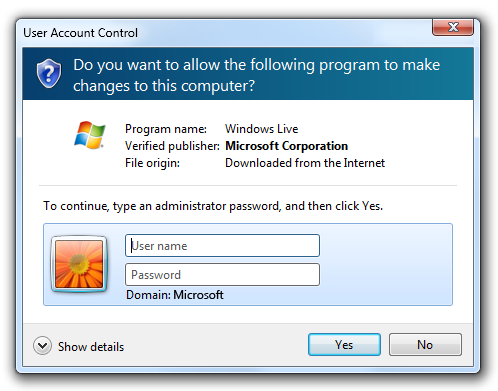
Many sysadmins have found this annoying, but even more annoying was all the end users calling to tell them about how annoying it was. There was a simple solution: just disable it.

Over time, some went back and turned it on, while others did not — instead letting the GPO’s disabling UAC remain in their active directory to this day. However, for those who turned it back on, they were once again reminded about how annoying it was and how many issues it caused. This was, of course, a double-edged sword, as UAC was also annoying to our adversaries.

So what does UAC do? UAC starts its work as soon as you log in. It checks if your account is an admin on the system, and if it is, then the UAC subroutine effectively splits the account into a high privilege and low privilege account. It locks admin operations behind an admin token, which then will prompt you for approval when you go to perform high privilege processes as you see below.
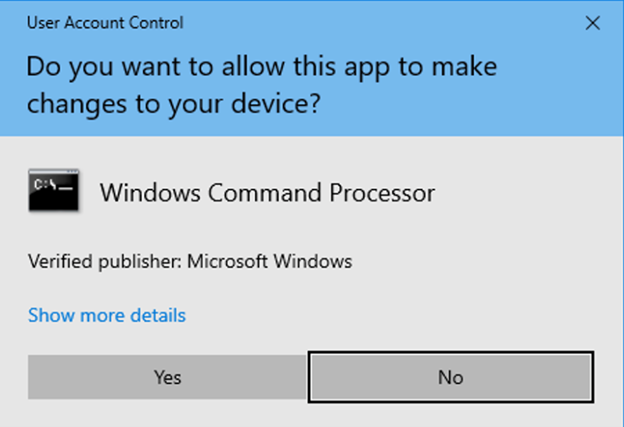
This is known as Admin Approval mode and does not require the user to input the password. In my opinion, this window should say “WARNING! This process is trying to perform admin actions. Do you expect this for this application?” because that is what it means when it interrupts your important spreadsheet session. If you are performing a process that only requires low privilege activities and you see this, you should stop right now!

A common question that has been asked about admin approval mode is “How is this safe? Can’t the process just hit yes for the user and execute the payload?” Not exactly; both the normal UAC and the admin approval UAC prompt are supposed to come up in the Windows Secured Desktop Environment. When this happens, only certain processes can interact with it. Specifically, the logged-in user’s explorer.exe process. So, in general, no, there is not a way for the malware to just “click yes.” Of course, there is a slew of UAC bypass attacks that attempt to subvert these protections, so it is not infallible, but it does dramatically increase the security posture of the system versus having it disabled.

If that is not enough of a reason to make sure you have it enabled, then how about macros? UAC protects a computer from malicious macros more than you think. Of course, it will go off as described above if the macro tries to access or modify sensitive system objects, but what many don’t know is that when you disable UAC, you also disable Mark of The Web (MoTW). MoTW is used to flag files that have been downloaded to your computer from untrusted locations, such as downloaded from the internet or sent as an email attachment. Office applications and other Windows processes look for this “mark” and will restrict certain actions based on it until you approve it.

This is why when you open an Excel document with macros on the internal share, it doesn’t prompt you to “enable editing” and exit Microsoft Office’s Protected Viewer. If your security team is pushing out the GPO settings to “Block Macros in Files Downloaded from the Internet,” this also relies on MoTW. Therefore, if UAC is disabled, the document will not have the MoTW attribute and will sometimes run the macro without prompting, which makes phishing your end users a walk in the park. Another notable feature related to MoTW is the Windows Smart Screen, which is in place to prevent the execution of untrusted code. SmartScreen operates around many of the same principles above by prompting the user on the Secure desktop, asking if they really want to execute the untrusted program. Again, this can help with preventing many initial compromise attacks.

As defenders, we not only need to ensure that these protections are active but that we are using them to our advantage. Disabling macros from documents downloaded from the internet is a great start. Ensure Windows SmartScreen is enabled on the system. For bonus points, consider preventing your end users from being able to bypass it with the “run anyway” button. This will harden your systems, making it even harder for attacks to gain a foothold. All of these settings can be managed by GPO or Intune policy and pushed to the environment with minimal impact. The foundation of a security program is built on good communication. So, should you get complaints from your IT staff, developers, or end-users, please take a moment to explain the underlying process. In their eyes, UAC is nothing but an annoyance, and the standard “because security said so” response is not going to convince them otherwise. We are all busy but taking the time now to educate our people helps to prevent misinformed configurations like the ones that prompted this article from being made in the future.


Ready to learn more?

Level up your skills with affordable classes from Antisyphon!

Pay-What-You-Can Training

Available live/virtual and on-demand