惯性聚合 高效追踪和阅读你感兴趣的博客、新闻、科技资讯
阅读原文 在惯性聚合中打开

推荐订阅源

酷 壳 – CoolShell
酷 壳 – CoolShell
H
Hacker News: Front Page
P
Palo Alto Networks Blog
T
ThreatConnect
Apple Machine Learning Research
博客园_首页
T
True Tiger Recordings
P
Privacy & Cybersecurity Law Blog
B
Blog
IT之家
IT之家
Last Week in AI
Last Week in AI
F
Full Disclosure
Hacker News: Ask HN
Hacker News: Ask HN
C
Comments on: Blog
Microsoft Azure Blog
C
Cybersecurity and Infrastructure Security Agency CISA
Microsoft Security Blog
博客园 - 【当耐特】
N
News and Events Feed by Topic
NISL@THU
NISL@THU
腾讯CDC
雷峰网
雷峰网
Security Latest
Security Latest
李成银的技术随笔
M
Microsoft Research Blog - Microsoft Research
L
LangChain Blog
L
Lohrmann on Cybersecurity
cs.CL updates on arXiv.org
C
Check Point Blog
Y
Y Combinator Blog
Recent Announcements
博客园 - Franky
N
News | PayPal Newsroom
V
V2EX
A
About on SuperTechFans
The Register - Security
月光博客
月光博客
奇客Solidot–传递最新科技情报
奇客Solidot–传递最新科技情报
Google Online Security Blog
MyScale Blog
MyScale Blog
Cisco Talos Blog
Cisco Talos Blog
Vercel News
Vercel News
WordPress大学
WordPress大学
C
Cyber Attacks, Cyber Crime and Cyber Security
The Hacker News
The Hacker News
IntelliJ IDEA : IntelliJ IDEA – the Leading IDE for Professional Development in Java and Kotlin | The JetBrains Blog
爱范儿
爱范儿
A
Arctic Wolf
L
LINUX DO - 最新话题
freeCodeCamp Programming Tutorials: Python, JavaScript, Git & More

Black Hills Information Security, Inc.

Same Problem, Different Angles: When Red Team and Blue Team Actually Talk to Each Other How to Identify and Exploit New Vulnerabilities Swapper – A Pure Regex Match/Replace Burp Extension A Practical Guide to BloodHound Data Collection Network Engineering Basics Signed, Trusted, and Abused: Proxy Execution via WebView2 Getting Started In Pentesting – Advice From The BHIS Pentest Lead Cloud Security: Tips and Resources for Securing the Cloud Lessons From A Chatbot Incident How to Lead Effective Tabletops Understanding GRC: How to Navigate Risks and Compliance Standards The “P” in PAM is for Persistence: Linux Persistence Technique Malware Analysis: How to Analyze and Understand Malware OSINT: How to Find, Use, and Control Open-Source Intelligence What to Do with Your First Home Lab When the SOC Goes to Deadwood: A Night to Remember Social Engineering and Microsoft SSPR: The Road to Pwnage is Paved with Good Intentions Common Cyber Threats Finding the Right Penetration Testing Company Deceptive-Auditing: An Active Directory Honeypots Tool The Curious Case of the Comburglar How to Set Smart Goals (That Actually Work For You) Inside the BHIS SOC: A Conversation with Hayden Covington Abusing Delegation with Impacket (Part 3): Resource-Based Constrained Delegation Why You Got Hacked – 2025 Super Edition Abusing Delegation with Impacket (Part 2): Constrained Delegation Abusing Delegation with Impacket (Part 1): Unconstrained Delegation GoSpoof – Turning Attacks into Intel Model Context Protocol (MCP) Bypassing WAFs Using Oversized Requests Getting Started with AI Hacking Part 2: Prompt Injection Wrangling Windows Event Logs with Hayabusa & SOF-ELK (Part 2) DomCat: A Domain Categorization Tool Wrangling Windows Event Logs with Hayabusa & SOF-ELK (Part 1) Microsoft Store and WinGet: Security Risks for Corporate Environments Default Web Content MailFail Commonly Abused Administrative Utilities: A Hidden Risk to Enterprise Security Stop Spoofing Yourself! Disabling M365 Direct Send Bypassing CSP with JSONP: Introducing JSONPeek and CSP B Gone Offensive Tooling Cheatsheets: An Infosec Survival Guide Resource DNS Triage Cheatsheet GraphRunner Cheatsheet Burp Suite Cheatsheet Impacket Cheatsheet Wireshark Cheatsheet Hashcat Cheatsheet EyeWitness Cheatsheet Nmap Cheatsheet Netcat (nc) Cheatsheet Hunt for Weak Spots in Your Wireless Network with Airodump-ng from the Aircrack-ng Suite Detecting ADCS Privilege Escalation Vulnerability Scanning with Nmap Getting Started with NetExec: Streamlining Network Discovery and Access How to Use Dirsearch Augmenting Penetration Testing Methodology with Artificial Intelligence – Part 3: Arcanum Cyber Security Bot How to Design and Execute Effective Social Engineering Attacks by Phone Abusing S4U2Self for Active Directory Pivoting Why Use a Macro Pad? Espanso: Text Replacement, the Easy Way Caging Copilot: Lessons Learned in LLM Security Augmenting Penetration Testing Methodology with Artificial Intelligence – Part 2: Copilot Augmenting Penetration Testing Methodology with Artificial Intelligence – Part 1: Burpference Intercepting Traffic for Mobile Applications that Bypass the System Proxy How to Root Android Phones Communicating Security to the C-Suite: A Strategic Approach Offline Memory Forensics With Volatility Getting Started with AI Hacking: Part 1 Go-Spoof: A Tool for Cyber Deception How to Test Adversary-in-the-Middle Without Hacking Tools Canary in the Code: Alert()-ing on XSS Exploits How to Hack Wi-Fi with No Wi-Fi Why Your Org Needs a Penetration Test Program Burp Suite Extension: Copy For Light at the End of the Dark Web Wi-Fi Forge: Practice Wi-Fi Security Without Hardware Avoiding Dirty RAGs: Retrieval-Augmented Generation with Ollama and LangChain Gone Phishing: Installing GoPhish and Creating a Campaign 5 Things We Are Going to Continue to Ignore in 2025 John Strand’s 5 Phase Plan For Starting in Computer Security Questions From a Beginner Threat Hunter GRC for Security Managers: From Checklists to Influence AI Large Language Models and Supervised Fine Tuning Attack Tactics 9: Shadow Creds for PrivEsc w/ Kent & Jordan One Active Directory Account Can Be Your Best Early Warning Introduction to Zeek Log Analysis Indecent Exposure: Your Secrets are Showing Creating Burp Extensions: A Beginner’s Guide Pitting AI Against AI: Using PyRIT to Assess Large Language Models (LLMs) The Top Ten List of Why You Got Hacked This Year (2023/2024) ICS Hard Knocks: Mitigations to Scenarios Found in ICS/OT Backdoors & Breaches Intro to Data Analytics Using SQL Finding Access Control Vulnerabilities with Autorize The Detection Engineering Process Cyber Risk Lessons We Can Learn From Hurricane Preparedness Intro to Desktop Application Testing Methodology What Is Penetration Testing? Adversary in the Middle (AitM): Post-Exploitation Pentesting, Threat Hunting, and SOC: An Overview QEMU, MSYS2, and Emacs: Open-Source Solutions to Run Virtual Machines on Windows
My Ransomware Post-Mortem
2017-01-09 · via Black Hills Information Security, Inc.

Cody Smith* //

As information security professionals we’re not invincible to breaches. Even the most robust security system can’t make up for a lack of user education, which I was painfully reminded of in December of 2016.

My “… !@$#” Moment:

Late one Sunday night, I was sitting at my desk working toward an empty inbox when a client of mine called me.

“Hey, do you have a minute? I can’t seem to open my files.”

“Sure, what’s going on?”

“Well, I can see where my files should be, but I can’t open anything. None of them look like they’re supposed to.”

“Can you describe what you’re seeing?”

“All of the file icons look like white pieces of paper, and their names are just a bunch of garbled letters with a weird file extension.”

At this point, I was quite concerned, “What does it say?”

“Dot Osiris? I don’t know if I’m saying that right.”

“… !@#$.”

My Response:

I quickly threw together my typical “go-bag” for things like this. My Apple MacBook Pro, a MacBook Air that has been converted into a Kali Linux machine, and a couple of flash drives with various distros, tools, etc.

On my way to the site, I prepared myself to see the worst. Maybe this is because of my training as a fireman, or maybe it was just my paranoia. Nonetheless, here is what I was expecting:

  • Full propagation throughout the SOHO network.
  • Full data-loss on multiple computers.
  • Loss of a client

However, when I got to the business, I realized that we weren’t as bad off as I had thought. While the one user’s files were encrypted (more on that later), the ransomware had only managed to encrypt that computer, and no other device on the network was affected. So, what happened, and how did it happen? Let’s break this down into what went wrong and what went right.

What Went Wrong:

In short, one thing went wrong. I didn’t educate the end-user on a recent threat that’s been sweeping the internet. I didn’t educate them on how “hackers” (or skids) were using scam-emails to deliver ransomware through Microsoft Office documents. That is my fault and mine alone. I took responsibility for the breach even though I wasn’t the one that caused it. Why? Because the network’s security was my responsibility, and as such, so was anything that happened to it.

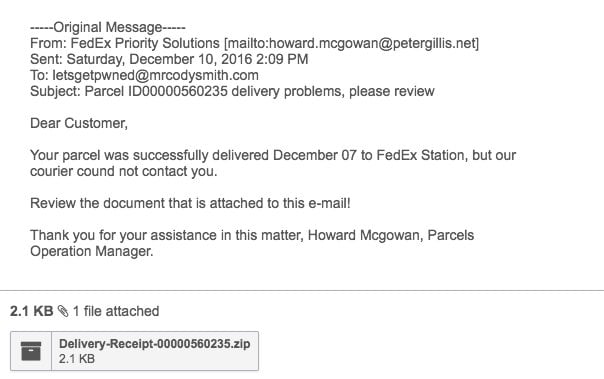
The user was sent an email similar to ones I’ve seen in the past. It was an email from “FedEx” claiming that a package couldn’t be delivered to the user. The plot twist? My user was expecting a package that day, from FedEx, and it wasn’t delivered to him.  I know, what’s the chance of this happening right? Well, the user downloaded the file, and they joyfully put in their password to the U.A.C. prompt when it came up. They enabled the Excel document’s macros, and then the ransomware propagated throughout the computer. However, unlike other attacks I’ve read about, it didn’t propagate throughout the network.

What Went Right:

I’m overly paranoid when it comes to security, so I had various steps in place to mitigate this threat. (Clearly, I didn’t have enough.) Below, I’ve listed an overview of what went correctly.

  • Backups – If you’ve never been on the receiving end of ransomware, you probably don’t know how grateful you are for backups. (Unless you own a Seagate hard-drive) My client had an effective backup strategy. Weekly backups from the computers to the local NAS, and from that NAS a weekly upload to an Amazon Web Services S3 Bucket. After that backup has sat in the S3 bucket for one week, it’s transferred over to AWS’s Glacier just in case the newest S3 backup has issues. Having the most recent backup in S3 allowed for a quick download (considering it was a 64GB file) that I was able to restore files from the next day.
  • Network Drive Segmentation – A lot of SOHOs have file-shares, and that’s okay. However, if one file-share has access to every computer on the network, then you’re going to have a bad time. However, this client’s network was segmented in such a way that users only had access to their own drive, for “cross account” sharing, a special drive is used with a different username and password than their personal folders.
  • Osiris Sucks – If you’re the author of Osiris, we have to have a talk, and for a few reasons.
  • Your malware didn’t encrypt anything with the .jpeg extension.
  • Your malware didn’t encrypt anything with the .pdf extension.
  • Your malware didn’t manage to change the background on the computer, and it only left 2-3 ransom notes, but none on the desktop
  • Your malware didn’t leave any .html files, but instead .htm files. *sighs*

Now, don’t get me wrong. Osiris Ransomware isn’t something you want to meet in the wild, and you really don’t want to meet it like I did, when the only post you found about it was two days old. However, Osiris isn’t without its faults.

What I Could’ve Done Better:

I could’ve had local account policy in place to thwart the ability to run Macros in Office Documents, as well as the ability to run anything out of %Temp%. I could’ve better educated my end users. I could have just sent out an email warning my clients of the possibility of them receiving one of the emails like what had caused our breach. Lastly, I could’ve tested to see if my faith in my end users was warranted. I could’ve sent them all an email that looked like “the email” and took note of who actually opened the document and ran the Macros. This would have at least allowed me to better see who is aware of what threats.

What you can do:

With that said, I’d like to leave you with a few easy tips of what you can do to improve your security posture:

  • Backups saved my life, and they can save your life too. It isn’t good enough to just “have backups” Your backups have to work, and they have to be current. If you haven’t checked your backup method in a while, do so! It can save your rear some day.
  • File shares are sometimes a necessary evil, but you can greatly reduce the risk if you try to do so. Just because someone thinks they need access to a drive doesn’t mean they do. A simple principle of least access comes in here.
  • User education is still the weakest point of any I.T. infrastructure, and it’s also one of the most important domains to make sure you have covered. We often overlook user education because “users are all idiots that shouldn’t be allowed near a computer”. However, while that may be the case, it isn’t good practice. Educate your users and they’ll be able to help you far more than you could hope for.

So with that said, I leave you with this: Can your network handle this breach?

_____

*Cody Smith is a guest poster**.  He is a Performance Engineer, Cyber-Security Junkie, and frequently tweets GIFs. He spends most of his time attempting to keep up with current trends, malware samples, threats, and vulnerabilities. In his spare time, likes to browse the web for pictures of Corgis.

**Oh, you want to guest post for us too? Shoot us a Twitter DM, or email us via our contact form!


Ready to learn more?

Level up your skills with affordable classes from Antisyphon!

Pay-Forward-What-You-Can Training

Available live/virtual and on-demand