惯性聚合 高效追踪和阅读你感兴趣的博客、新闻、科技资讯
阅读原文 在惯性聚合中打开

推荐订阅源

F
Full Disclosure
Recorded Future
Recorded Future
T
Tenable Blog
S
Securelist
C
CERT Recently Published Vulnerability Notes
T
Threatpost
S
Schneier on Security
A
Arctic Wolf
The Hacker News
The Hacker News
C
CXSECURITY Database RSS Feed - CXSecurity.com
Know Your Adversary
Know Your Adversary
P
Privacy International News Feed
Threat Intelligence Blog | Flashpoint
The Register - Security
Cisco Talos Blog
Cisco Talos Blog
AWS News Blog
AWS News Blog
K
Kaspersky official blog
T
True Tiger Recordings
T
Threat Research - Cisco Blogs
V
Vulnerabilities – Threatpost
P
Palo Alto Networks Blog
T
The Exploit Database - CXSecurity.com
小众软件
小众软件
B
Blog
Cyber Security Advisories - MS-ISAC
Microsoft Azure Blog
Cyberwarzone
Cyberwarzone
C
Cybersecurity and Infrastructure Security Agency CISA
T
Tor Project blog
Spread Privacy
Spread Privacy
Malwarebytes
Malwarebytes
P
Proofpoint News Feed
F
Fox-IT International blog
F
Fortinet All Blogs
P
Privacy & Cybersecurity Law Blog
G
GRAHAM CLULEY
量子位
Latest news
Latest news
OSCHINA 社区最新新闻
OSCHINA 社区最新新闻
博客园 - 叶小钗
Project Zero
Project Zero
T
Tailwind CSS Blog
N
Netflix TechBlog - Medium
Martin Fowler
Martin Fowler
IntelliJ IDEA : IntelliJ IDEA – the Leading IDE for Professional Development in Java and Kotlin | The JetBrains Blog
I
Intezer
博客园_首页
腾讯CDC
H
Hackread – Cybersecurity News, Data Breaches, AI and More
D
Darknet – Hacking Tools, Hacker News & Cyber Security

Black Hills Information Security, Inc.

Same Problem, Different Angles: When Red Team and Blue Team Actually Talk to Each Other How to Identify and Exploit New Vulnerabilities Swapper – A Pure Regex Match/Replace Burp Extension A Practical Guide to BloodHound Data Collection Network Engineering Basics Signed, Trusted, and Abused: Proxy Execution via WebView2 Getting Started In Pentesting – Advice From The BHIS Pentest Lead Cloud Security: Tips and Resources for Securing the Cloud Lessons From A Chatbot Incident How to Lead Effective Tabletops Understanding GRC: How to Navigate Risks and Compliance Standards The “P” in PAM is for Persistence: Linux Persistence Technique Malware Analysis: How to Analyze and Understand Malware OSINT: How to Find, Use, and Control Open-Source Intelligence What to Do with Your First Home Lab When the SOC Goes to Deadwood: A Night to Remember Social Engineering and Microsoft SSPR: The Road to Pwnage is Paved with Good Intentions Common Cyber Threats Finding the Right Penetration Testing Company Deceptive-Auditing: An Active Directory Honeypots Tool The Curious Case of the Comburglar How to Set Smart Goals (That Actually Work For You) Inside the BHIS SOC: A Conversation with Hayden Covington Abusing Delegation with Impacket (Part 3): Resource-Based Constrained Delegation Why You Got Hacked – 2025 Super Edition Abusing Delegation with Impacket (Part 2): Constrained Delegation Abusing Delegation with Impacket (Part 1): Unconstrained Delegation GoSpoof – Turning Attacks into Intel Model Context Protocol (MCP) Bypassing WAFs Using Oversized Requests Getting Started with AI Hacking Part 2: Prompt Injection Wrangling Windows Event Logs with Hayabusa & SOF-ELK (Part 2) DomCat: A Domain Categorization Tool Wrangling Windows Event Logs with Hayabusa & SOF-ELK (Part 1) Microsoft Store and WinGet: Security Risks for Corporate Environments Default Web Content MailFail Commonly Abused Administrative Utilities: A Hidden Risk to Enterprise Security Stop Spoofing Yourself! Disabling M365 Direct Send Bypassing CSP with JSONP: Introducing JSONPeek and CSP B Gone Offensive Tooling Cheatsheets: An Infosec Survival Guide Resource DNS Triage Cheatsheet GraphRunner Cheatsheet Burp Suite Cheatsheet Impacket Cheatsheet Wireshark Cheatsheet Hashcat Cheatsheet EyeWitness Cheatsheet Nmap Cheatsheet Netcat (nc) Cheatsheet Hunt for Weak Spots in Your Wireless Network with Airodump-ng from the Aircrack-ng Suite Detecting ADCS Privilege Escalation Getting Started with NetExec: Streamlining Network Discovery and Access How to Use Dirsearch Augmenting Penetration Testing Methodology with Artificial Intelligence – Part 3: Arcanum Cyber Security Bot How to Design and Execute Effective Social Engineering Attacks by Phone Abusing S4U2Self for Active Directory Pivoting Why Use a Macro Pad? Espanso: Text Replacement, the Easy Way Caging Copilot: Lessons Learned in LLM Security Augmenting Penetration Testing Methodology with Artificial Intelligence – Part 2: Copilot Augmenting Penetration Testing Methodology with Artificial Intelligence – Part 1: Burpference Intercepting Traffic for Mobile Applications that Bypass the System Proxy How to Root Android Phones Communicating Security to the C-Suite: A Strategic Approach Offline Memory Forensics With Volatility Getting Started with AI Hacking: Part 1 Go-Spoof: A Tool for Cyber Deception How to Test Adversary-in-the-Middle Without Hacking Tools Canary in the Code: Alert()-ing on XSS Exploits How to Hack Wi-Fi with No Wi-Fi Why Your Org Needs a Penetration Test Program Burp Suite Extension: Copy For Light at the End of the Dark Web Wi-Fi Forge: Practice Wi-Fi Security Without Hardware Avoiding Dirty RAGs: Retrieval-Augmented Generation with Ollama and LangChain Gone Phishing: Installing GoPhish and Creating a Campaign 5 Things We Are Going to Continue to Ignore in 2025 John Strand’s 5 Phase Plan For Starting in Computer Security Questions From a Beginner Threat Hunter GRC for Security Managers: From Checklists to Influence AI Large Language Models and Supervised Fine Tuning Attack Tactics 9: Shadow Creds for PrivEsc w/ Kent & Jordan One Active Directory Account Can Be Your Best Early Warning Introduction to Zeek Log Analysis Indecent Exposure: Your Secrets are Showing Creating Burp Extensions: A Beginner’s Guide Pitting AI Against AI: Using PyRIT to Assess Large Language Models (LLMs) The Top Ten List of Why You Got Hacked This Year (2023/2024) ICS Hard Knocks: Mitigations to Scenarios Found in ICS/OT Backdoors & Breaches Intro to Data Analytics Using SQL Finding Access Control Vulnerabilities with Autorize The Detection Engineering Process Cyber Risk Lessons We Can Learn From Hurricane Preparedness Intro to Desktop Application Testing Methodology What Is Penetration Testing? Adversary in the Middle (AitM): Post-Exploitation Pentesting, Threat Hunting, and SOC: An Overview QEMU, MSYS2, and Emacs: Open-Source Solutions to Run Virtual Machines on Windows Clear, Concise, and Comprehensive: The Formula for Great SOC Tickets
Vulnerability Scanning with Nmap
2025-07-16 · via Black Hills Information Security, Inc.

Terry is a seasoned penetration tester with a diverse background across IT, cybersecurity, and military service. Before joining Black Hills Information Security in 2022, he performed various roles including pentesting, incident response, and forensic analysis.
Nmap, also known as Network Mapper, is a commonly used network scanning tool. As penetration testers, Nmap is a tool we use daily that is indispensable for verifying configurations and identifying potential vulnerabilities. With so many options and capabilities, it’s no surprise how many use cases there are for Nmap. Everything from general TCP and UDP port scanning, verifying running versions of software for a service, brute forcing commonly used credentials, and validating vulnerabilities found with other tools.  

In this blog, we will cover basic vulnerability scanning with Nmap using built-in Nmap NSE scripts. This blog assumes you have some general knowledge of Nmap’s core functionality and NSE scripts. If you’re not Nmap savvy, I recommend checking out Serena DiPenti’s blog Using Nmap Like a Pro (https://www.blackhillsinfosec.com/shenetworks-recommends-using-nmap-like-a-pro/) for a quick primer on basic Nmap functions and commonly used scripts. 

NSE Script Categories 

First, a little about the NSE script categories. The Nmap scripting engine (NSE) has defined categories to group scripts with similar properties together. Scripts can belong to multiple categories based on their function. They are broken down into the following fourteen categories.  

  • auth 
  • broadcast 
  • brute 
  • default 
  • discovery 
  • dos 
  • exploit 
  • external 
  • fuzzer 
  • intrusive 
  • malware 
  • safe 
  • version 
  • vuln 

For this blog, we will primarily focus on the default and vuln categories. Scripts included in the default category were chosen based on factors related to speed, usefulness, verbosity, reliability, and intrusiveness. If you’re curious about what scripts are included in a particular category, you can use the following command to view the scripts included in each category, with this command providing the scripts included in the vuln category.  

nmap --script-help vuln 

The output includes details for all scripts in that category, shown in the following screenshot. Each entry also includes the category memberships for each script. For example, the afp-path-vuln script is included in the exploit, intrusive, and vuln categories.  

Nmap –script-help Output for Vuln Category 

Nmap Default Scripts 

Using Nmap to find some of the low hanging fruit in an environment can be accomplished using the following command. We will be scanning a lab network using the subnet 192.168.56.0/24, comprised of vulnerable virtual machines for demonstration purposes.  

nmap -sC -sV -p- -oA labscan-sC-sV-allports 192.168.56.0/24 

Let’s break this command down, and then we’ll discuss the results. The command runs Nmap with the -sC, -sV, -p-, and -oA options. The following is a breakdown of the purpose of each option.  

  • -sC: Executes the “default” category scripts of the NSE. These scripts provide safe and useful checks for basic vulnerabilities, service metadata, SSL details, and default configurations.  
  • -sV: Enables service version detection. This helps determine the specific version of services running on open ports, which can be useful for identifying vulnerabilities tied to those versions. It also provides data that can be leveraged by other scripts during a scan. 
  • -p-: Scans all 65,535 TCP ports. This is a comprehensive port scan and can be replaced with -p 1-65535 for the same effect; the difference is purely stylistic. 
  • -oA: Generates three types of output simultaneously (normal, XML, and greppable) using a specified filename base. This is useful for keeping a comprehensive record of scan results in multiple formats. 
  • -A: Activates aggressive scanning features, which include OS detection (-O), service version detection (-sV), default script scanning (-sC), and traceroute (--traceroute). This option is a powerful tool for thorough enumeration, though it is more intrusive and can be more easily detected. 

Output from this command is shown in the following screenshots. The first image shows the output for two different services on a Windows host, with call outs on the additional information generated by the default scripts.  
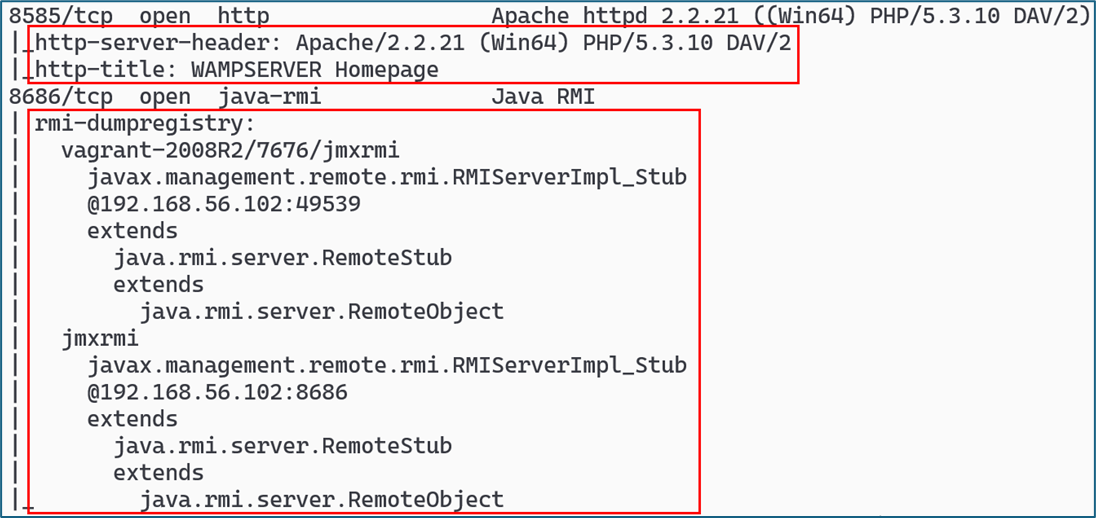
Nmap Default Scripts Output Example 

The next image shows information on the Terminal Services (RDP) service, with the scripts rdp-ntlm-info, ssl-cert, and ssl-date providing additional information, including information on the domain name and system time.  
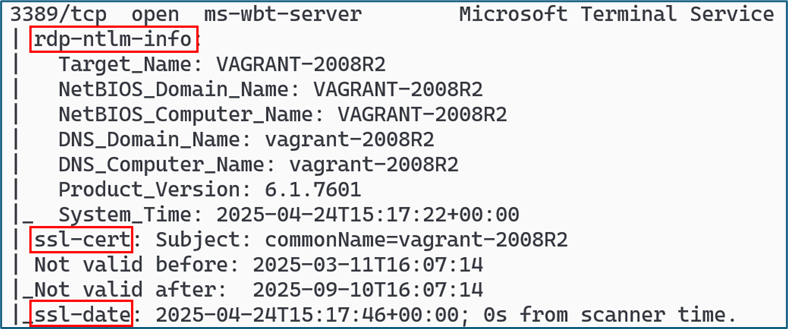
Nmap Default Scripts Output Example 

Nmap Vuln Scripts 

The default scripts can provide a significant amount of information on a host but don’t really provide direct vulnerability information, such as whether a host is vulnerable to a particular CVE. That’s where the vuln category comes in handy. This is a built-in category of NSE scripts for vulnerability checks called vuln. To invoke this set of scripts, the following command syntax would be used. Note the -sC option is not enabled, but this can be included depending on your scanning needs. 

nmap -sV --script vuln -oA labscan-sV-vuln 192.168.56.0/24 

The screenshot below shows some of the additional vuln scripts that were run against the same Windows host we scanned earlier. The host was running SMB services, and you’ll notice the vulnerability checking scripts are focused on SMB or SAMBA vulnerabilities. This host was missing the patch for the well-known SMB vulnerability patched by MS17-010, and the Nmap script provided information on the CVE number, as well as additional links to gather more information.  
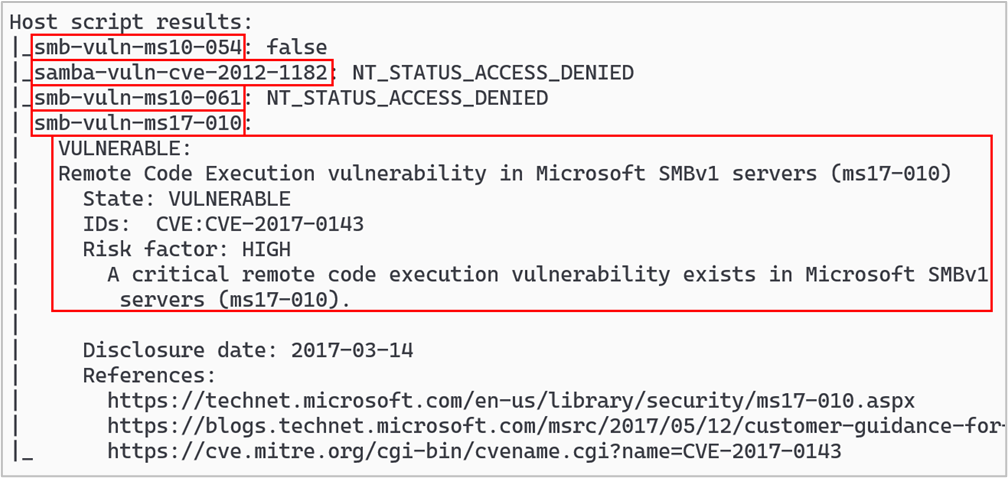
Host Script Results Showing Vuln Script Results 

Vulners NSE Script 

If you want even more information on CVEs that affect a particular system you are testing, check out the vulners NSE script. This script provides a significant amount of information on potentially applicable CVEs for each service on a target system. It is important to note that the database containing the CVEs is not local, and this script will send traffic out of a network to the Vulners API. This is important to note if you do not have internet access from your scanning host. To invoke this script, the following syntax would be used. Note that the -sV option is required for this script.  

nmap -sV -p- --script vulners -oA labscan-vulners-192.168.56.0/24 

The output from this script is voluminous, to say the least. The sample output in the following screenshot shows some of the exploits and CVEs that were pulled from the Vulners database for OpenSSH 9.2p1, along with links to the Vulners website with more information for each item. The version information was provided by the -sV option.  
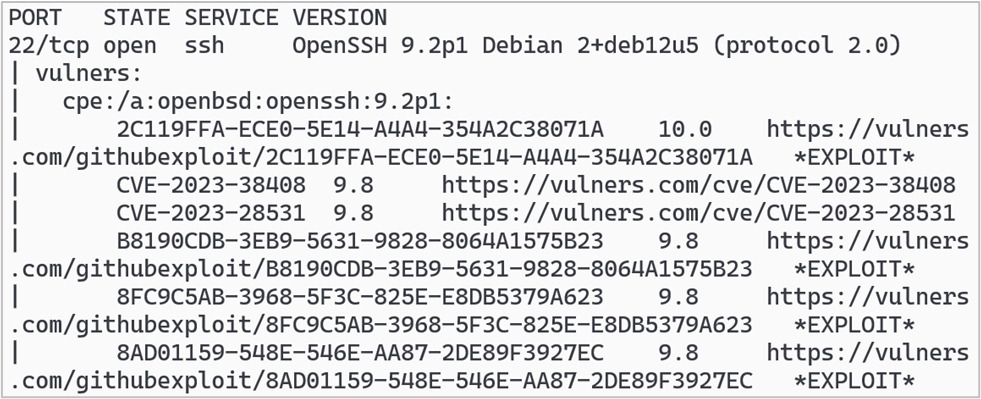
Vulners Script Results Example 

As we’ve seen, Nmap NSE scripts can provide a lot of additional vulnerability data in addition to ports and service versions. There are even more options with Nmap, and I’d recommend looking through the Nmap documentation at https://nmap.org/docs.html and on their GitHub page at https://github.com/nmap/nmap


Ready to learn more?

Level up your skills with affordable classes from Antisyphon!

Pay-What-You-Can Training

Available live/virtual and on-demand