
惯性聚合 高效追踪和阅读你感兴趣的博客、新闻、科技资讯
阅读原文 在惯性聚合中打开

推荐订阅源

酷 壳 – CoolShell
酷 壳 – CoolShell
H
Hacker News: Front Page
P
Palo Alto Networks Blog
T
ThreatConnect
Apple Machine Learning Research
博客园_首页
T
True Tiger Recordings
P
Privacy & Cybersecurity Law Blog
B
Blog
IT之家
IT之家
Last Week in AI
Last Week in AI
F
Full Disclosure
Hacker News: Ask HN
Hacker News: Ask HN
C
Comments on: Blog
Microsoft Azure Blog
C
Cybersecurity and Infrastructure Security Agency CISA
Microsoft Security Blog
博客园 - 【当耐特】
N
News and Events Feed by Topic
NISL@THU
NISL@THU
腾讯CDC
雷峰网
雷峰网
Security Latest
Security Latest
李成银的技术随笔
M
Microsoft Research Blog - Microsoft Research
L
LangChain Blog
L
Lohrmann on Cybersecurity
cs.CL updates on arXiv.org
C
Check Point Blog
Y
Y Combinator Blog
Recent Announcements
博客园 - Franky
N
News | PayPal Newsroom
V
V2EX
A
About on SuperTechFans
The Register - Security
月光博客
月光博客
奇客Solidot–传递最新科技情报
奇客Solidot–传递最新科技情报
Google Online Security Blog
MyScale Blog
MyScale Blog
Cisco Talos Blog
Cisco Talos Blog
Vercel News
Vercel News
WordPress大学
WordPress大学
C
Cyber Attacks, Cyber Crime and Cyber Security
The Hacker News
The Hacker News
IntelliJ IDEA : IntelliJ IDEA – the Leading IDE for Professional Development in Java and Kotlin | The JetBrains Blog
爱范儿
爱范儿
A
Arctic Wolf
L
LINUX DO - 最新话题
freeCodeCamp Programming Tutorials: Python, JavaScript, Git & More

Black Hills Information Security, Inc.

Same Problem, Different Angles: When Red Team and Blue Team Actually Talk to Each Other How to Identify and Exploit New Vulnerabilities Swapper – A Pure Regex Match/Replace Burp Extension A Practical Guide to BloodHound Data Collection Network Engineering Basics Signed, Trusted, and Abused: Proxy Execution via WebView2 Getting Started In Pentesting – Advice From The BHIS Pentest Lead Cloud Security: Tips and Resources for Securing the Cloud Lessons From A Chatbot Incident How to Lead Effective Tabletops Understanding GRC: How to Navigate Risks and Compliance Standards The “P” in PAM is for Persistence: Linux Persistence Technique Malware Analysis: How to Analyze and Understand Malware OSINT: How to Find, Use, and Control Open-Source Intelligence What to Do with Your First Home Lab When the SOC Goes to Deadwood: A Night to Remember Social Engineering and Microsoft SSPR: The Road to Pwnage is Paved with Good Intentions Common Cyber Threats Finding the Right Penetration Testing Company Deceptive-Auditing: An Active Directory Honeypots Tool The Curious Case of the Comburglar How to Set Smart Goals (That Actually Work For You) Inside the BHIS SOC: A Conversation with Hayden Covington Abusing Delegation with Impacket (Part 3): Resource-Based Constrained Delegation Why You Got Hacked – 2025 Super Edition Abusing Delegation with Impacket (Part 2): Constrained Delegation Abusing Delegation with Impacket (Part 1): Unconstrained Delegation GoSpoof – Turning Attacks into Intel Model Context Protocol (MCP) Bypassing WAFs Using Oversized Requests Getting Started with AI Hacking Part 2: Prompt Injection Wrangling Windows Event Logs with Hayabusa & SOF-ELK (Part 2) DomCat: A Domain Categorization Tool Wrangling Windows Event Logs with Hayabusa & SOF-ELK (Part 1) Microsoft Store and WinGet: Security Risks for Corporate Environments Default Web Content MailFail Commonly Abused Administrative Utilities: A Hidden Risk to Enterprise Security Stop Spoofing Yourself! Disabling M365 Direct Send Bypassing CSP with JSONP: Introducing JSONPeek and CSP B Gone Offensive Tooling Cheatsheets: An Infosec Survival Guide Resource DNS Triage Cheatsheet GraphRunner Cheatsheet Burp Suite Cheatsheet Impacket Cheatsheet Wireshark Cheatsheet Hashcat Cheatsheet EyeWitness Cheatsheet Nmap Cheatsheet Netcat (nc) Cheatsheet Hunt for Weak Spots in Your Wireless Network with Airodump-ng from the Aircrack-ng Suite Detecting ADCS Privilege Escalation Vulnerability Scanning with Nmap Getting Started with NetExec: Streamlining Network Discovery and Access How to Use Dirsearch Augmenting Penetration Testing Methodology with Artificial Intelligence – Part 3: Arcanum Cyber Security Bot How to Design and Execute Effective Social Engineering Attacks by Phone Abusing S4U2Self for Active Directory Pivoting Why Use a Macro Pad? Espanso: Text Replacement, the Easy Way Caging Copilot: Lessons Learned in LLM Security Augmenting Penetration Testing Methodology with Artificial Intelligence – Part 2: Copilot Augmenting Penetration Testing Methodology with Artificial Intelligence – Part 1: Burpference Intercepting Traffic for Mobile Applications that Bypass the System Proxy How to Root Android Phones Communicating Security to the C-Suite: A Strategic Approach Offline Memory Forensics With Volatility Getting Started with AI Hacking: Part 1 Go-Spoof: A Tool for Cyber Deception How to Test Adversary-in-the-Middle Without Hacking Tools Canary in the Code: Alert()-ing on XSS Exploits How to Hack Wi-Fi with No Wi-Fi Why Your Org Needs a Penetration Test Program Burp Suite Extension: Copy For Light at the End of the Dark Web Wi-Fi Forge: Practice Wi-Fi Security Without Hardware Avoiding Dirty RAGs: Retrieval-Augmented Generation with Ollama and LangChain Gone Phishing: Installing GoPhish and Creating a Campaign 5 Things We Are Going to Continue to Ignore in 2025 John Strand’s 5 Phase Plan For Starting in Computer Security Questions From a Beginner Threat Hunter GRC for Security Managers: From Checklists to Influence AI Large Language Models and Supervised Fine Tuning Attack Tactics 9: Shadow Creds for PrivEsc w/ Kent & Jordan One Active Directory Account Can Be Your Best Early Warning Introduction to Zeek Log Analysis Indecent Exposure: Your Secrets are Showing Creating Burp Extensions: A Beginner’s Guide Pitting AI Against AI: Using PyRIT to Assess Large Language Models (LLMs) The Top Ten List of Why You Got Hacked This Year (2023/2024) ICS Hard Knocks: Mitigations to Scenarios Found in ICS/OT Backdoors & Breaches Intro to Data Analytics Using SQL Finding Access Control Vulnerabilities with Autorize The Detection Engineering Process Cyber Risk Lessons We Can Learn From Hurricane Preparedness Intro to Desktop Application Testing Methodology What Is Penetration Testing? Adversary in the Middle (AitM): Post-Exploitation Pentesting, Threat Hunting, and SOC: An Overview QEMU, MSYS2, and Emacs: Open-Source Solutions to Run Virtual Machines on Windows
How to Increase the Minimum Character Password Length (15+) Policies in Active Directory
2016-11-28 · via Black Hills Information Security, Inc.

Kent Ickler //

As a start to a series on Windows Administration in the eyes of a security-conscious “Windows Guy” I invite you on configuring AD DS PSOs (Password Security Objects) and how they can be implemented in your environment to enforce acceptable password restrictions beyond what native AD GPO supports.

The Arbitrary: A drive for longer passwords.

About the time you’ve finished reviewing your SOX-DSS-HIPAA-Omnibus-PCI-CJIS-FBI-CIA-BYOBeer audit findings, your empathic auditor reveals the progressive requirement of a “15 character minimum password.” Possibly because last year’s policy change and enforcement of a “14 character minimum password” was too much fun to not be an annual experience, you know a headache will soon ensue.   As the Active Directory Admin, you are about to learn the crux of backwards-compatibility and how it is limiting today’s security platforms.

Backwards Compatibility Limits Security

History Lesson for the Post-Millennials

Back in Windows 95/98 days, passwords were stored using the LM Hash.  The LM hash method was secure in its day– a password would be same-cased, padded to 14 characters, broken into two 7 character halves, and each half is used to encrypt a static string.  The resulting two encryptions are put together, forming the LM Hash stored password.  Arguably LM Hash and cryptographic functions in yesteryear were sufficient mechanisms to store a password and data without the threat of a timely brute-force compromise.  Today, a lean built hashcat system will brute force 100 LM hashes in just a few moments.

While Microsoft systems eventually retired the LM Hash for more secure (yet still compromisable) hash functions, the backwards compatible cryptography remained for years following NT4, leading systems into the new millennium with  password vulnerabilities and limiting acceptable Group-Policy configurations.  Native Active Directory group-policy password settings still haven’t graduated from the 14 character stigma, this is most relevant when attempting to set a “15 character minimum password”.
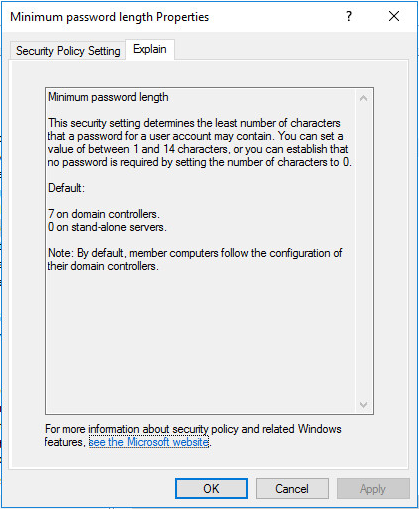
Group Policy Limitation

Fear not, die-hard Windows 2012 GUI loving admins: Active Directory can natively support 15+ minimum character passwords, all from the GUI and without headaches!  Windows 2008 AD DS introduced “Fined Grained Password Policies” or Password Setting Object (PSO).  PSOs instead of using a computer-object Group Policy targeted specific Active Directory user accounts or user groups.  However, creating a PSO in Windows 2008 was still reserved for ADSI editors and PowerShell ninjas (See more information at bottom).  In Windows 2012, the feature moved from the back-end Active Directory management and into a front-end GUI buried within the seldom used Active Directory Administration Center. More importantly though, in our hunt to overcome password character limitation requirements, PSOs allow for a maximum value of the minimum password character length 255 characters, effectively preventing password changes.

PSOs in Windows 2012+

Setting up PSO’s within Windows 2012+ is easy and won’t affect users until they attempt their next password change.

Buyer beware and always test your work, however; see caveats at bottom.

Control Panel -> System and Security -> Administrative Tools -> Advice Directory Administrative Center
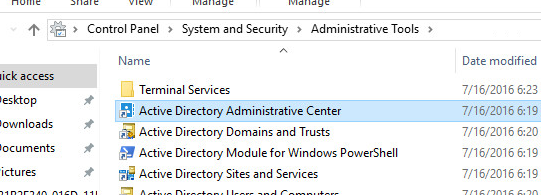
DomainName -> System -> Password Settings Container

Right Click -> New -> Password Settings

Complete the PSO settings and assign a User or User Group target.  To assign the policy to all users, use “Domain Users”.  Notice in this test we have specified 20 characters to be the minimum length for acceptable passwords.

Testing your work:

Changing password with a new 15 character password:

Test your work:

Changing password with a new 20 character password:

Caveats and Considerations:

There are a couple of serious considerations that should be made when using a PSO to configure a password requirement.  On Administration and troubleshooting, PSO’s don’t lend themselves nicely in an RSOP, so be sure your administrators know to check for PSOs if your support desk is hearing about password-change headaches.  Know that because the PSO is targeting domain user accounts instead of domain computer accounts, workstation/server local user accounts will not be affected, nor will domain computer accounts be affected.  It is important therefore to operate both the typical Active Directory Group Policy as well as the PSO to limit acceptable passwords.

There are other alternatives to using a PSO to set the password policy to limit acceptable passwords.  There are HKLM reg-hacks that will force submissive systems to specific password lengths.  There is also a decade’s old solution of building a custom password filter library and registering it in the system.  Regarding backwards compatibility & LM Hashing, there are solutions within Group Policy and HKLM for that too.

As Microsoft slowly closes the backward-compatibility security gap, we may eventually find that the Password Policies within native AD DS Group Policies will begin to catch up to the security standards of today and forcing a 7, 14, 15 255, 500 character minimum password that will be no headache at all– Or, we’ll all just be chiseling stone tablets.

On a last note, be sure to buy your internal auditors and pen-testers breakfast.

More Information:

Creating a PSO in Windows 2008: https://technet.microsoft.com/en-us/library/cc754461(v=ws.10).aspx

LM Hash information: https://technet.microsoft.com/en-us/library/hh994558(v=ws.10).aspx

Preventing the use of LanMan Hash: https://support.microsoft.com/en-us/kb/299656

Want to learn more mad skills from the person who wrote this blog?

Check out these classes from Jordan and Kent: