



A REPORT FROM an independent think-tank has found that nearly 90% of Dublin’s data centres are located in economically deprived communities.
The greater Dublin area is home to 97 active or planned data centres and Tasc (Think-tank for Action on Social Change) has today launched an online map allowing the public to explore the location of these data centres.
The SEAI (Sustainable Energy Authority of Ireland) recently noted that data centres are one of the “fastest growing sectors” in Ireland, with a per-capita level of development that is around 10 times higher than the European average.
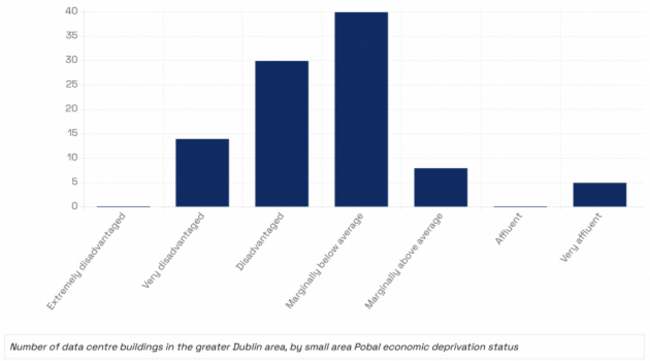
Tasc found that 84 of the 97 Dublin area data centres are located in disadvantaged areas.
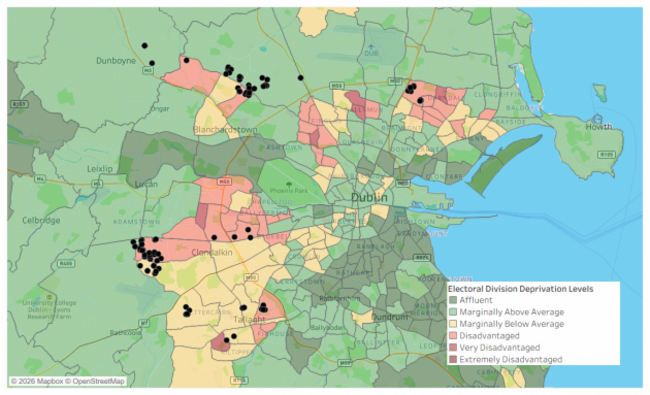
It uses Pobal’s HP Deprivation Index to classify areas on a scale from “extremely disadvantaged” to “very affluent”.
The index is Ireland’s primary social gradient tool and is used by many government departments and state agencies for the identification of disadvantage.
Tasc said that its map points to major data centre “clusters” in Blanchardstown, Tallaght, and Clondalkin, “communities already facing higher unemployment and lower educational attainment than the Dublin average”.
Tasc said this “concentration reveals a clear spatial inequality” and that the “infrastructure underpinning the global digital economy is being embedded in communities that are already economically marginalised”.
Tasc added that data centres bring only short-term employment during the construction phase and that they “generate relatively few permanent jobs” once operational.
It also noted that “many of these roles require specialised technical skills or advanced education, limiting their accessibility to residents in disadvantaged areas”.
Tasc also voiced concern about the “massive quantities of electricity” data centres consume.
It was recently warned by the Climate Change Advisory Council that rising data centre demand is offsetting gains in renewable generation.
Electricity consumption directly from data centres has increased by 463% since records began in 2015, and data centres accounted for 22% of Ireland’s electricity demand in 2024.
It said that additional data centre demand “will continue the well-established trend of data centres cannibalising any increase in Irish renewable capacity, causing stagnation of the share of renewable electricity meeting demand”.