




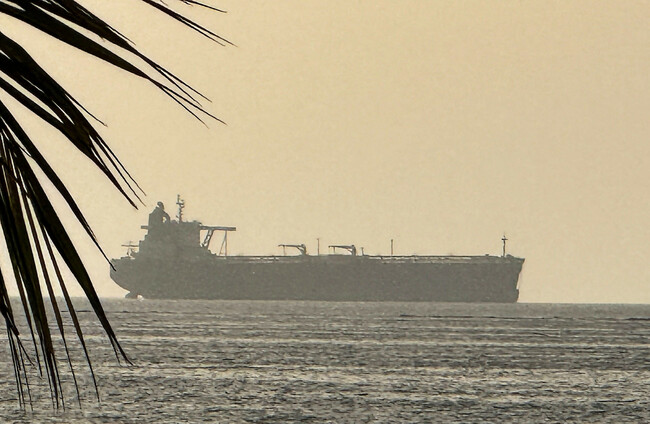
THE EVACUATION OF around 11,000 mariners stranded by the closure of the Strait of Hormuz was suspended Thursday after an attack on a vessel in the Gulf of Oman, the International Maritime Organization (IMO) said.
The UN’s maritime agency said earlier this week it would begin evacuating 600 ships and their crews that were trapped by the US-Iran war, after Washington and Tehran agreed a preliminary deal to end the conflict.
But a cargo ship was damaged by an unknown projectile off the Omani coast in the strategic strait on Thursday, prompting the IMO to halt the operation.
“I have decided to temporarily pause (the evacuation plan’s) implementation in order to reconfirm that the necessary safety guarantees continue to be in place for the ships on our evacuation list and all those in the region,” IMO Secretary-General Arsenio Dominguez said in a statement.
The vessel that was hit on Thursday was not travelling under the IMO’s evacuation framework, which began on Tuesday evening, Dominguez said.
The UK Maritime Trade Operations (UKMTO) security agency said the ship’s captain had reported damage to the bridge but no casualties.
Seventy confirmed crossings of the Strait of Hormuz were recorded on Wednesday, according to an X post by analytics firm Kpler, but traffic is at around half of its pre-war level.
Iran’s Persian Gulf Strait Authority warned on X that ships using routes outside the designated framework “will not be covered by safe passage guarantees”.
Earlier on Thursday, Iran’s Revolutionary Guards warned against any crossings of the Strait of Hormuz without authorisation, saying vessels not complying “will be dealt with”.
Impact on Irish consumers
Oil prices are also expected to remain “well above” those before the war in Iran throughout the rest of 2026 and 2027, the Economic and Social Research Institute (ESRI) said.
This means that although so far price increases have been concentrated on energy, second-hand effects are expected to be felt across the rest of the year – such as rising food prices.
The research institute published its analysis of the domestic economy and inflationary pressures in today’s Quarterly Economic Commentary.
It has urged policymakers to “closely monitor” food prices in the months ahead because input costs – such as fertiliser – are increasing sharply due to the US-Iran war, with consumers “likely to face higher prices in the coming months” as a result.
Added to this, the ESRI said, is that Irish and UK grocery markets are linked, and industry forecasts for grocery prices in Britain estimate a 9% increase for this year.
It warned this will particularly impact for lower and middle income households, as food makes up almost 15% of total expenditure.