






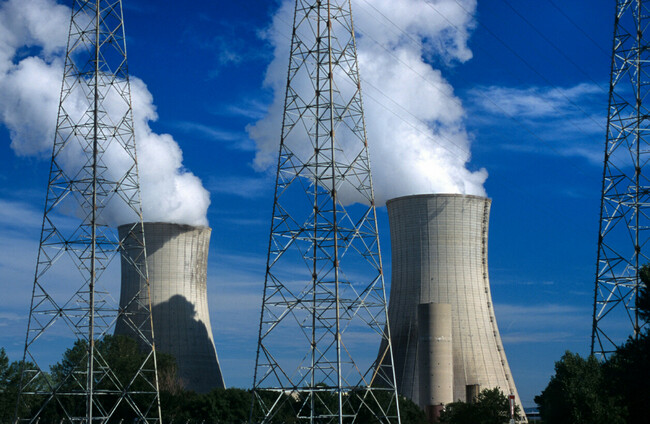
IF IRELAND WERE to embrace nuclear power through the use of small modular reactors, the government would face a “regulatory challenges” over the disposal of the waste from the units.
Academics from University College Dublin (UCD) have told TDs and senators that the nuclear waste from the reactors would require disposal “deep underground” in repositories – and likely face challenges as a result.
The potential for nuclear power was up for discussion at the Joint Oireacthas Committee on Climate, Environment and Energy on Wednesday, where the potential benefits and drawbacks were outlined to politicians.
The debate has been gathering steam in recent months, with Fianna Fáil parliamentary party members recently approving a plan to lift a ban on nuclear power in Ireland.
This debate has been focusing in on small modular reactors. Proponents argue the modular reactors offer faster construction compared to traditional large-scale nuclear power plants.
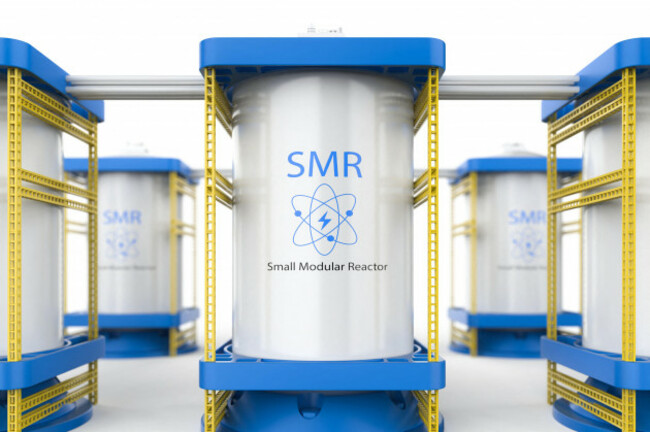
While experts from UCD said nuclear can provide “zero emission” power, they outlined a difficult picture for development of the sector in Ireland due to significant reforms being required.
Muhammad Maladoh Bah, from the UCD Energy Institute, told the committee that a clear challenge to the development of a nuclear programme lies in how to organise its waste management.
“Siting of a nuclear facility would require extensive screening, including ensuring that it is away from population areas, that it has necessary geotechnical characteristics, that it has access to water but is not a flood risk, and has strong road and rail connections,” Bah said.
Once uranium is enriched, it can be used as fuel for a reactor for perhaps up to five years in a nuclear power plant. After this point the spent fuel must be stored.
The committee heard that while this waste can be stored in interim facilities, ultimately very long-term storage is needed.
The long-term management of nuclear waste, Bah added, presents “further complex challenges”, as the internationally recognised best practice for spent nuclear fuel is to dispose of it in a geological repository deep underground.
Nuclear waste management “therefore faces siting and regulatory challenges,” Bah said.
Andrew Keane, director of the UCD Energy Institute, said it was because of difficulties in establishing a nuclear programme that means it is “difficult to foresee nuclear power availability in Ireland before 2050″, whether through small modular reactors or any other form.
“The statutory ban on nuclear power, and the lack of necessary regulatory frameworks, provide an initial block to the development of nuclear power,” Keane said.
He added that significant reform, including the creation of an independent nuclear regulatory authority, would be necessary to create a programme.
Budget overun warning
The economic implications of a nuclear programme were queried by the government’s chief science adviser, Aoife McLysaght, who siad this question was “still very much open”.
The professor explained that in countries with established nuclear plants, overruns in budget and timeline “appear the norm” from her research.
While this is partly the issue small modular reactors are promised to address, McLysaght said that “at the moment it appears to be a case of watch this space”.
Also appearing at the committee was the Irish Academy of Engineering, which argued that it was possible to still deploy the smaller reactors by the 2040s.
‘Persistent mistake’
The group said Ireland has been guilty of making the “persistent mistake” of starting major infrastructure projects late with a “weak” policy foundation, and “then blame the planning system for inevitable slow delivery”.
Therefore, it said, work on building the policy foundations for small modular reactors “needs to start now if we want to have an option of deploying them” by the 2040s.
Committee chair Naoise Ó Muirí said that the meeting was providing TDs and senators with initial insights into developments into the technology and its possible applications.
“Nuclear energy has been used internationally for decades. However, there remains limited analysis of its feasibility in an Irish context,” Ó Muirí said.
“This discussion will help to begin bridging that gap, as we consider how nuclear energy might contribute to Ireland’s future energy mix alongside renewable sources.”