









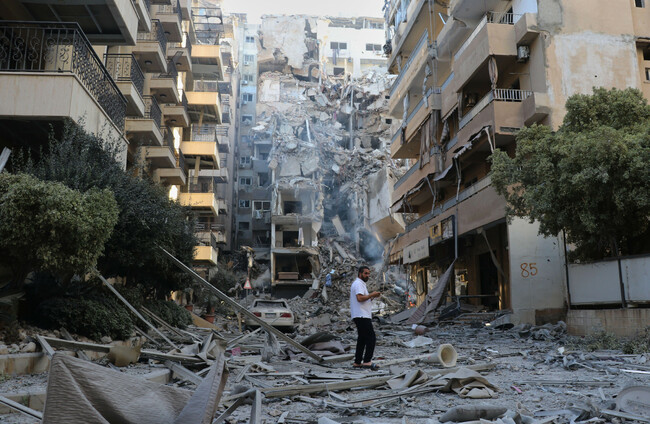
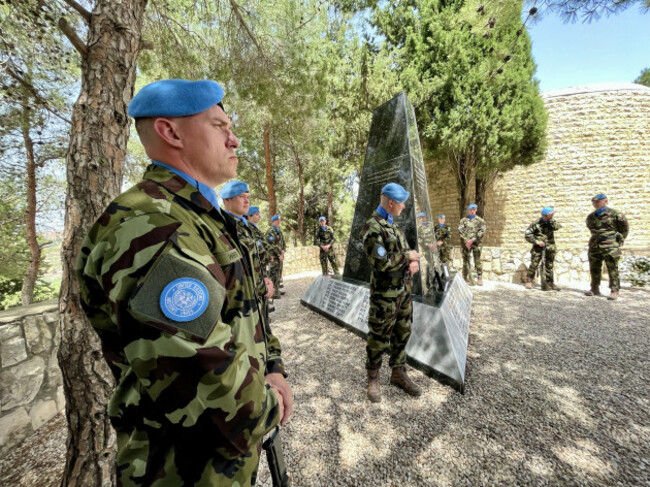
THE LEBANESE HILLSIDE town of Tibnine, where a monument to 48 Irish soldiers killed on peacekeeping duty stands, has been struck in the midst of numerous Israeli bombing raids across the south of the country overnight and this morning.
It is the latest series of air raids by Israel since a ceasefire was declared on 14 April.
The location, which is a Coptic Christian area, is located a short journey from the Irish camp 2-45 near At Tiri.
An orphanage, which was supported by Irish government aid and the Irish Defence Forces, had previously been bombed and damaged. A number of other projects in the area have also been carried out with help from Ireland down through the years since UNIFIL started in 1978.
Irish soldiers go there once a month, when it is safe to do so, to pay tribute to their dead colleagues.
An Irish Defence Forces spokesperson said that they had not heard of any damage to the monument in this morning’s bombing raids.
The south has been largely evacuated of civilians in many places, including in towns such as those near the Irish camp.
One source in the south described the area around the Irish camp as being akin to a moonscape with the near carpet bombing of At Tiri and Bint Jbeil.
Tyre struck
Overnight and this morning the historic city of Tyre in South Lebanon, a hub for displaced civilians, has suffered heavy bombardment overnight as Israeli forces launched airstrikes across the country.
Tyre is an ancient seaside town with extensive Roman and Phoenician archaeological sites. It is located an hour by road south of Beirut.
The city is on the main road into the Hezbollah stronghold south of the Litani river and is used by Irish troops to travel back and forth to Beirut.
It is also the location where many of those displaced from the southern towns and villages have been taking shelter. The Israeli Defence Forces (IDF) issued evacuation warnings which, according to local reports, caused large numbers of people to throng the roads as they left before the bombing took place.
The IDF said in a statement on its Telegram channel that it struck 135 Hezbollah targets across the south, in Tyre and the nearby town of Nabatieh, and in the Beqaa Valley close to the Syrian border.
The Israelis claimed they were striking ten rocket launch sites as well as a Hezbollah training camp in the Beqaa.
The Tyre bombing struck apartment blocks in the city, but Israel claimed in its statement that it struck military targets.
Videos have been circulating online of the bombing raids, with fireballs erupting from buildings at the centre of built-up areas in the city.
Graphic photographs have been circulating of badly damaged bodies.
There were also attacks in nearby Sidon and Beirut where a senior Hezbollah officer died.
The Israeli attacks have been condemned by Nawaf Salam, the Lebanese Prime Minister in a statement on X.
Hezbollah strikes
Separately Hezbollah fighters have continued to strike IDF targets with drones, mirroring tactics seen on the battlefields of Ukraine. An Israeli soldier was killed by one of the devices in recent days.
Hezbollah is also circulating videos on social media showing them using drones to strike Israeli military vehicles.
The Lebanese government has said at least 14 people have been killed in the overnight raids.
UNIFIL, the peacekeeping mission in the area of which Ireland is a part of, had reported that 600 Hezbollah “projectiles” had been sent towards northern Israel.
“Civilians continue to bear the heaviest impact. Hundreds of thousands have been forced to flee their homes, often at very short notice. Damage to homes, roads, and essential infrastructure is severely affecting daily life and recovery efforts.
“Peacekeepers remain on the ground, monitoring and reporting to the Security Council. Wednesday saw around 670 projectiles fired – the highest level since 17 April,” a spokeswoman said.
Ireland successfully rotated troops through the war zone in recent days as the 127 Infantry Battalion returned home and the 128 Infantry Battalion took up their positions.
An Irish Defence Forces spokesman said: “The situation in South Lebanon remains highly volatile, but all Irish personnel are well and accounted for.
“Personnel of the 128th Infantry Battalion continue to employ force protection measures enabling them to observe and monitor the ongoing conflict in line with UNSCR 1701. Óglaigh na hÉireann remains resolute in its commitment to UNIFIL.”
A Department of Foreign Affairs spokesman said Ireland’s funding in Lebanon is focused on humanitarian work.
“We are deeply concerned at the extensive destruction of civilian infrastructure and the displacement of civilians. We are continuing to support humanitarian responses in Lebanon,” he said.