



RTÉ NEWS ONLINE and The Journal are the two most used online news sources in the country, according to an annual report on news consumption in Ireland.
The Reuters Institute Digital News Report 2026 found that despite news avoidance being at an all-time high among Irish people, a number of online news brands maintained their audience or gained their readership since last year.
The survey was conducted between January and February using an online questionnaire. A total of 2,053 people were surveyed in Ireland.
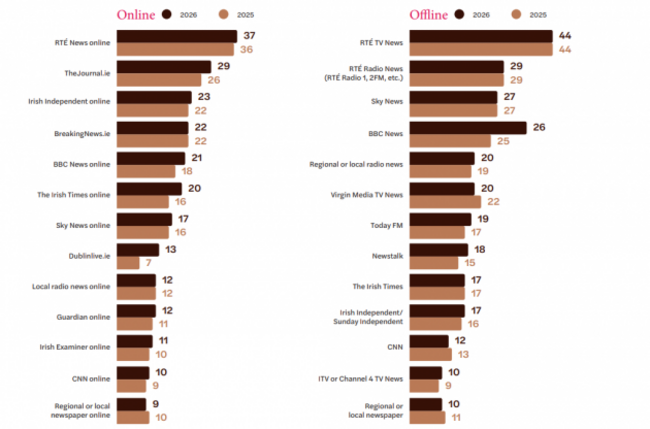
It found that The Journal was the second most used online news outlet, with nearly a third (29%) of respondents indicating they had read it in the past week. This is up three points on last year and behind only RTÉ on 37%, a drop of one point on 2025.
The Irish Independent online was the next most used on 23%, followed by BreakingNews.ie on 22% and BBC News online on 21%.
Television and online news sources – excluding social media – were cited by 31% of respondents as their main source of news that week. Social media was next on 21%, with radio news programmes cited by 3% of respondents. Print was down a percentage point on 3%.
Overall, more people in Ireland are avoiding the news than ever before.
Some 47% of respondents said they found themselves actively trying to avoid news, up six points on last year. Those who say they never avoid news is at 22%, down from 28% last year.
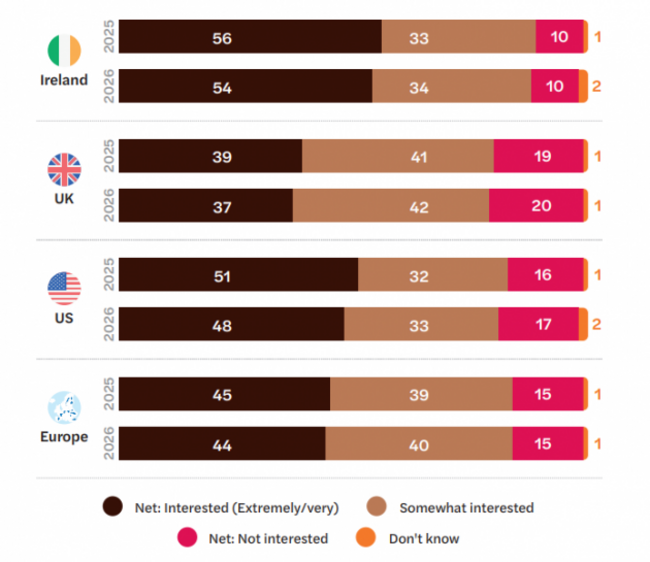
Yet Irish people are much more engaged with news when compared to other countries. More than half (54%) said that they are “extremely” or “very” interested in news. In the UK, only 37% said the same, while the European average is 44%. In the US, that number stands at 48%.
Commenting on the report, The Journal editor Sinéad O’Carroll said, “The team here are grateful for each and every person who uses The Journal to stay informed. Despite such marked news avoidance being reported, we know our readers want to make sense of what’s happening in their world, why it matters and what the nation is thinking about it. We take our role in helping them to do that seriously – but also know The Journal should be a place they want to visit every day. That’s what continuously motivates us in our work.”
Trust in the news
The number of people who said they could trust most news most of the time in Ireland has fallen from 51% last year to 42% this year.
However, in comparison, Ireland is still ahead of the UK (31%), the US (26%), and the European average (36%).
The report suggests that the decline is not about the reputations of legacy Irish news organisations, but more to do with the “much broader and messier mix of sources, formats and platforms” where people can now encounter news.
Age is a major part of the picture: trust is much lower among younger people than among older groups. A third (33%) of 18-24 year olds trust most news most of the time, compared with over half (52%) of those aged 65 and over.
This generational difference in how news is encountered and integrated into everyday life is likely behind this decline in trust, the report states, with older audiences still tied to direct relationships with familiar news organisations compared to younger audiences being confronted by news in non-journalistic environments.
A large majority of younger adults consume creator-related news content, with usage at 65% among 18–24s and 64% among 25–34s, compared with just 13% among those aged 65 and over.
Younger users were found to not only be following creators mainly focused on news (39%), but they are also consuming creators who primarily post about other topics but sometimes talk about news (42%).
The report notes ”an unprecedented fragmentation of news sources” that has been driven by emerging formats, with traditional news sources reaching fewer people.
Television remains the most-used traditional format at 56%, followed by radio at 35% and newspapers at 20%, but all three have declined sharply since 2015. Audio’s role has been further strengthened by the rise of podcasts as a weekly news source (12%).
Significantly, some 7% said they use AI chatbots for news weekly. That figure doubles to 14% when looking specifically at those aged 18-24. The report noted that audiences may not consider AI-generated news summaries on search engines as a ‘chatbot’, which suggests that engagement with AI-generated news may be much higher.
The use of AI for news in Ireland is lower than that of active users in Asia (11%), Latin America (10%) and Southern and Eastern Europe (9% and 8%). But at 7%, use in Ireland is higher than in the UK (4%) and the US (6%).