





Stephen McDermott
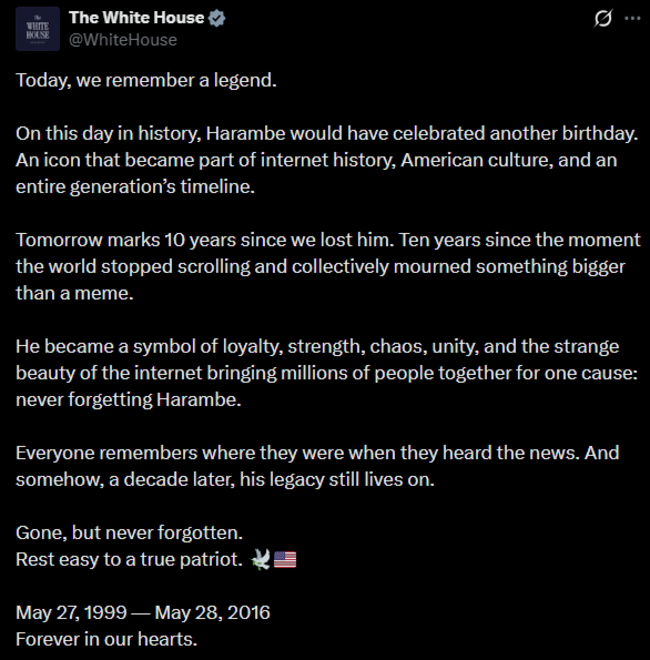
THIS WEEK, THE White House took to social media to pay tribute to what it called a “legend” and “true patriot”.
“Everyone remembers where they were when they heard the news. And somehow, a decade later, his legacy still lives on,” the official account of the most powerful political office in the world wrote to 4.7 million followers on X.
You’d be forgiven for thinking this was about some icon of American culture or, given how the Trump administration has used the account since taking office, a fallen hero of the MAGA movement.
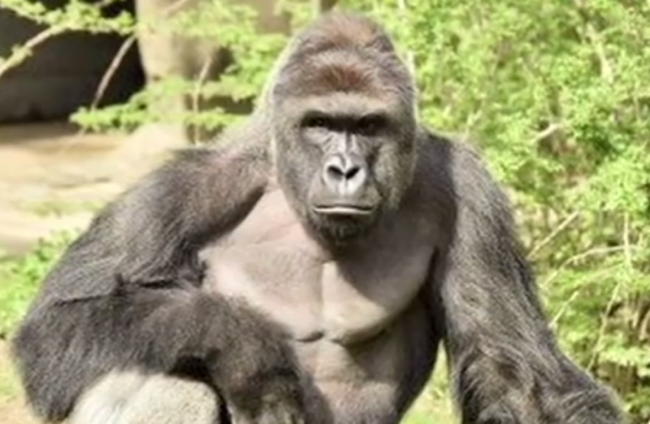
Instead, the bathos was the point: this was actually a presidential account adopting the language of remembrance for Harambe, a western lowland gorilla who was shot dead at Cincinnati Zoo 10 years ago this week.
The reference would be instantly recognisable to anyone who spent too much time online in 2016.
For those who aren’t aware of the backstory, Harambe was killed by staff at the zoo after a three-year-old boy accidentally entered his enclosure.
The incident was filmed and posted online, turning it first into a news story, then a meme and ironic memorial movement that captured the surreal, ludic quality of social media at the time.
The reference has endured to such an extent that a friend of mine recently designed and printed a batch of Star Wars-themed stickers reading “Harambe Shot First” (a darkly humorous homage to the famous “Han shot first” debate known to fans of the films).
Those stickers – a multi-layered online joke about another multi-layered online joke – feel like an appropriate cultural afterlife for Harambe.
But there’s also something telling in our current cultural climate when the official digital voice of the US presidency takes to X to shitpost about an internet moment from a decade ago.
It says a lot that the post barely jarred with me when I saw it this week, though I did, however, have to pause long enough to wonder whether it was sincere, ironic, or some obscure attempt by Trump to antagonise Cincinnati.
It felt revealing that the official account of the American presidency shitposting about Harambe was not strange enough to feel impossible.
Nowadays, even serious political accounts behave like content pages and chase the same engagement as influencers, meme accounts and brands by riffing on the cultural fluency of those who spend their lives online.
Political communication has been flattened into the same algorithmic logic as everything else on social media these days.
This isn’t unique to the United States: Sinn Féin were credited for their ability to speak to young voters via meme culture not long after Harambe was shot, while even Fianna Fáil have recently started pumping out videos leaning into zeitgeist-y viral moments.
Irony is increasingly becoming a default institutional language in online spaces, particularly on platforms where sincerity and solemnity struggle to cut through everything else.
Part of the reason is that people often use platforms as a space to escape through scrolling, not as places to absorb solemn institutional messaging.
But it’s telling that, at a time when democracy feels like it’s in crisis – especially for younger voters – such accounts feel that shitposting and ironic humour are the best way to reach people in a relatable way.
The obvious question is why absurdity feels like the correct register for politics now.
The dark possibility is that unseriousness speaks to people at a time when the world is increasingly difficult to process because of authoritarian politics, genocide in the Middle East, Europe’s deadliest war in eight decades, the climate emergency, and so on.
There has been a long artistic tradition of such a response during times of instability.
Dadaism and then Surrealism emerged from the wreckage of the First World War to respond to a world that felt politically broken, while the Theatre of the Absurd likewise leaned into the concepts of futility and nonsense after the horrors of World War Two.
However, those movements responded to absurdity from the outside: it is a different thing to see absurd posting styles adopted by institutions that define the political landscape in 2026.
Unlike artists (or individual content creators), social media accounts like the White House’s collapse institutional seriousness and online unseriousness into one another, rather than rebel against the absurdity of the current moment.
The internet changed how people respond to politics, but it has now changed how politics talks back to people.
The Harambe meme once belonged to the organic humour of ordinary internet users, which, even in a moment of irony, was this week repurposed as a national myth.
If shitposting like this becomes the language of power, what happens when politics needs to be serious?