


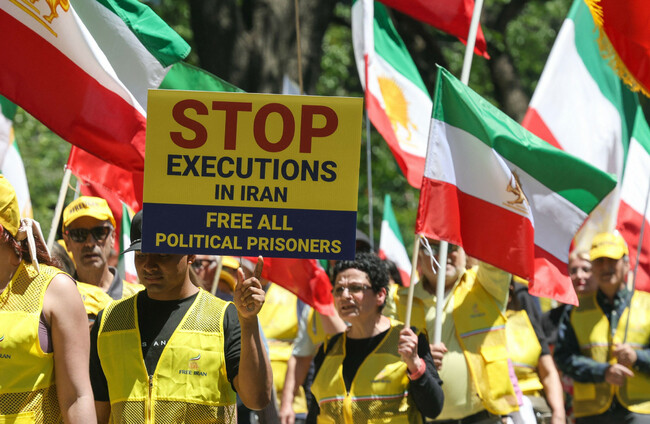
THE NUMBER OF executions carried out around the world surged to its highest recorded level in more than four decades last year, according to a new report from Amnesty International.
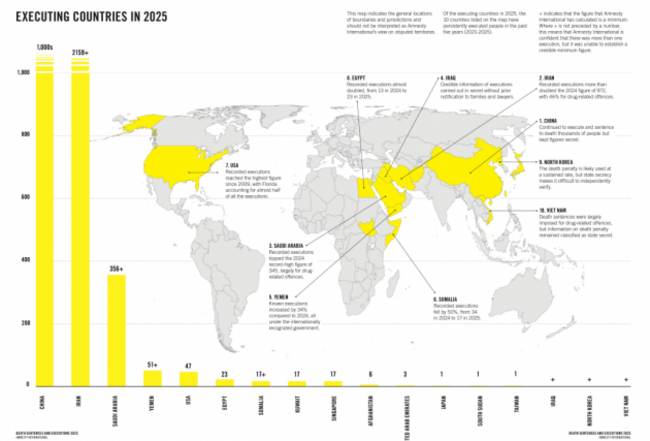
The human rights organisation said at least 2,707 people were executed across 17 countries in 2025, a 78% increase on the previous year and the highest figure Amnesty has recorded since 1981.
The true figure is likely far higher, Amnesty warned, as the total does not include the “thousands” of executions believed to have been carried out in China, which remains the world’s leading executioner but does not publish official data.
The sharp rise was driven overwhelmingly by Iran, where at least 2,159 executions were recorded, accounting for around 80% of all known executions worldwide.
Saudi Arabia also recorded a dramatic increase, carrying out at least 356 executions, many linked to drug offences. Executions also rose sharply in Egypt, Singapore, Kuwait and the United States.
“A shameless minority are weaponising the death penalty to instil fear, crush dissent and punish marginalised communities,” Amnesty secretary general Agnès Callamard said.
“From China, Iran, North Korea and Saudi Arabia to Yemen, Kuwait, Singapore and the USA, this shameless minority are weaponising the death penalty to instil fear, crush dissent and show the strength state institutions have over disadvantaged people and marginalised communities.”
The report says governments increasingly used executions as part of “tough on crime” and national security narratives, particularly in states accused of cracking down on dissent and civil liberties.
Amnesty said almost half of all known executions last year were linked to drug-related offences, despite international human rights standards stating the death penalty should only be used for the “most serious crimes”.
— Amnesty International (@amnesty) May 18, 2026Close to half of the executions recorded in 2025 were the result of the intensification of highly punitive approaches in the “war on drugs”. Drug-related executions in China, Iran, Kuwait, Saudi Arabia and Singapore contributed to these numbers.
The death penalty has often been… pic.twitter.com/0JM7VeBwGU
At least 1,257 executions for drug offences were recorded in China, Iran, Kuwait, Saudi Arabia and Singapore.
The organisation accused Iranian authorities of using executions as a political weapon following the 2022 Woman Life Freedom protests and after military strikes by Israel in 2025.
Two men connected to the protests were executed after what Amnesty described as grossly unfair trials, while at least 11 men accused of spying for Israel were executed after the June strikes.
The report also highlighted the disproportionate impact of executions on minority groups in Iran, including Kurdish, Baluchi and Afghan communities.
In the United States, 47 executions were carried out, the country’s highest total since 2009. Nearly half of these executions took place in the state of Florida.
— Amnesty International (@amnesty) May 18, 2026With human rights under threat around the world, millions of people continue to fight against the death penalty each year in a powerful demonstration of our shared humanity.
As executing countries become ever more isolated, many countries are choosing to listen.
In the… pic.twitter.com/DyPzgA78ft
Amnesty said the increase reflected a growing willingness among some US states to expand execution methods, including firing squads and nitrogen gas asphyxiation.
Despite the spike in executions, Amnesty said the number of countries carrying out executions remains relatively small.
Only 17 countries were known to have executed people in 2025, continuing a broader long-term global trend away from capital punishment.
When Amnesty began campaigning against the death penalty in 1977, only 16 countries had fully abolished it. That number has now risen to 113 (Ireland abolished the death penalty in 1990, though the last execution took place here in 1954).
Several countries moved closer to abolition last year. Vietnam abolished the death penalty for eight offences including bribery and drug transportation, while the Gambia removed it for murder and treason offences.
Bills to abolish the death penalty were also introduced in Lebanon and Nigeria, while courts in Kyrgyzstan blocked efforts to reintroduce it.
“It’s time for executing countries to step into line with the rest of the world and leave this abhorrent practice in the past,” Callamard said.