


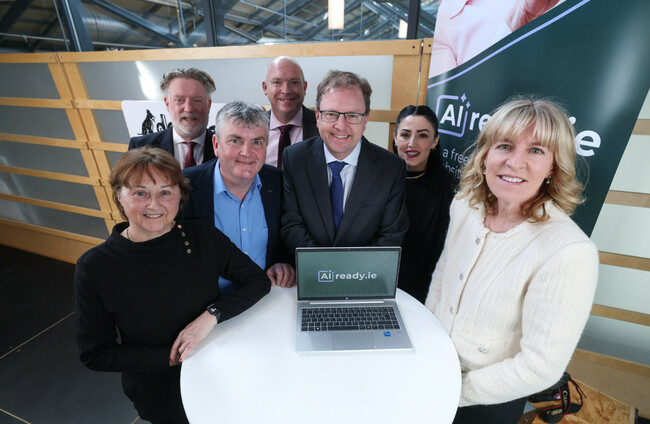

WHEN THE IRISH government announced that it was launching an online platform that would give users – primarily older people – easy access to digestible lessons in AI literacy, I was cautiously optimistic.
Chatbots and other tools underpinned by generative AI systems (the kind that produce natural language responses to queries, or generate synthetic media on demand) are becoming more prevalent in public and private services, and it’s important that people understand what these technologies are and how they work.
I knew the government was working on such a thing, and was initially concerned they would go in the direction the UK government did with their AI Skills Hub. The UK hub similarly promised short courses that could be completed by anyone from anywhere, but turned out to be little more than a directory of corporate training packages sponsored by industry providers of such technologies. Think Google, Amazon, Microsoft.
Technologist Andrew Cherry picked over the UK platform and found it near-impossible to find one of the alleged 20-minute courses that were so heavily touted, spending more than that amount of time just registering and trying to access one of them. And that was just the start of the issues he had with the course he took (provided by Accenture), which overall he found unhelpful, sloppy and overly concerned with pushing him to set up a ChatGPT account. (He detailed the whole painful experience in a rather entertaining Bluesky thread.)
Ireland’s AIready.ie, however, seemed like it could be different. When the website was launched, there was no sign of corporate sponsorship of the courses and shortly before its announcement was the official launch of Age-Friendly AI, a national AI literacy initiative for older adults.
This programme has been developed and co-designed with its target audience over the last couple of years to deliver in-person workshops that leave participants with a critical understanding of AI – that is, they leave this programme as informed users with the power to decide how they choose to engage with these technologies. It’s funded by Research Ireland and delivered by researchers from Technological University Dublin and the Adapt research centre.
Bringing the public along
It was announced earlier in April that the second phase of Age-Friendly AI would see its workshops rolled out to public libraries across the country. The Minister of State with responsibility for AI, Niamh Smyth TD, was expected to be in Johnston Central Library in Cavan to launch the programme, but was called away at the last-minute. She said of the launch: “The work being done through Adapt’s Age-Friendly AI programme is so vital, it bridges the generational divide, ensuring that the rewards of AI are accessible, equitable, and empowering for everyone, regardless of age.”
Seeing that the goals of this government-backed programme were so aligned with those of AIready.ie, I expected the new platform would reflect the resources from these co-designed and evidence-backed workshops (which are available for anyone to explore via the Age-Friendly AI website).
So, with a hopeful heart and a willing member of the over-60s audience targeted by AI Ready (my mam), I decided to have her try it out.
My mam is very handy on her phone, but even with me alongside her, it took an hour to get from start to finish of half of one of these alleged 20 to 30-minute courses. We were discussing things as we worked through them because I was recording for my For Tech’s Sake podcast, but that was not the real culprit of our slow progression. Let’s just say the user experience threw up hurdles and left a lot to be desired.

I had some quibbles with the user experience of the registration process, and once we had passed through that and tried to launch the first course, we couldn’t seem to get it to load. It’s not unusual for learning environments to load as pop-up windows, but this was not signalled when we hit Start.
We eventually found the new tab that had been opened in the mobile browser, and we were both struck by the small size of the text in this material, reportedly designed for use on mobile devices by older users. This was a frequent note of complaint from my mam throughout her lesson, and I noticed other features of the layout that signalled this was evidently not designed with mobile use at the forefront.
Other aspects of the content design made for a painful experience, but I have been advised by those with experience in designing such broad-reaching online programmes that this is a challenge of the format. (Instructional designers are encouraged, sometimes against their better instincts, to favour constant clicks and interactive engagements to ensure the attention of users is held throughout.)
Individual user experience issues with an education platform designed for broad use can be assumed and forgivable to a degree, but that’s not where the issues with AI Ready’s content ended.
Tough to navigate
A good chunk of the first module was dedicated to telling users that ChatGPT and Gemini exist, and you should set up accounts with them. No other tools were mentioned, nor did the early lessons give a good grounding in what these tools are or how they work.
It’s repeatedly specified that you don’t need a ChatGPT or Gemini account to complete the course, but there are details given on why you should have an account and extensive instructions on how to go about doing it.
My mam got the distinct impression that she was being pushed to set up an account, and even getting a sales pitch on why a paid account would be better. She did not appreciate this.

But I couldn’t even write this off as a blatant push to Gemini and ChatGPT, because it even fumbled that. In a particularly laughable moment, course materials instructed her to open up ChatGPT or Gemini but provided no links or addresses. My mam did what many people do in that situation and Googled, but if you Google “Gemini” the first result is a sponsored link from ChatGPT.
Eager to get on with it, she almost automatically clicked the first link, thinking it was Gemini. Does blindly using a tool, not even knowing what it is, demonstrate a good learning outcome for AI literacy?
This was my mam’s first time engaging with a chatbot outside of a customer service experience, and she was not having a good time. She asked about live traffic information and was told, incorrectly, that there were fuel protests on. She was not really interested in the use cases presented on support for writing (“By the time you do all that, you could have done the message”). She was irritated and fed up by the end, and deeply unimpressed. Likewise, she did not get the impression of AI being a useful time-saver, but a tremendous waste of time.
The wrong approach?
I was deeply concerned that there was very little explanation of the limitations of these systems. It seemed to me less a lesson in literacy and more a desperate plea for use. But the use cases presented were not compelling, especially as they did have to responsibly caveat everything in saying you’d have to double-check information and make your own decisions, undermining the pitch for it to be useful in the everyday.
At most, the lesson felt like an effort to stop people from using search engines. So many of the scenarios mapped out could achieve the same resolution with some search engine savvy, but this was not addressed. In fact, in the quiz questions, the non-AI option was marked as wrong, even when it was a valid choice.
In the healthcare use cases, instructions to share personal information only with professionals are contradicted by suggesting you input doctor’s notes for an AI summary, or share the exact medications you’re on with the chatbot as part of an exercise.
The course also overstates chatbot capabilities. It suggests that using ChatGPT or Gemini could help you set reminders, with no acknowledgement that such a feature would require either premium features, deeper app integrations, and/or the downloading of a chatbot app (none of which is explained).
I went on and finished the other modules by myself. The content became more informative, but the best parts felt like AI was being shoehorned in. There was good, solid advice on detecting scams, then an exercise saying you should copy and paste a suspicious email into a chatbot, redact information carefully, ask if the bot thinks it’s a scam, and then take that advice with a pinch of salt, trusting others and your own instincts above it. Once again, this is not coming across in practice as the efficient helper it’s touted as in theory.
It may seem to some that I am being nit-picky, which is in my nature as an editor, producer and reviewer. But I am experienced and knowledgeable enough about content design and user experience to know that many small issues like this compound to form an incongruent mess that is painful to navigate.
I don’t know how this course was developed, but if this is what AI-assisted work from government platforms looks like, it demonstrates sloppiness and a noted lack of care for detail and quality.
I was reminded of the Guidelines for the Responsible Use of AI in the Public Service released by the government last year. I may be one of the few people outside the government who took the time to read this 84-page document, which also suffered from a lack of appreciation for good content production. Entire paragraphs of text are repeated, there are examples of what I would call ‘sloppy and paste’, and there was a confusing mix of redundant explanation of common concepts and then broad statements covering complex instruction that lacked explicit detail.
It’s not unusual for government docs to be overstuffed and repetitive, but this one came across as rushed and lacking quality control.
AI Ready was launched with fanfare from the government and attracted a lot of media attention – some of it uncritically repeating what the platform promised without investigating what it actually delivered. One piece of media in particular drew a lot of attention: an opinion piece from Minister James Lawless written with the help of AI.
Plenty of critique and praise was directed at Lawless for this piece. As an editor, I would say it’s not a particularly substantive piece of writing. As a researcher looking into this story, this one sentence took me by surprise: “Developed by my department in partnership with industry, including Microsoft Ireland, AIready.ie represents one of the Government’s largest and most ambitious responses to the emergence of AI to date.”
By the time I read this, I had already picked over the AIready.ie website, and hadn’t spotted any mention of industry involvement with this project. No logos signalling funding support, only a statement that it comes from the government, the education provider Solas, and the National Skills Council.
What does the government say?
I queried the Department of Further and Higher Education, which clarified with an explanation of the council: “The National Skills Council represents the voice of enterprise in Ireland’s skills system, with a membership drawn from across industry, including the chairperson of the council, Dr Kevin Marshall, who is the head of future skilling at Microsoft Ireland. Part of the council’s advice to Government last year was the creation of such a resource. Following consideration of that advice, AIready.ie was developed.” (Google is also represented on the council, with Dr Claire Conneely, head of its Education for Social Impact team, as an enterprise member.)
The Department also responded to the issues I raised with the course content. They stressed that the references to ChatGPT and Gemini throughout the courses are not endorsements. “They were used as recognisable examples of large language model–based systems that many people will already have heard of, which helps reduce friction for learners who are completely new to AI,” they said in a statement.
They also emphasised that “AI Ready does not promote, recommend, or privilege any commercial provider, and it does not require learners to use any specific tool” and that these are “illustrative examples only” (but it bears noting that step one of the course exercises is “Log in to your ChatGPT or Gemini account”).
They also stated that “the course does not present generative AI as authoritative or reliable. It repeatedly emphasises that outputs can be incorrect, misleading, or fabricated, and that human judgement is always required. Later modules go deeper into how generative AI works at a conceptual level, why errors occur, and how to question and validate outputs responsibly.
“We see AI Ready as scaffolding learning over time, rather than trying to cover everything in a single introductory module.”
I asked about who was consulted with to develop these courses and was advised that they drew upon ”established AI‑literacy and digital‑skills frameworks, public‑sector guidance, and current research on responsible AI use, as well as advice from the National Skills Council”.
It is mind-boggling to me that the government seemingly created something new, shoddily, from scratch when they could have leaned on programmes they are already supporting to deliver AI literacy, such as Age-Friendly AI.
In his op-ed, Lawless (and his AI collaborator) wrote: “Each generation has faced new challenges, and each time we have chosen to invest in people.”
To me, AI Ready does not demonstrate investment in its users, nor investment in AI literacy experts, that I can see. And, from my view, it hasn’t invested in content design professionals.
So, which people, specifically, is this government investing in?
Elaine Burke is a tech and media journalist and broadcaster, and is host of the For Tech’s Sake podcast.