




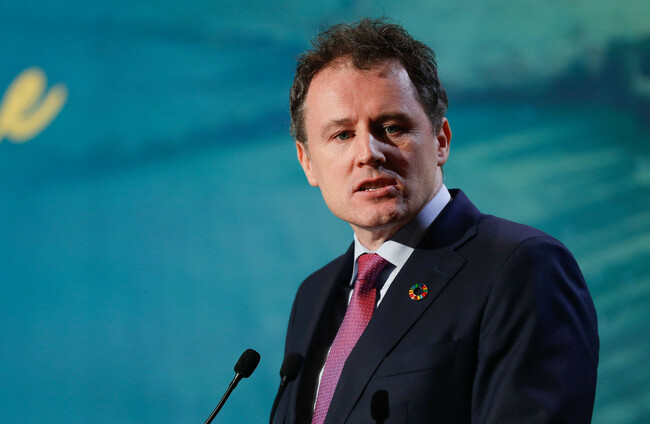
THE MINISTER OF State with special responsibility for Sport has said the government respects and supports the decision of the FAI to fulfil the upcoming football fixtures between the Irish men’s team and Israel.
Ireland is due to face Israel in the Nations League at a neutral venue on 27 September before a return game in Dublin on 4 October.
Ireland’s recent friendly match with Qatar was halted twice by fans protesting against upcoming games with Israel.
Tennis balls rained down on the Aviva Stadium pitch on Thursday from supporters in the upper tiers of the West, East and South Stand.
Earlier this year, FAI CEO David Courell said that fulfilling the fixtures was the only “viable option” and that “in reality, we do not have a choice”.
The FAI noted in February that a boycott of the Israel games “would lead to the forfeiture of six points” and could lead to relegation of the team to League C of the Nations League.
Speaking on RTÉ’s The Week in Politics, Minister of State with special responsibility for Sport Charlie McConalogue remarked that the FAI “find themselves in a very challenging situation”.
“From a sporting point of view, UEFA and FIFA banned Russia from their competitions,” said McConalogue.
“That hasn’t happened in relation to Israel, so the FAI have to make a decision and they’ve made that decision.
“We, as a government, support that decision and their right to make it.
“It’s important that we respect that decision.”
However, the Social Democrats’ Jennifer Whitmore accused the government of “talking out of both sides of its mouth”.
“[Government is] saying their ministers aren’t going to attend the match, but they’re not actually coming out against it.
“We need the government to come out and say that they do not want this game to go ahead.
“It’s not fair to leave the players in a position where there’s pressure coming on them, and we need to see the government take a leadership role.”
She added: “It’s just unconscionable to me that we would have a country, who the Taoiseach and Tánaiste have said is committing a genocide, that we will play soccer against them, have their flag flying in our stadium, listen to their national anthem.
“It just doesn’t make sense.”
Both Sinn Féin and the Social Democrats will bring a motion before the Dáil calling for a boycott of the games against Israel.
When it was put to Sinn Féin’s David Cullinane that a boycott would mean the Irish team forfeiting the two games, Cullinane remarked: “Six points versus genocide, a bit of perspective.
“This is about leadership, it’s about our moral standing as a country.
“When you talk about soccer, when you see players killed, supporters killed, sporting grounds levelled and don’t exist any more in Gaza.
“They are people who also love the game, but they’re dead and their grounds are gone.
“I think we need to take that strong stand and the FAI should do what’s right, but the government also has to do what’s right.”
McConalogue replied that the “place for the government to lead is not through a sports match, it’s through the political arena”.
He said this was being done through the Occupied Territories Bill and in joining South Africa in its genocide case against Israel at the International Court of Justice.
“I think what’s really important is that the players are not pulled into the middle of this,” said McConalogue.
“The FAI has made their decision, we should respect that, and we should pursue politically this issue continuously in the international arena.”
Occupied Territories Bill
Meanwhile, McConalogue said that with the Occupied Territories Bill, the government wants to introduce a bill “which is robust and meets all the legal tests that undoubtedly it will receive”.
The government aims to have the legislation enacted before the summer Dáil recess, but it will not include a ban on a trade in services.
Last year, the Oireachtas Foreign Affairs Committee recommended a ban on both trade in goods and services.
Cullinane said it is “cowardice” to pass the bill without including services.
When asked about concerns that including services could impact upon Irish jobs, Cullinane said: “I think that’s a big red herring, because the bill does exactly what it says, the Occupied Territories Bill.
“We’re talking about companies that operate in the occupied territories, mainly in the West Bank.
“There’s lots of exaggeration, but you have to take a real, strong, moral and political stand.
“I’m just really disappointed that they have gutted and taken a wrecking ball to the bill.”
Elsewhere, Whitmore remarked that “Israel needs to feel that they’re outside the rules, because there hasn’t been any tangible sanctions placed against them”.
However, McConalogue said the government wants the bill to be “implementable”.
“It’s easy for the opposition to say something, but the government actually have to do it, and for it to be implementable.”
He said that services are not included in similar measures being taken by other European countries, such as Spain and the Netherlands.
“The services aspect is not possible in terms of implementation or in terms of stacking up legally,” said McConalogue.