






(Seo alt ónár bhfoireann Gaeltachta. Is féidir an bunleagan as Gaeilge a léamh anseo)
THE DECISION TO provide an English language version of the accreditation process only for journalists wishing to cover Ireland’s Presidency of the EU Council has drawn strong criticism from Fianna Fáil MEP, Cynthia Ní Mhurchú.
While the Irish Government has placed considerable emphasis on Irish being central to this Presidency term, more than on previous occasions, the accreditation process – the first point of contact journalists from Ireland and internationally will have with the Irish Presidency – is in English only.
This issue is coming into sharper focus as journalists and correspondents from across the world are registering to obtain accreditation to be present at meetings and other events that will be held in Ireland when Ireland’s six-month term in the role begins on 1 July – and this cannot be done through Irish.
The Ireland South MEP for Ireland South told The Journal she felt both “disappointment and anger” at the absence of an Irish language option from the accreditation process.
Ní Mhurchú said this shortcoming should be rectified immediately. “I am contacting the Minister, the civil servants and the Taoiseach about this to resolve the problem,” she said.
“Irish has legal recognition in Ireland and in Europe and the government must protect it.”
In a statement from Ireland’s EU Presidency Press Office, which falls under the remit of the Department of Foreign Affairs, a spokesperson defended the decision, indicating that the Irish Government was following the precedent set by other governments that had held the Presidency in their turn.
“In line with the established practice of previous EU Presidencies, data entry on the accreditation platform is available in English,” said a spokesperson.
“This practice was followed during Cyprus’s current Presidency of the EU and during Denmark’s recent Presidency of the EU.
“Nevertheless, regarding accreditation, the Irish Presidency of the EU has made efforts to ensure that the access badges to be worn by Irish and international delegates and by the media during our EU Presidency will be in Irish and English.”
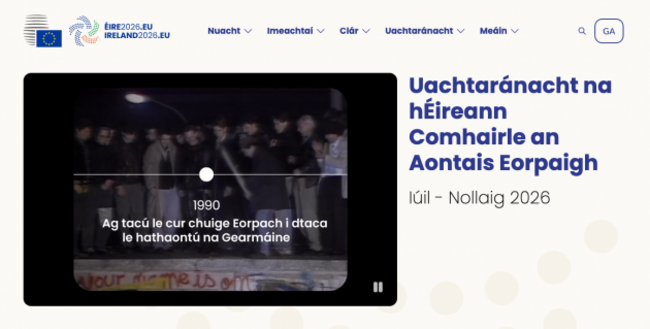
The spokesperson explained that “the Irish Presidency of the EU website is available in Irish, English and French.”
“It serves as the first source of information and contact for anyone seeking information about Ireland’s Presidency of the Council of the European Union,” said the spokesperson.
“Irish will be part of the programme of Ireland’s EU Presidency. Certain events will be hosted in Irish, and the Irish language, the arts, literature and music will be represented in the Cultural Programme, and Irish will be used at Union meetings and in communications during Ireland’s EU Presidency.”
The spokesperson also said that the Irish Presidency had made efforts to ensure “that the access badges to be worn by Irish and international delegates and by the media during our EU Presidency will be in Irish and in English.”
Conradh na Gaeilge, the Irish language advocacy organisation noted the efforts made by the Irish Presidency to place Irish at the centre of the Presidency but the organisation’s spokesperson, John Prendergast, expressed dissatisfaction at the absence of Irish from the accreditation process.
“It is certainly disappointing that the registration is not available to people in Irish and people seeking to obtain accreditation during the Presidency.”
He also questioned whether this shortcoming was in keeping with the obligation on Government departments to make forms available in Irish as well as English under the Official Languages Act 2003.
That legislation was enacted to promote the use of Irish by State bodies and Government departments and also to clarify how it should be used. The relevant section, 9(d), provided for Irish versions only of forms to made available or Irish and English versions of forms to be made available. It did not provide for English only forms to be made available.
Prendergast said, however, that he was aware that the Minister had yet to issue guidelines on the operation of this section. “Unfortunately, you would hope that a Government department would want to implement a strong practice regarding status bilingualism proactively across all of its work, and without doubt Ireland now has these opportunities with the Presidency to do that on a European level – a place where many minority language communities are living,” he said.
It was confirmed in a statement from the Office of the Language Commissioner that the Minister had commenced the provision relating to application forms in December 2024 but that the guidelines had not yet been issued “nor has any public body been prescribed for the purpose to date either.”
“This means there is currently no direct obligation on public bodies in relation to application forms until the Minister for the Gaeltacht brings statutory guidelines into effect,” said a spokesperson for the Commissioner.
“The Language Commissioner has drawn attention to the urgent need to bring the guidelines into effect without delay.”
In the first language scheme agreed between the Minister for the Gaeltacht and the Department of Foreign Affairs in November 2006, the Department said that application forms were being provided at that time “in Irish and English alike.”
In response to a query from The Journal, a spokesperson for the Department for Community and Rural Development and the Gaeltacht said that the guidelines would be issued “soon” following a wide consultation process and participation with a range of public companies and in the context of “additional developments that have emerged in 2026″.
The statement added that public companies would be given time to reach compliance with the relevant legislation after being ordered to do so. “The Technical Working Group, which was established under the National Plan, would also have a role regarding the development and implementation of strategies for Articles 9A and 9B, according to the guidelines,” said the spokesperson.
The Journal’s Gaeltacht initiative is supported by the Local Democracy Reporting Scheme
This article was originally written in the reporter’s native Irish and has been translated to English here. AI was used as part of the translation process before final edits.