





ONE OF THE less observed features of the current Trump administration is the proliferation of side hustles amongst Cabinet members.
Transport Secretary Sean Duffy, a former reality TV star and Fox News contributor, spent seven months making another reality TV show. Much of ‘The Great American Road Trip’, was filmed during the massive government shutdown that wreaked havoc on America’s airline industry.
You’d think with air traffic controllers going sick en masse, TSA workers quitting by the thousands and ICE agents being dispatched to America’s biggest airports to plug the labour shortfalls, the Transport Secretary would have had his hands full. But apparently not. During the crisis, he opted to tool around America’s highways and byways in his oversized gas guzzler, with a full crew capturing him and his wife in a never-ending sing along with their nine children.
Robert F Kennedy spends most of his time on the lucrative anti-vaccine speaking circuit, when he’s not making videos of himself exercising semi-naked in saunas with Kid Rock or engaged in fitness contests with fellow cabinet members.
Pete Hegseth likewise seems obsessed with projecting his own physical prowess, and even the President of the United States has half a dozen side hustles ranging from crypto to branding to flogging all manner of substandard tat online, from Bibles to guitars to his $249 a bottle ‘Fight,Fight,Fight’ cologne, the scent of which he describes as ‘Your rallying cry in a bottle.’
What about JD?
JD Vance likewise seems to regard his Vice Presidency a part-time gig; in between scuttling American support for Ukraine, serving as the fall guy for the US-Iran peace negotiations, procreating at an alarming rate and ‘owning the libtards’ online, he’s assiduously promoting his second memoir, doing the rounds of every talk show as he test drives his Vance v.27 persona ahead of the 2028 Presidential primary season.
The US Vice President has had more reincarnations than Madonna. From the hillbilly underclass to the Ivy League Washington elite, everyman populist to tech bro investment banker, Never Trumper to one of Trump’s most fawning acolytes, avowed isolationist to Iran war defender, free speech champion to Orwellian silencer of dissent, defender of democracy to Putin’s champion and, for the purposes of this book at least, from eschatological evangelical to atheist to Catholic convert.
In Hillbilly Elegy, his 2016 up by his bootstraps memoir, he chronicles his rise from Appalachian dysfunction to the American dream. In ‘Communion; Finding My Way Back to Faith’, Vance chronicles his religious and political U-turns while striving to keep a foot in multiple Christian and conservative camps. The result is about as bewildering, contrived and contradictory as you might expect.
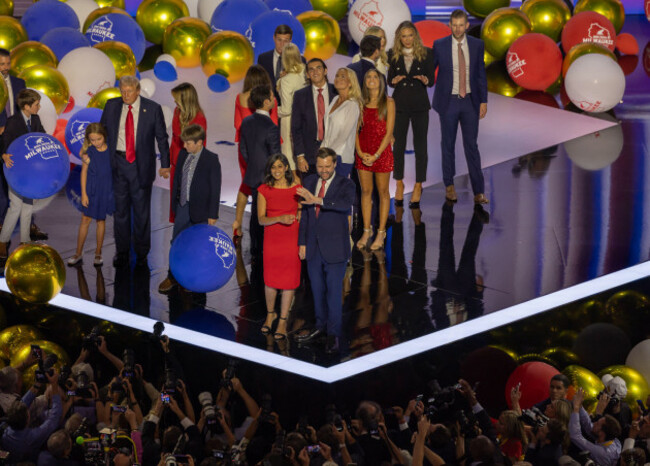
In the US, Protestants, including evangelicals, make up almost half of the electorate, while Catholics account for fewer than a quarter. Non-affiliated and non-Christian faiths account for the remainder. In his attempt to lay out his 2028 stall as a principled politician and man of faith, Vance unwittingly reveals his hollow core. A shapeshifter with no fixed principles, a charlatan with no non-negotiable beliefs. An empty vessel awash on a sea of anomie and self-loathing, propelled forward by insatiable ambition.
Vance’s charting of his progress from hillbilly evangelical to High Catholic and army grunt to Vice President is notable mainly for his penchant for self-aggrandisement and contempt for the institutions that served as stepping stones on his journey.
In the opening pages, he observes that he isn’t just the Vice President, but is also ‘among the youngest in history to hold the office.’ With the sort of humblebrag he has long since perfected, he reminds us of his underclass roots so that we too can marvel at his boundless success in the fields of tech and finance and politics and procreation and conclude – as he does – that this can only be due to his innate brilliance. Certainly, he’s too smart for the therapy he sought to help him come to terms with his dysfunctional childhood. “I’m sure that therapy helps many people, but it made me want to puke,” he notes.
Emerging Vance identities
He portrays his decision to run for Senate in 2022 as ‘a quirky intellectual exercise’. Likewise, his 2019 conversation to Catholicism is largely presented as an intellectual pursuit. Unsurprising then, that he saw fit to school Popes Francis and Leo, fresh from the Baptismal font, on the theological concept of ordo amoris. That he was thoroughly schooled in return is absent from these pages. He litters ‘Communion’ with references to philosophers and theories – name-dropping Augustine and Aquinas, CS Lewis and GK Chesterton’s treatises on Christian doctrine and Rene Girard’s theory of mimetic desire, without much apparent purpose other than to display the depth and breadth of his knowledge.
But he needs to keep the Protestant evangelicals on board for 2028, and they skew highly suspicious of egghead Catholics. So he scorns aspects of Catholicism, acknowledging the ‘weird’ practice of praying to dead people (including the Virgin Mary) and ‘weirdness’ of the Catholic belief in the Eucharist. His contempt extends to the Vatican and its ‘trite platitudes’ on immigration. One wonders why he bothered to convert to a religion he finds so wanting.
A clue may lie in his obsessive striving. His interest in religion was reawakened as a student at Yale upon hearing Peter Thiel, his mentor and bank roller of his 2022 Senate campaign, describe himself as a Christian. It was also at Yale that Vance happened upon Leonard Leo, the former CEO of the Federalist Society and one of the most powerful Catholics in America. Leo served as the gatekeeper of judicial appointments for Republican Presidents going back to Reagan.
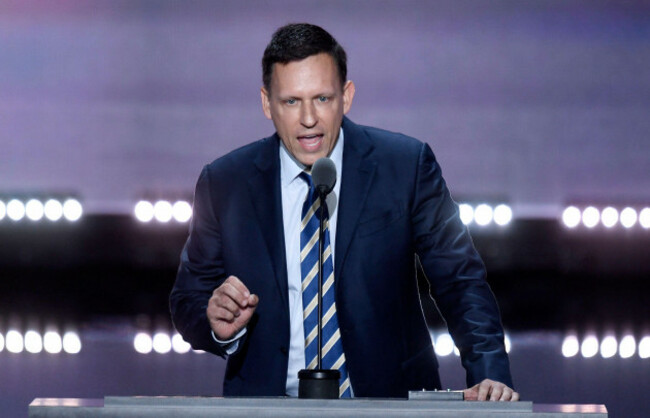
During Trump’s first term, conservative Catholics were pretty much running the White House and the Washington DC legal system. Leo handpicked his three Supreme Court nominees: Neil Gorsuch, Brett Kavanaugh and Amy Coney Barrett. All six of the conservative justices on the Supreme Court are Catholic, although Gorsuch attends an Episcopalian church. Justice Sonia Sotomayor, who was appointed by Obama, is a liberal Catholic. For an up-and-coming Republican, converting could be viewed as a politically savvy move.
What Vance may not have reckoned on was that his nemesis would arrive in the form of an American Pope. Talk about divine intervention. Leo, who is hugely popular in the US, has emerged as one of the Trump administration’s most outspoken critics. Dissing a Pope with approval ratings Vance can only dream of is a tricky business.
And the opposition to Vance’s hardline immigration policies isn’t just coming from Rome. Pope Leo has continued Francis’s systemic replacement of conservative Catholic Cardinals and Archbishops with appointees who are more concerned with social justice issues like immigration rights, climate change and economic equality.
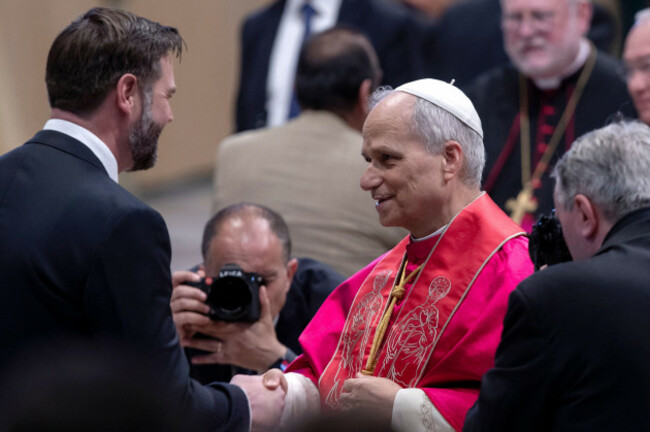
Trump’s great friend, New York Cardinal Tim Dolan was ushered out the door at warp speed last year. Previously, US Cardinals could elect to stay on as long as they choose past retirement age, but Leo dispatched him with a ‘Here’s your mitre and what’s your hurry?’ The new Cardinal of New York danced alongside Mayor Zohran Mamdani during a Knicks victory celebration last week.
The archdioceses of Chicago, San Diego, Newark and Los Angeles are also headed by openly pro-immigrant Cardinals. It’s no coincidence that the new archbishop of Washington DC is one of the most outspoken pro-immigrant rights figures in the US. The Vatican has taken the social justice fight to Vance’s backyard.
References to immigration in ‘Communion’ reveal little of the virulent nativism he peddles for the benefit of the MAGA base. When he writes about immigration policy ‘trade-offs’, he doesn’t reference the estimated 200,000 children whose parents have been deported, nor the thousands who endure horrific conditions in child detention centres. Nor indeed does he repeat his lies about Haitian migrants eating their neighbours’ pets, a claim that prompted swarms of white supremacists to terrorise thousands of Haitians living and working legally in Ohio.
The title of Communion’s first chapter, ‘What’s the Matter With JD Vance?’ invites many alternative theories to the self-serving conclusion proffered by Vance; that he’s too spiritual and smart and sexy for his shirt.
The most perceptive comes from American novelist Joyce Carol Oates. She likens Vance to ‘one of those characters in Dostoyevsky who has been humiliated by life in his youth and seeks out forever afterwards, circumstances that instead of elevating him will humiliate him again; his humiliation then frees the resentment, rage, spite he would otherwise suppress.’
Posting on X, she concludes, “Even if he becomes the next US president, the prediction is the same cycle repeated endlessly.”
Marion McKeone is an award-winning journalist, writer and documentary maker.