





Darach Ó Séaghdha Author and linguist
In Calling 353, a brand-new series for The Journal, bestselling Motherfoclóir author and podcaster Darach Ó Séaghdha casts a linguistic eye on how we talk about what it means to be Irish, the signs we post to each other about Irishness – and what really lies beneath it all.
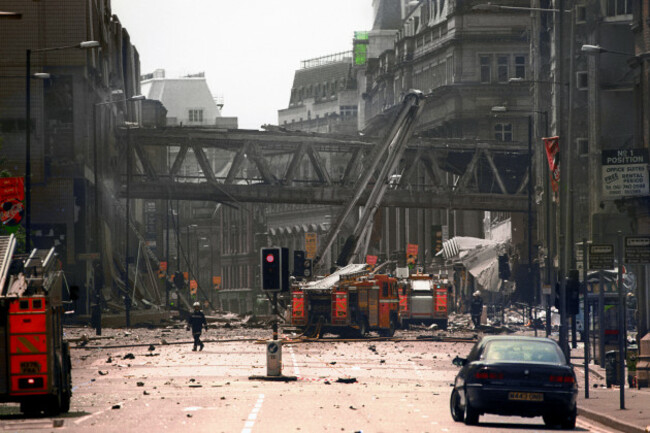
THIS PAST WEEK marked the thirtieth anniversary of the IRA’s bombing of Manchester, the largest payload of explosives to hit Britain since the Luftwaffe.
The 3,300 lb bomb was timed to cause maximum disruption: England was hosting the Euros that year (“it’s coming home” had a double meaning that year, which has since slid from memory) and Manchester was due to host a match between Germany and Russia the next day. The shops around Corporation Street were packed with last-minute shoppers picking things up for Father’s Day.
And yet, despite the size of the bomb and the sheer volume of people in the blast radius, there were no fatalities from the Manchester 1996 bomb. A critical factor in avoiding deaths on the day was that the codeword-based warning system worked well.
It has since been revealed that the codeword in use that day was “Kerrygold”.
Who picks such codewords, and what criteria do they use? You may have had to change a password on a computer recently and been advised by the website that your chosen password is not secure enough. Do codewords for bomb threats face such scrutiny?
A murky business
The business of terrorist organisations sharing verifiable codewords with journalists and police is a murky one. You can understand how someone who wants the terrorists who killed their family member caught and punished might take a dim view of the police having open lines of communication with those terrorists and sharing secret words with them, instead of arresting them.
As it happens, the practice of using a codeword to verify that a bomb threat is real is attributed to the IRA and was subsequently adapted by other similar organisations around the world.
Shane Paul O’Doherty, who was active in the organisation in the 1970s, was unimpressed with the police response to his warnings about a bomb he had planted in Oxford Street. It occurred to him that the London Metropolitan Police probably received a very high volume of hoax and nuisance calls, and decided to take a different approach. He contacted the Press Association and advised them that the codeword “Double X” would be used to warn of upcoming IRA bombs and to prove he wasn’t messing he gave them a very precise description of two small bombs which were to detonate that day. He subsequently advised the IRA Army Council of the codeword.
O’Doherty has since said that “double X” had no meaning, it just sounded dramatic.
The idea was not an immediate success. Some cells considered that knowledge of a code word could be used as proof that a suspect was a member of the IRA, and were reluctant to participate.
But while a system for checking and updating codewords was eventually put in place in England, the larger number of militant organisations in the North – along with the risk of “false flag” warnings and bombings from Loyalist groups – meant that codeword-verified warnings were not as successful there.
According to the UK Independent in 1997, the practice was for a member of the IRA to give a codeword to the gardaí in Dublin. The gardaí would then give this to the RUC Special Branch in Belfast, who would share it carefully with relevant parties in the North and in Britain, including news agencies. This meant that there was usually one active IRA codeword at the time, but multiple codewords from factions could also be in use; any paramilitary group who wanted to lodge a codeword were given a hearing on face value.
If codewords seen like a relic from a different time to you, you might be right. The Los Angeles Times, possibly under the influence of the glamour and drama of their home city, confidently declared in their description of the practice that the IRA liked to use codewords that had deep historical and political significance to their cause, like “Easter Rising”, “Michael Collins” and “Shamrock”.
But if that was true, how did Kerrygold get used? Was Celtic Tiger consumerism already replacing traditional republicanism?
In with mobile phones, out with codewords
Another factor, already at play during the Manchester bombing, would also have a bearing on the use of codewords. Readers over 40 might remember Eircell’s 088 mobile phone service – those big, chunky Motorola phones the size of an extra large burrito – which was still in its infancy in 1996. Mobile phones were easier to trace than landlines at the time, and a trace gave more information, so the Manchester police were able to identify that an Irish mobile phone number was used to give the bomb warning (that mobile phone was probably as big as the bomb itself). And this traceability may have mitigated the need for codewords at all.
War in general creates surreal situations and bitter ironies, like the entire premise of Catch 22. And who could forget the line, “Gentleman, you can’t fight in here, this is the war room” from Doctor Strangelove? The Troubles had more than its fair share of this dark surrealism and bitter irony. For example, you may have seen a short film called The Ban looked into the practice of actors dubbing over Gerry Adams’s voice in news interviews (one of the actors was the “on file in a filing cabinet” guy from the Donegal Catch ad).
Likewise, the volume of codewords from fringe paramilitary groups caused its own problems, especially when one obscure Loyalist group insisted on using increasingly provocative codewords until they were told “Fuck The Pope” would not be acceptable and they should come up with another.
Darach will be back next Sunday with more thoughts on the words and Irish cultural phenomena that unite us.