


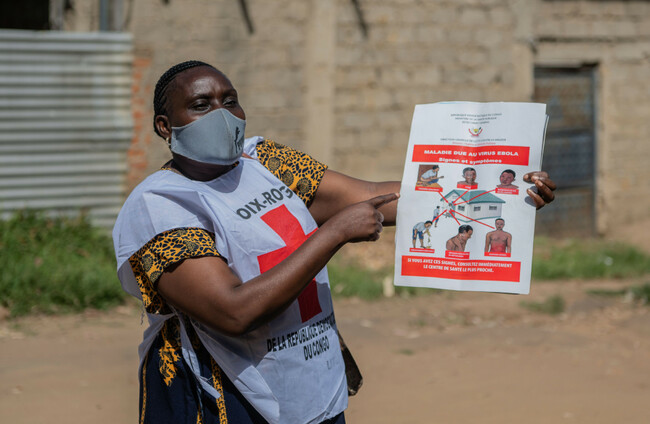
THE HEAD OF the World Health Organisation (WHO) has warned that the Ebola outbreak in the Democratic Republic of Congo is “outpacing us” and will “get worse before ii gets better”.
Ebola is a deadly viral disease that spreads through direct contact with bodily fluids. It can cause severe bleeding and organ failure.
Democratic Republic of Congo (DRC) declared an outbreak on 15 May caused by the Bundibugyo strain, which has no approved vaccine or treatments.
So far, 101 cases have been confirmed in DRC, with 10 confirmed deaths.
However, there are now more than 900 suspected cases and 220 suspected deaths and the director-general of the WHO, Dr Tedros Ghebreyesus, warned that the “epidemic in DRC is much larger”.
On 17 May, the WHO declared the Ebola outbreak in DRC a public health emergency of international concern.
However, Ghebreyesus today warned that the “outbreak is spreading rapidly”.
He said a delay in detecting the outbreak “means that we are now playing catch-up with a very fast-moving epidemic”.
While he said the WHO is scaling up operations, he added that the “epidemic is outpacing us”.
“We are facing an extremely serious and difficult outbreak,” said Ghebreyesus.
“It will get worse before it gets better.”
However, Ghebreyesus added that “we know how to stop it”.
“We have stopped every previous Ebola outbreak, and we will stop this one too.
“The question is just how quickly we can do it, and how many more lives will be lost before we do.
“We will not rest until we bring this outbreak under control.”
Last week, the WHO upgraded its risk assessment from high to very high at the national level.
For Irish citizens, a Do Not Travel notice is in place in relation to DRC, which is the highest level of warning.
Irish citizens are urged not to travel to DRC and those already there are encouraged to consider leaving if it is safe to do so.
Ghebreyesus added that that countries bordering DRC are at “especially high risk and should take immediate action”.
In Uganda, there are five confirmed cases and one death.
Ghebreyesus praised Uganda’s president for cancelling the Martyrs’ Day commemoration, which can attract up to two million people.
The risk level globally is deemed to be low.
The WHO has released $3.9 million from its Contingency Fund for Emergencies.
‘Especially challenging’
Ghebreyesus added that there are “several aspects of this outbreak that make it especially challenging”.
Ghebreyesus also noted that the provinces hit by the outbreak are “highly insecure, with intensified fighting in recent months, causing more than 100 000 people to be newly displaced”.
He also pointed to “significant distrust of outside authorities among the local population” and noted that there have been two security incidents at health facilities in the past week.
Meanwhile, Ghebreyesus noted that there are no approved vaccines or therapeutics for Bundibugyo virus.
There have only been two previous outbreaks of Bundibugyo, in Uganda in 2007 and DRC in 2012.
Last week, WHO reviewed the pipeline of vaccines, therapeutics and diagnostics and recommended prioritising two monoclonal antibodies to advance in clinical trials.
“We are also discussing with partners candidate vaccines in the development and manufacturing pipeline,” added Ghebreyesus.