
惯性聚合 高效追踪和阅读你感兴趣的博客、新闻、科技资讯
阅读原文 在惯性聚合中打开

推荐订阅源

V
V2EX
爱范儿
爱范儿
Martin Fowler
Martin Fowler
T
The Blog of Author Tim Ferriss
B
Blog RSS Feed
博客园 - 聂微东
G
GRAHAM CLULEY
Engineering at Meta
Engineering at Meta
Threat Intelligence Blog | Flashpoint
WordPress大学
WordPress大学
Scott Helme
Scott Helme
AI
AI
S
Security Affairs
T
Threat Research - Cisco Blogs
M
MIT News - Artificial intelligence
T
Troy Hunt's Blog
H
Hackread – Cybersecurity News, Data Breaches, AI and More
人人都是产品经理
人人都是产品经理
AWS News Blog
AWS News Blog
T
Threatpost
Cyberwarzone
Cyberwarzone
www.infosecurity-magazine.com
U
Unit 42
V
Vulnerabilities – Threatpost
J
Java Code Geeks
博客园 - Franky
月光博客
月光博客
Blog — PlanetScale
Blog — PlanetScale
NISL@THU
NISL@THU
D
Docker
小众软件
小众软件
N
News and Events Feed by Topic
Microsoft Security Blog
Y
Y Combinator Blog
A
Arctic Wolf
D
DataBreaches.Net
云风的 BLOG
云风的 BLOG
Forbes - Security
Forbes - Security
量子位
PCI Perspectives
PCI Perspectives
美团技术团队
K
KPMG report finds enterprise disconnect between AI and its ROI | CIO
I
InfoQ
Security Archives - TechRepublic
有赞技术团队
有赞技术团队
腾讯CDC
P
Proofpoint News Feed
S
Security @ Cisco Blogs
G
Google Developers Blog
C
Cisco Blogs

TheJournal.ie

Court told Eleanor Donaldson placed bugging device in her husband’s car over fears of affair TD says she's been left with 20cm scar after skin cancer diagnosis Homelessness: Record number in emergency accommodation, including new high for children Blue Origin rocket explodes during test launch Uber app now allows passengers to audio record their journey if they feel unsafe John Gibbons: The planet is burning, but Ireland still isn't taking climate change seriously 'Truly devastating': Tributes paid to Masuma Sohrabi after stabbing in Clifden Mother and carer: You don't appreciate public services until your child needs them to survive Left or right? Sinn Féin's fence-sitting may be about playing the long game Gavan Reilly: Gerry Hutch and his 30% vote in Dublin Central's best-heeled area Gavan Reilly: The Gerry Hutch 37.1% share of the vote in the shadow of the IFSC Ebola on the rise: Why the latest outbreak should concern all of us Ireland's data centre energy drain: How Big Tech added €1.4bn to household electricity bills Living with myeloma: 'I chose not to fight this blood cancer, but to instead live alongside it' Alberta’s separation bid: How Canada’s next political crisis could come from within Kelly Earley: Militarism might be Ireland’s next economic disaster Raising them right: Ireland has a dog poo problem, and we parents are sick of stepping in it Money Diaries: A recently graduated digital journalist on €35K living in Dublin Global tech job losses: Is ‘AI-washing’ the new trend nobody wants to call out? Down on the farm with a difference: This is what happens when animals are allowed to feel safe Surrealing in the Years: Some shameful Irish attitudes take a leaf out of Israel's book Motoring: Should we trust self-driving cars? The physio is in: Ireland is growing older, but are we moving enough to age well? Tech dubbed 'creepy': AI smart glasses are here, but our privacy laws have not caught up Larry Donnelly: The polls point one way for Friday but byelections rarely follow the script The war on human thought: Educational institutions must take back control from AI The Bee Guy: World Bee Day won't save our little bee friends Kelly Earley: Could Mountjoy Square be Dublin’s most important park? Money Diaries: How is your spending and saving going? Would you like to keep a diary for us? Rearing them right: Should modern parents bring back ‘the man’? Ireland's energy future: What if the real failure here is that we stopped thinking bigger? Barry Cummins: I shudder to think I sat in Tina Satchwell’s home while her body lay buried there Richard Boyd Barrett: Sanction Israel now, the way we did Russia An Spidéal in a byelection: We're caught between dereliction, development and a lack of vision Growing old disgracefully: The older I get, the more I understand my granny Surrealing in the Years: How is Bertie Ahern still finding new ways to disappoint us? Drink-driving: If your chance of being caught is 1 in 77, where is the deterrent? Navigating an uncertain world: The adults are panicking, but the kids are alright Lynn Ruane: The evidence clearly shows that the 'war on drugs' was a failed experiment The Bezos Ball: This year's Met Gala sold its soul to billionaires, did anyone notice? Life on the road: Our shared MS diagnoses forced us to finally start living How are you dealing with the cost of living? Would you like to keep a Money Diary for us? Kelly Earley: Should we scrap HAP? Ireland urgently needs an alternative Loss of a parent: I spent 50 years preparing for my father's death, but it still came as a shock Body of Evidence: Why your body starts storing fat in your 50s — and how it affects your brain Hear me out: Every new school building site should also be a classroom Money Diaries: A software engineer on €100K living in Dublin Life with a stoma: My worst nightmare became a reality, but this has given me my life back Summer festival supports: At PsyCare, we aim to be the calm in the chaos Surrealing in the Years: Come on guys, we don't have it in the locker to pull off nuclear energy Car love: I have that strange affliction of seeing cars as having personalities and souls David Attenborough turns 100: He brought the natural world into focus for us, we owe him so much Leavitt steps away, DJ Rubio wings it: Trump’s White House looks increasingly chaotic Time to act: Animal cruelty still happens every day in Ireland – our laws must catch up The housing crisis: Like wildfire, we need to abandon the delusion it’ll burn itself out United Ireland: On the contrary, Northern Ireland is not a burden, it brings fresh opportunities Dr Catherine Conlon: Hantavirus at sea triggers a global health response — what is this virus? Ireland, an electrostate: 100 years after Ardnacrusha, we now face the same energy challenges Good Vibrations: The Cork choir helping cancer survivors to reclaim their voice Money Diaries: An apprentice mechanic on €22K living in the Midlands Opinion: Women over 40 have been sidelined for too long. Now we push back Neurodivergence: The phrases people with ADHD are tired of hearing Surrealing in the Years: I'm not a government minister and AI didn't help me write this article The people carrier: Why have they almost disappeared from Irish roads? AI not so ready: The government's new tech literacy platform needs some improvement From Gaza to Iran: Israel's regional conflict expands with little accountability Stephen's Green Shopping Centre: Jaded Dubliners have had enough of bland, soulless buildings Noeline Blackwell: Character witnesses expose a legal system that fails victims Minister for nature: We need to work together to protect against biodiversity loss Kelly Earley: Don’t fall for the idea that Dublin is dangerous Irishwoman living abroad: Like many of my generation, the 'bailout babies', I chose emigration Gender-based violence: It’s time to recognise survivors as experts by experience Money Diaries: A compliance officer on €45K living in the Midlands Blood donation: Ireland's stocks are a lifeline for patients, but the system is under strain An Irish conundrum: Why do 125 people a year buy a convertible in this country? When morality becomes law: The parallels between modern oppressive Iran and Ireland’s past Surrealing in the Years: Housing plans will have us living like Bosco, if Bosco had roommates Fail to prepare: Recent fuel protests have exposed Ireland’s lack of future climate planning Larry Donnelly back from Boston: The recent fuel protests have struck a chord in Irish America Caroline Foran's new book: I wish I'd known sooner that self-compassion changes everything The Spring Economic Statement: Ireland is no longer forecasting the future, it’s bracing for it Soccer academies: Football can unite Ireland, but the hard work to build its future starts here The physio is in: The rise of fitness wearables is changing how and why we move Pirate queens, powerbrokers & public servants: Anne Chambers on her life as an Irish biographer Dublin's screen-free school: We have no tablets, no screens and no regrets Money Diaries: A man receiving invalidity pension living in the west of the country Office vacancy rates: Dublin's busy office market isn't broken, the interpretation of data is The money dial: How we manage our finances best to protect what we care about the most Opinion: Carbon tax may be the tax we love to hate, but it's the one we can't afford to scrap From Idaho to Ireland: I chose to leave the US behind, and now I love my new home Maria Walsh: Hungary's election result shows the centre can still hold in Europe Opinion: With a 'looksmaxxing' influencer rushed to hospital, is the war on ageing getting ugly? Opinion: The protests aren't just about fuel, they're a revolt against a hollow state The Pontiff vs the President: Trump, Pope Leo and the Catholic contradiction Harm reduction drugs policy: Compassion for some cannot become a risk to all Women and the Catholic Church: Reform has long been promised, but real change has been denied Motoring: How we can all get a bit more from our fuel Surrealing in the Years: 'Fuel protests' are bad news for a society that's given up on nuance Some very creative accounting was needed to greenlight the Galway ring road It's his menu, not ours: Let's not rush to criticise Rory McIlroy's choice of dinner
Labour's long knives: Starmer may be weak, but his opponents are not strong
2026-05-14 · via TheJournal.ie

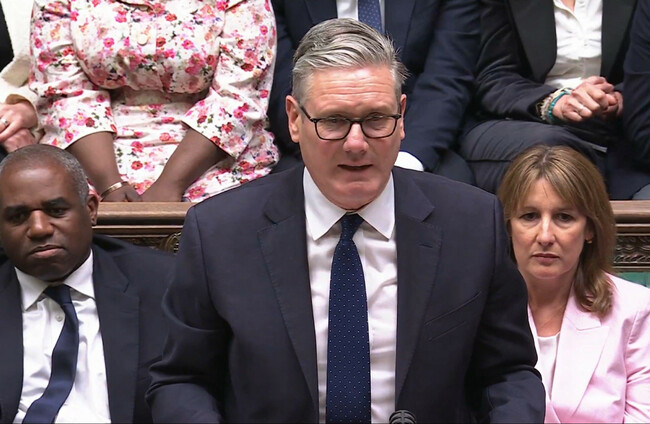
Keir Starmer during the debate on the King's Speech in the House of Commons, London, after the State Opening of Parliament. Wednesday. Alamy Stock Photo

Keir Today Gone Tomorrow

British PM Keir Starmer’s authority has steadily collapsed this week, but a change of leader may do little to stop Labour’s deeper electoral decline, writes Sydney Nash.

THE VOTES ARE in, and no one likes Keir Starmer. At least, that’s the conclusion being drawn from last week’s elections in England, Scotland and Wales.

At a purely technical level, Starmer was not on the ballot, but that did not stop Nigel Farage and his team from using the slogan “Vote Reform, Get Starmer Out”.

The events of the past week would suggest that that message was bang on the money.
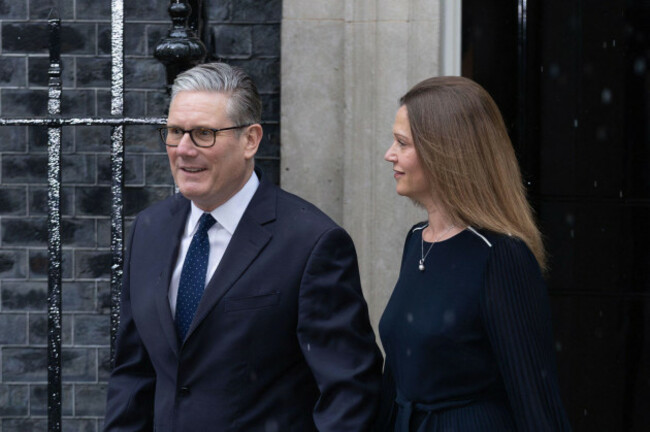
london-england-uk-13th-may-2026-uk-prime-minister-keir-starmer-l-and-his-wife-victoria-starmer-depart-10-downing-street-to-attend-the-state-opening-of-parliament-in-london-credit-image Starmer and his wife Victoria depart 10 Downing Street to attend the State Opening of Parliament in London on Wednesday. Alamy Stock Photo Alamy Stock Photo

Last Thursday, Reform hoovered up votes by the thousand. In England, they gained 1,452 council seats. Labour lost 1,498. In Wales, Reform won 34 seats, having previously had none.

Labour limped home with nine, having previously been the government. Reform even grew its vote share in Scotland, winning 17 seats, giving it the same representation in Edinburgh as Labour.

Labour’s electoral pain was not inflicted by Reform alone – the Greens, Plaid Cymru, Liberal Democrats, and Scottish National Party (SNP) all significantly contributed to Labour’s collapse.
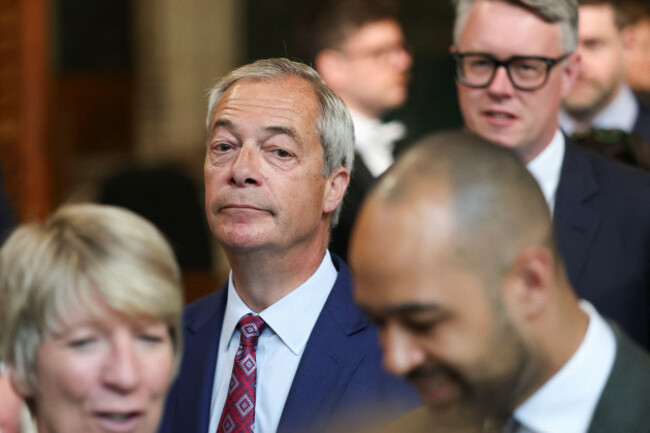
reform-uk-leader-nigel-farage-walks-through-the-members-lobby-of-the-houses-of-parliament-in-london-to-the-house-of-lords-to-hear-the-kings-speech-during-the-state-opening-of-parliament-picture-dat Nigel Farage's Reform Party has caused ripples in UK politics in recent weeks. Alamy Stock Photo Alamy Stock Photo

Despite this, a significant number of senior Labour figures seem to have read Reform’s slogan as a prophecy and are now focusing their time on trying to make it come true.

The calls for Starmer to resign began long before the elections. Anas Sarwar, Leader of the Labour Party in Scotland, sensing that Starmer was a drag on his own electoral prospects, called on him to step down in February. Back then, the Cabinet rallied behind Starmer. No longer.

Mutterings of a heave

On Monday, Home Secretary Shababa Mahmood told Starmer to resign. A day later, the stakes were raised. Four ministers – Miatta Fahnbulleh, Jess Philips, Alex Davies-Jones and Zubir Ahmed – joined calls for Starmer to resign and quit their jobs as well, for good measure.

Five Parliamentary Private Secretaries have also resigned, and at the time of writing, more than 80 Labour MPs had publicly called on Starmer to stand aside and make way for a new Labour leader and a new prime minister.

All of this has a strikingly familiar feel to it. It is less than four years since Boris Johnson faced a series of resignations, which ultimately led him to quit. In July 2022, Johnson suffered the indignity of more than 30 ministers and aides resigning in less than 24 hours.

file-this-photo-combination-shows-from-left-wes-streeting-in-liverpool-sept-30-2025-angela-rayner-in-shoreditch-london-june-5-2025-andy-burnham-in-liverpool-sept-29-2025-shabana-mahmoo Wes Streeting, Angela Rayner, Andy Burnham, Shabana Mahmood and Ed Miliband. Alamy Stock Photo Alamy Stock Photo

Starmer is not facing this level of disloyalty yet, but just like Johnson, he is deeply unpopular, mired in scandal (the appointment of Peter Mandelson as ambassador to the US for Starmer, the Owen Paterson, Chris Pincher and Partygate scandals for Johnson), and has taken a kicking at the local elections.

For Starmer, all of this is happening just 22 months after he won an enormous majority. For Johnson, the demise came only 19 months after he had won his own.

The similarities are so stark that it can feel as if the United Kingdom is living politics on repeat.

Could Starmer survive?

If that is the case, Labour politicians should reflect carefully on what happened to the Conservatives after Johnson was ousted. Some are doing this, and it is causing them to pause in fear of a leadership contest leading to chaos, not a reversal in electoral fortunes. 

Meanwhile, Starmer is digging in. Even though his appointment of Gordon Brown and Harriet Harman to newly created roles was met with bemusement, his reset speech on Monday was viewed as underwhelming, and the King’s Speech was overshadowed by leadership challengers coming to Downing Street, Starmer remains bullish and says he has no intention of resigning. This might come across as wishful thinking, but there is reason to believe that Starmer might be able to hang on, at least for now. 
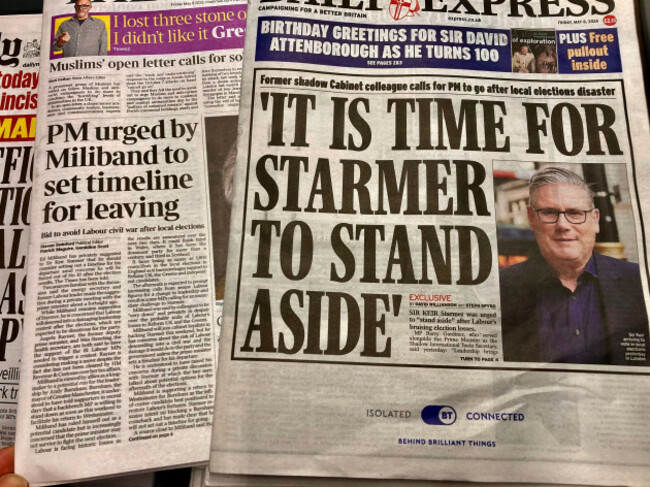
british-newspaper-widely-report-keir-starmer-was-urged-to-stand-aside-after-labour-lost-in-2026-may-local-election British newspaper widely report Keir Starmer was urged to stand aside after Labour lost in 2026 May local election Alamy Stock Photo Alamy Stock Photo

If Starmer’s opponents want to get rid of him, 81 MPs must back one specific challenger before a leadership election can be triggered. This would be a difficult hurdle to overcome under any circumstances, but the lack of consensus amongst Labour MPs regarding who they want to replace Starmer makes it even more challenging.

Furthermore, 111 MPs have now signed a statement opposing a leadership contest, while the bookmakers’ favourite to replace Starmer, Mayor of Manchester Andy Burnham, cannot be Labour leader, let alone PM since he is not even an MP. Starmer is undoubtedly weak, but his opponents are not overwhelmingly strong.

Given this, don’t be surprised if weeks and maybe even months pass with Starmer still occupying Number 10. If that does happen, we can expect further attempts at a government reset, most probably at the Labour Party conference in September.

Recent evidence suggests that such attempts will fail, in which case, the news will be dominated by the list of challengers who will continue to sit in the wings, waiting to topple Starmer. However, if they wait too long, they will quickly find themselves facing an electoral Groundhog Day when the UK next goes to the polls in May 2027.

Who wins?

If Starmer does go, the Labour Party will have solved the problem of having him as its leader. However, this may not be enough for them to solve the problem of how Labour survives in a new age of electoral politics.

For at least the last decade, British politics has been undergoing a grinding and often dramatic restructuring. The origins of this can be found in the aftermath of the 2008 financial crash, which led many to conclude that the system was fundamentally broken. However, it was not until the 2016 Brexit referendum that the new divide in British politics was revealed.
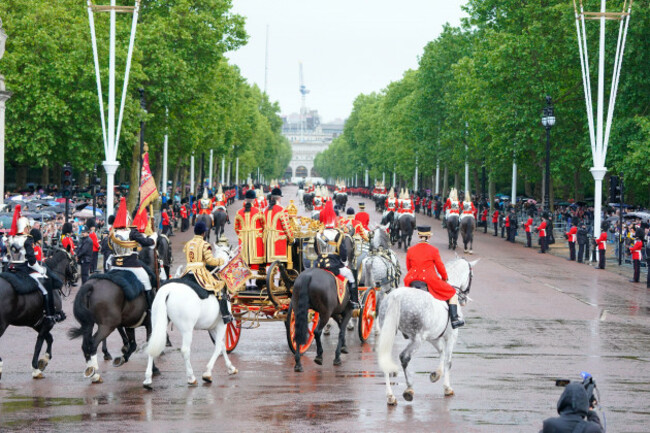
london-uk-13th-may-2026-king-charles-iii-and-queen-camilla-depart-buckingham-palace-in-the-irish-state-coach-en-route-to-the-palace-of-westminster-for-the-state-opening-of-parliament-where-the-ki Britain's King Charles and Queen Camilla depart Buckingham Palace for the Palace of Westminster for the State Opening of Parliament, where the King delivered his King’s Speech on Wednesday. Alamy Stock Photo Alamy Stock Photo

What was expressed as leave vs. remain then has since been variously described as open vs. closed, nativist vs. internationalist, somewheres vs. nowheres, and haves vs. have nots. However, it is imperfectly labelled; this is the divide that now runs through British politics, and it is forcing every political party to respond.

This is easier for some than it is for others. Reform, the Liberal Democrats, the Green Party, Plaid Cymru and the SNP all sit comfortably on one side or the other of this divide, and they are increasingly able to reap the rewards at the ballot box, just as they did last week. Labour, like the Conservatives, appears to be stuck, simultaneously on both sides of the divide and on neither.

The problem for Labour is not just that it has an unpopular leader (although this certainly doesn’t help) but that the structural changes in British politics risk making it appear irrelevant in the eyes of voters. Addressing this will require Labour to completely reinvent itself.

This is an enormous challenge, and the temptation will be to avoid the difficult questions, the arguments and the trade-offs, convince oneself that only Starmer was the problem, and hope that all that is needed to change Labour’s electoral fortunes is to get rid of him. It won’t be.

Changing leaders will only change Labour’s electoral fortunes if a new leader has the vision, capability, charisma and energy required to carry their party through this reinvention whilst simultaneously running the government.

Whether or not such a leader exists within Labour’s ranks remains to be seen.

Sydney Nash is a former civil servant, UK/EU negotiator, and advisor on Brexit and international trade. He writes in a personal capacity and can be found on Substack @nashsgc.

Readers like you are keeping these stories free for everyone...

A mix of advertising and supporting contributions helps keep paywalls away from valuable information like this article. Over 5,000 readers like you have already stepped up and support us with a monthly payment or a once-off donation.