


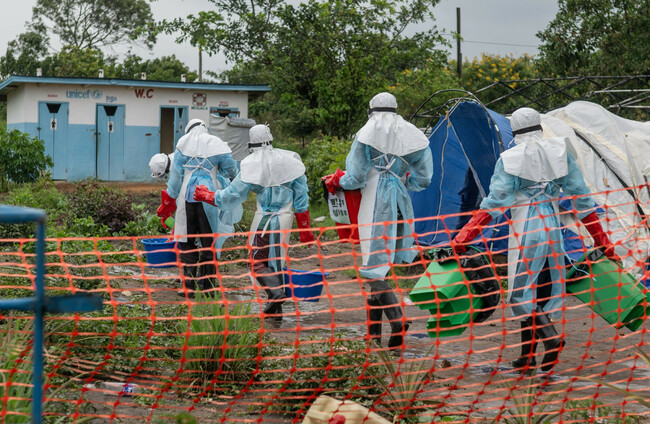
EVE ROBINSON WAS supposed to be coming home to Ireland next week from the Democratic Republic of the Congo, but that changed when a fresh outbreak of the deadly Ebola virus was reported in the central African Country.
An epidemiologist from Drogheda in Co Louth, Robinson had been covering for a colleague while they completed a research project.
Stationed in the city of Goma in the DRC for the last seven weeks, she has been working with the medical NGO Doctors Without Borders (MSF) as health officials have tried to battle the country’s 17th Ebola outbreak.
Robinson said that because of the latest health emergency there, she has decided to stay another two weeks in the DRC.
The strain of Ebola in this latest outbreak, caused by the Bundibugyo virus, has no treatment or vaccine and is different from the more common Zaire form of the virus.
To make things worse, there are a number of factors that make the DRC a difficult place for health workers to combat and monitor the spread of the outbreak, most of all the fact that some areas of the country are under the control of armed groups opposed to the government.
According to MSF and international health bodies like the UN’s World Health Organization, the full scale of the outbreak is not yet known, and Robinson said it would take “a few weeks” before the full picture becomes clear.
Despite the challenges posed by the fractured governance landscape, “MSF is in a good position because it was already active in areas controlled by armed groups”, she said.
Robinson said that the leaders of these groups have all committed to cooperating and reporting cases and that while recent conflicts have not limited her colleagues’ work so far, they are still “likely to pose some difficulties”.
The roads in the north-east of the country, where the first cases were reported in the Ituri province, are dotted with checkpoints that limit movement.
Another challenge for health workers is garnering public trust.
“Fear and suspicion and tension is always high during outbreaks,” Robinson said.
“It is really important to work with communities and build trust,” she said.
“Overall it’s very scary for people to see people brought into isolation centres,” she said, adding that “some people will die and their loved ones won’t see them again”.
She also noted that “funeral rituals are really important in this part of the world”, which poses another challenge because the bodies of infected people need to be buried in a controlled way to avoid the spread of infection.
This week, people angered after doctors refused to hand over the body of a man who died from Ebola in the DRC set fire to tents at a health facility.
Police fired warning shots and tear gas to disperse the crowds.
Rumours and misinformation about the disease are a persistent problem during outbreaks of Ebola in the DRC. Some people believe Ebola is fabricated while there are also level of mistrust among the population when it comes to international NGOs.
With deadly diseases spreading and conflict still affecting parts of the country, The Journal asked Robinson if her friends and family worry about her safety.
She said her parents are naturally worried, but it’s also not her first time doing this work – she has worked with MSF on and off for years.
Robinson was also keen to stress that the work of doctors is not limited to the latest Ebola outbreak as the DRC is also currently dealing with Cholera and malnutrition among other things.
This is why, she said, “it’s really important not to forget all the other things happening” and to continue to maintain other services at the same time.