



Niall O'Connor
THE ATTORNEY GENERAL has called into question whether it would be lawful for foreign military personnel who may be deployed to help defend Ireland during the upcoming presidency to take action against any perceived threat.
The Journal has learned that a high level meeting took place in recent days between senior security officials from government departments, the Irish Defence Forces and An Garda Síochána.
It comes ahead of the start of the six-month presidency period, which kicks off next Wednesday with a high-profile event at Dublin Castle.
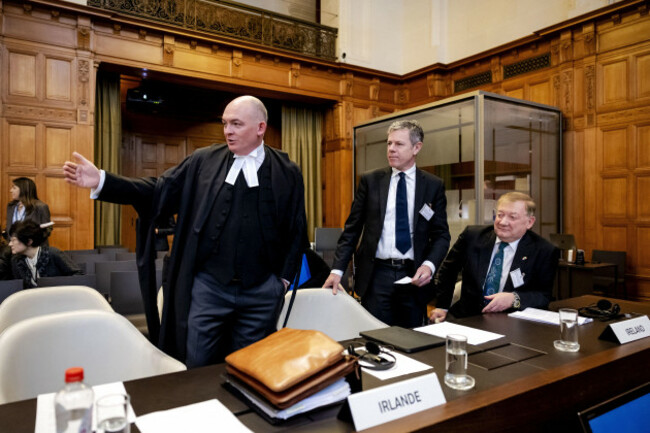
Attorney General Rossa Fanning attended the meeting between the agencies to give advice about the lawfulness, particularly from a constitutional perspective, on the use of foreign military forces to help Ireland.
Sources with knowledge of the meeting said the contribution of Fanning, the primary legal adviser to the government, was a point of tension with senior figures from the state’s security agencies.
Sources said the legal stumbling block is an Irish constitutional issue. Article 15.6 allows only the Oireachtas to raise a military or armed force. In other words only an army created by the vote of the Oireachtas can operate in Ireland.
The key issue is around Rules of Engagement – the protocols governs when force can be used and the degree of the force.
The issue was well-known throughout the preparations for the presidency to date.
It’s understood the renewed frustrations stem from the fact that it had been hoped the issue could have been resolved by now, so that it was clear how all parties should operate should a threat arise.
Rules of engagement
There are concerns the government would be able to prevent an incident similar to the one that occurred last December, when four unidentified military-style drones flew towards the flight path of Ukrainian president Volodymyr Zelenskyy’s plane after it landed in Dublin.
Ireland still does not have its own military radar detection or air defence capability.
Sources said the solution to the air defence problem was the deploying of foreign naval ships near locations that high profile summits are due to take place.
While the plan is at the highest level of secrecy it was also being examined that foreign military personnel could be deployed to work with the Irish Defence Forces to secure high-profile events.
It is understood the operational planning for Operation White Weaving, the name for the security mission to secure the Presidency, is being handled by An Garda Síochána.
On the picket
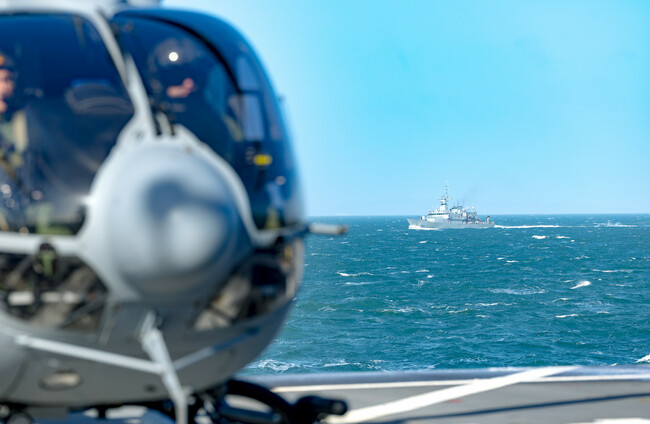
Sources with knowledge of the planning process said at least one ship, understood to be French, would act as a so-called air defence radar picket.
This is a military concept whereby the ship’s sensors are positioned in a way to pick up all airborne traffic – threats and civilian traffic alike.
This capability is far ahead of anything Ireland has – at present the State depends on civilian radar which really only picks up aircraft which are broadcasting on transponders.
The foreign military radar equipment would also be able to pick up aircraft much further out and far higher.
Ireland also does not have air defence missile batteries sufficient to handle incoming air threats if the worst case scenario develops.
The problems arise if the foreign ship’s crew identify a threat and then decide to shoot it down (in that any decision taken by the crew to take military action could also place that crew in conflict with the Irish constitution).
One solution considered was that the ship would stay outside of Irish territorial waters, which extend 12 nautical miles offshore. But again, if they have to engage a target within Irish territorial waters and airspace this would then cause a significant legal problem for the State.
Drone threat
The assessment is that potential threats could come from drones or rogue aircraft.
The drone threat is assessed as potentially coming from land-launched drones – controlled either by sophisticated operators or by amateur troublemakers. There is also a concern that the drones would be launched off a so-called mothership offshore.
These examples would fit the profile of what happened during the Zelenskyy incursion when the drones flew out to the 12-mile limit from inside the Irish territorial area, and flew above a naval vessel.
As one well-placed source put it: “It may become a question of self-defence for the foreign ship and they will react”.
Foreign help to EU summits
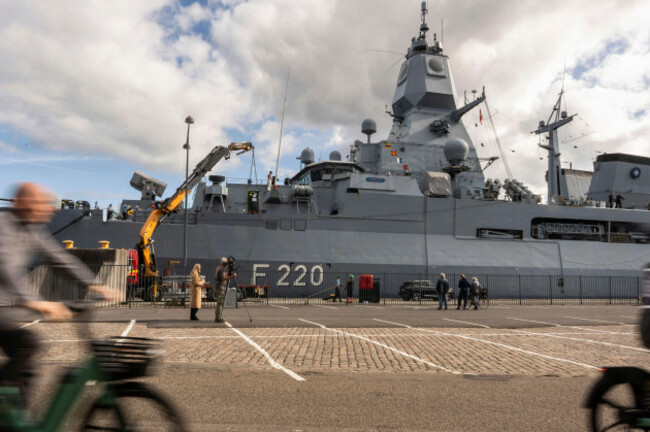
In September 2025 France, Germany, Finland and Sweden sent military personnel to Denmark to assist in the security operation surrounding European summits because of the drone threat.
A German frigate was also sent to the city to act as an air defence picket. Similar operations also took place during Cyprus’ holding of the EU Council Presidency.
Recently, at the Munich Security Conference, The Journal observed police and military personnel from outside of Germany working with German security services to secure the event.
A source also said that the recent G7 summit in Évian, France required a massive security operation. There were 21,000 troops and police with fighter jets and defence radars and batteries as well counter drone equipment.
One source said French authorities liaised closely with their neutral Swiss counterparts as Évian is located on the France/Switzerland border. Similar offers of support would have been offered to Ireland in advance of the presidency, one well-placed source said.
There is a well-known or supposedly secret deal between Ireland and Britain about use of Irish airspace by the Royal Air Force.
The Department of the Taoiseach, the Department of Defence and the Irish Defence Forces were asked for statements but had not responded by time of publication.
An Garda Síochána said: “An Garda Síochána does not comment on such matters.”
Gardaí have obtained small scale short range counter-drone equipment in advance of the presidency and have been receiving training in Portugal and other locations. Armed Support Unit and Emergency Response Unit armed gardaí have been trained also.
The Irish Defence Forces have secured counter-drone equipment from France which will be used in Casement Aerodrome in Baldonnell. More than 30 personnel have been receiving training on the kit.
Irish Air Corps helicopter crews have also been training on how to shoot down drones using a machine gun on their aircraft. PC-9 aircraft have been training in intercepting aircraft also but sources said their use is limited to slow moving planes.
As revealed by The Journal foreign police forces from Portugal, France and the PSNI were deployed to work on anti-drone equipment in Dublin city centre during the Zelenskyy visit. There is no evidence of foreign military involvement in that operation.