


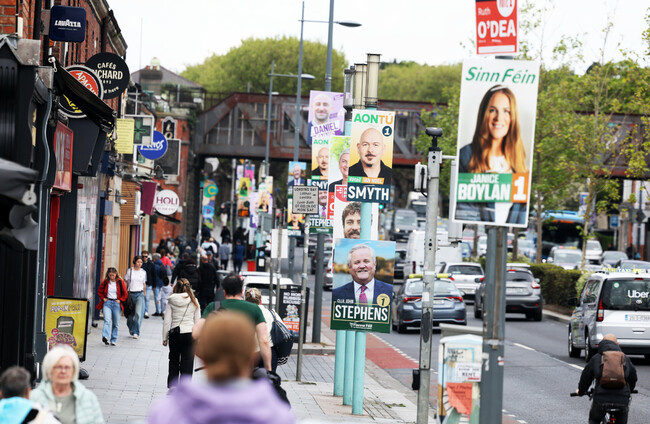
ELECTION POSTERS SHOULD not be banned outright, but their size should be limited and legislation governing their use should be more strongly enforced, the Electoral Commission has said.
In a series of recommendations released today, An Coimisiún Toghchái said that while election posters play an important part in public engagement with the electoral process, there needs to be stricter enforcement of existing rules and more consideration of environmental concerns.
It also noted the numerous environmental and public safety issued connected with the use of posters. To counter this, the Commission recommended that the “permitted shape and size of posters should be limited to reduce the amount of waste and environmental damage they cause.
Ireland is one of the places in the world where posters are most used, and while they used to feature more issue-based messaging, posters nowadays can often just feature the face and name of a candidate and party.
Art O’Leary, Chief Executive of An Coimisiún Toghcháin said: “Election posters have long been part of the landscape of Irish democracy.
“Democracy does not stand still. It evolves to meet the expectations of each generation.
“Our challenge is to preserve the elements of our electoral tradition that continue to serve voters, while ensuring that campaigning is safe, sustainable and respectful of the public spaces we all share.
The recommendations we publish today seek to strike that balance.”
An Coimisiún was asked by government in July 2023 to examine the use of posters at elections, and last March, launched a public consultation on whether campaign posters should be banned.
The report by DCU released today, commissioned by An Coimisiún Toghchái, found that 59% of people surveyed said that posters were key to their awareness of the presidential election last year, with the report saying that posters work through “incidental exposure”, where people unknowingly and subconsciously learn about candidates and elections without directly seeking out the information.
Election posters can be less important in high-profile elections such as the presidential election, with those surveyed suggesting that posters may be important in raising visibility for by-elections.
But while posters may remain key to the visibility of election campaigns, the environmental consequences are significant.
During one general election cycle, the use of posters can produce as many emissions as a plane-full of passengers making two return flights from Dublin to New York.
In the 1,014 responses to the public consultation, environmental concerns that emerged related to waste and litter generated by posters, as well as harm to the surrounding landscape.
Many posters are made of plastic, and one respondent wrote: “Parties should be encouraged to find biodegradable solutions and there are solutions out there.”
The report also estimated that around 280,000 posters were made for the 2024 general election, accounting for almost one-third of all election expenses logged with the Standards in Public Office.
Politicians interviewed by the Commission were aware of the environmental impact of posters, but tried to justify their continued use.
One councillor said that while the use of posters was “really not great”, they are a “small sacrifice in terms of what [he] could do for the environment having been elected”.
The Commission recommended stricter enforcement of existing rules, clarity on responsibility for monitoring compliance, limited poster sizes, and improved facilities for their disposal and recycling post-election.
On the limiting of size, the commission said that this should be introduced “on a phased and gradual approach to allow the reuse of existing poster stock”.