


ANOTHER ONE BITES the dust.
This week marks ten years since the UK voted for Brexit and fittingly there is another prime ministerial resignation to mark the occasion.
Keir Starmer today became the sixth departure from 10 Downing Street in that time. David Cameron started the trend the morning after the Brexit vote.
As it stands Starmer is less than two years in office, so his stint will be comfortably shorter than either Boris Johnson and Theresa May, with only the historical quiz question that is Liz Truss shorter among that decade.
Starmer has been PM longer than Rishi Sunak, but Sunak wasn’t forced to resign and was instead dumped by the electorate.
In the case of Starmer though, he didn’t crash spark an economic crisis like Truss, so how has it come to pass that he was forced out despite a huge majority in parliament and three years before another general election was required?
The short answer is that Starmer is unpopular to a degree that is unmatched in recent British history and his party is refusing to shoulder that burden any longer.
By various measures, Starmer is standing down as the country’s most unpopular prime minister in decades.
In YouGov polling from last month, just 23% of Britons view Starmer favourably, while 69% view him unfavourably, giving him a net favourability rating of -46.
Asked if he has been a good prime minister or a bad one, just 11% of people gave Starmer a measure of positivity. These numbers are toxic and have proven to be somewhat irreversible.
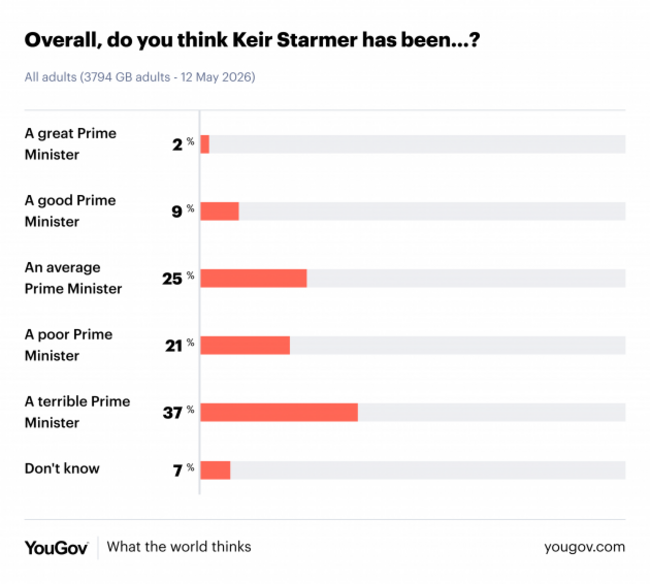
These figures have been shown in more than just polling, with Labour cratering in local elections in England and parliamentary ones in Scotland and Wales in May.
Those electoral results ultimately got the ball rolling on Starmer’s eventual departure, prompting Labour’s mayor of Manchester Andy Burnham to seek a return to parliament to give him the platform to challenge Starmer.
Burnham won a hastily-called byelection handily last week and is now the presumptive next Labour leader and UK prime minister.
According to some who spoke to The Journal in Makerfield ahead of that byelection, their motivation in voting for Burnham was explicitly to “get Starmer out” of Downing Street.
The fact that Starmer’s unpopularity was a factor in electing a party colleague to parliament to succeed him shows just how unusual the situation is, but how did it come to pass that Starmer is so unusually disliked?
Road to ruin
The general view on Starmer’s premiership is that he failed to outline a clear vision of what he was for, while simultaneously making a series of poor decisions that reflected badly on him.
As one Labour voter told YouGov: “He’s been a bit rubbish – unambitious, inconsistent, timid, uncharismatic and lacking in bold vision.”
Early in his tenure, when new prime ministers are thought to have the most amount of momentum or political capital, Starmer was forced on the defensive on a number of fronts.
There was a row over his and his wife’s acceptance of gifts from a Labour donor and the fact that his high profile chief of staff Sue Gray had got a pay bump after the general election.
Even more damaging were hugely unpopular cuts to social welfare payments that included a cut to winter fuel payments.
Starmer and his chancellor Rachel Reeves were forced into a U-turn on that move but not before it had everyone up in arms about what was perceived as an attack on pensioners.
Other climbdowns included shelving plans for an inheritance tax for farmers, which attracted widespread attention.
Throughout his two years there were various other reversals that added to the sense that Starmer was making it up as he went along.
Starmer, who had famously taken the knee in support of the Black Lives Matter movement as leader of the opposition, was last year criticised for a divisive speech in which he spoke about immigration risking an “island of strangers” in Britain.
In a move that only served to underline the lack of coherence, Starmer later said he regretted what seemed like an ill-advised shift in tone.
The Journal / YouTube
During his resignation speech this morning, it is of note that the first achievement Starmer spoke about was how he had “changed his party” following the leadership of Jeremy Corbyn
While running to replace Corbyn back in 2020, Starmer published a list of 10 pledges that included protecting the rights of migrants, more nationalisation of public services and a ‘Green New Deal’.
On the latter policy, Starmer rowed back on green promises ahead of being elected in 2024, ditching Labour’s policy plan to spend £28 billion (around €32 billion) on green investments.
Many of Starmer’s u-turns were performed under pressure from political rivals, with critics on the left accusing Starmer of abandoning progressive promises to win back Reform UK voters.
This approach yielded little success, as polling academic Eoghan Kelly of Queen Mary University of London told The Journal last month.
“He’s managed to get the worst of both worlds,” Kelly said.
“They’re not winning over Reform voters because Reform voters don’t believe them on immigration. But they are alienating progressive voters, because progressive voters do believe them.”
It is something of an understatement to say that Reform voters don’t buy Starmer’s message on immigration. In fact, Starmer has become somewhat of a hate figure among the anti-immigration right and far-right in Britain.
One of the first major events Starmer faced as prime minister was riots in Southport following the murder of three young girls at a dance class in the English town.
The perpetrator Axel Rudakubana was arrested in the immediate aftermath of the attack and has since been sentenced to a minimum 52 years in jail.
Starmer’s government criticised people inciting violence in the aftermath of the attack and targeted social media companies for facilitating it.
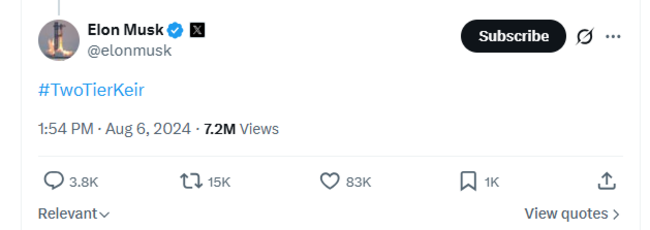
Elon Musk, owner of X, posted “civil war is inevitable” after riots in the town and has been a frequent critic of Starmer during his time in office.
A number of rioters have been jailed for the violence in Southport and both Musk and Reform leader Nigel Farage have stoked allegations of ‘two-tier’ justice in criticism of Starmer on numerous occasions.
Morgan McSweeney
Much of the blame for the approach of courting Reform voters was laid at the door of Morgan McSweeney, the long-time Starmer ally who went on to replace Gray as chief of staff.
McSweeney quit in April after months of pressure but in the end it only temporarily delayed the inevitable departure of Starmer himself.
Irishman McSweeney was most closely associated with the disastrous decision to appoint Peter Mandelson as ambassador to the US, but the decision was ultimately Starmer’s and may go down as his single worst appointment
Mandelson quit his role over his close ties to the paedophile financier Jeffrey Epstein and though their friendship was known in advance of the appointment, Starmer has claimed that he “lied repeatedly” about the extent of their friendship.
For Starmer, many of these mis-steps would perhaps have been survivable if he had managed to get the British public to buy into him personally, but he also seemed to fail at this too.
The moniker of ‘boring’ has been applied frequently to Starmer, and he even leaned into it, promising as PM to “tread more lightly on your lives” than some of his predecessors.
It seems that Starmer ultimately left too little of a good impression at all, allowing the narrative to be shaped by others, and leading to yet another turn of the carousel that is Downing Street.