


The impact of snow on cash withdrawals. The national habit of wrinkling banknotes. The lifespan of a fiver. These are issues which occupy minds in the Central Bank of Ireland, where cash is king. Or is it?
“We’re conscious that consumer habits are changing,” says Karen O’Leary, director of enforcement at the Central Bank and, most recently, its director of currency.
“I’ve certainly noticed that the scouts in the supermarkets bagging groceries, for instance, will have a SumUp machine with them for contributions.
“Covid accelerated that change, though we saw a surge for cash, interestingly, at the start of the pandemic.
“People thought, ‘oh, I better have some cash on hand’ — but when it emerged that cash might be a vector for transmission of the disease, that changed.”
The Killorglin native says that additional ways to pay are being adopted: “There’s a gradual decline of about 7%-7.5% per year in the use of cash, but at the same time as long as there’s a public demand for cash then there’ll be a supply of cash.”
And that demand persists. O’Leary recently asked a colleague to guess how much cash in value was withdrawn all over Ireland in March 2026 — their answer was €15m.
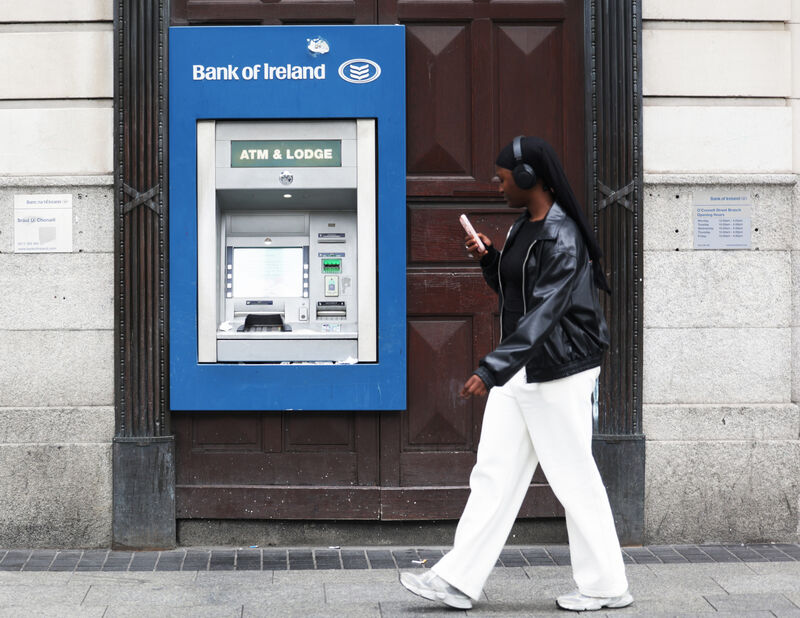
“It was €1bn,” says O’Leary. “In one month, from ATMs and cash-back in the Republic.
“Over the course of the year the amount withdrawn is around €12bn, so it’s roughly €1bn per month, though there are peaks and troughs along the way.”
Christmas is an obvious one of those peaks. “Around 30% of the demand for banknotes is around the holiday season,” says O’Leary.
“Those who collect money from us are the banks and An Post, so you’re talking about double social welfare payments, retailers looking for more cash stock through the banks for Christmas, and so on. And that filters through to retail and withdrawals.”

Research suggests that only 7% of people never use cash. That figure is growing, but it shouldn’t drive hasty decisions.
For instance, the Nordic countries went almost cashless some years ago but have done a lot of work in the last five years to reverse that trend.
They found the absence of cash was isolating for people, particularly the vulnerable and those who are unbanked, or do not have a bank account: It’s estimated that up to 10% of the population of the EU are unbanked, so they can be seriously discommoded in a cashless economy.
“The Nordic countries probably overcorrected,” says O’Leary.
A lot of eurozone countries have realised that a policy of moving away from cash is not necessarily a good one.
“We’ve avoided that, and the access to cash legislation which came in last year recognised that we need an infrastructure here for people who a) depend on cash, and b) prefer to use cash.
”In fairness, the Department of Finance, with whom we worked closely, recognised that. If there’s a society which has a preference for and dependence on cash then there’s a role for the public sector in making sure that that’s still available. That’s how we see our job.”
Even as the use of cash is declining, the volume of bank notes issued is growing year on year.
The Central Bank has noted the euro being used as a store of wealth by those outside the EU because of the strength of the currency, despite some recent, well-publicised issues with availability.
Readers may recall a major power outage across Portugal and Spain in April last year, when card payments and ATM withdrawals suddenly stopped.
“We’re part of government contingency planning to address situations like that power outage,” says O’Leary.
“With electronic payments there are a number of vectors of risk, from cyber threats to basic electricity outages. We’re conscious that those can happen without warning. Because we don’t have a land border we have to be careful that nothing disrupts the supply of currency, for instance. The contingencies are slightly more complicated.
“Plus, you never know when you might get a surge in demand.”
The stories from those visiting Spain and Portugal during that outage were straightforward: people who had cash on them before the outage hit could get to airports, or buy goods.
It makes sense to have cash, absolutely.
“When you see payment outages that’s sometimes down to malfunctions, operational glitches — nothing untoward — but it’s always interesting to see the reactions online to those outages, say online comments on news stories and so on. It’s usually people saying ‘cash is king’ over and over," says O'Leary
“We work with firms and payment providers on operational resilience, and while it doesn’t happen that often, there is a collective shiver when things go wrong.”
Habit and comfort
The comfort of cash is also alluring when other challenges emerge.
The Central Bank associates large-scale withdrawals with particular declarations from Met Éireann, for instance.
When heavy snow is forecast they know to expect an “incredible” rush on cash from ATMs.
Are there other reasons for the fondness for cash?
“I think there’s a privacy motivation for many people, but it’s more likely habit and comfort,” O’Leary says.
“People put money in envelopes and jars and there can be a sense of ‘If I can see it I can manage it’.
“That’s what people are used to and it’s understandable if they’re slow to move away from that, particularly if they’re on low incomes.
“We don’t promote one form of payment over another. Our strategy is access and choice, but access means access to anything: to banking, to cash.
“Having more than one form of payment is important. If you’re fully cash-dependent then it’ll be harder though, and if there’s digital exclusion that’s a different issue, but in general we’re agnostic.”
Not all bank notes are created, or treated, equally.
Lower-denomination notes are passed around more frequently and suffer more wear and tear, while higher-denomination notes aren’t circulated as much, and obviously people take more care of them.
The average lifespan for a lower-denomination note? About four years.
That lifespan is aided by a varnish on €5, €10, and €20 notes which make them more durable and last longer, but much depends on how they’re handled.
Some Central Bank staff compare the Irish treatment of bank notes with Europeans who don’t punish the euro in their pockets quite as much.
That means comparing long leather wallets used on the continent — all those bank notes kept straight and unfolded — with an Irish tendency to keep fivers and tenners balled-up in pockets.
(Some notes are also more admired than others. The Swiss franc has fans in the trade in terms of its design and quality, unlike the US dollar. The latter has traditionally been seen as low in security technology — the design was very simple, there was no colour, and the notes were all the same size.)
And coins?
“There was an increased demand for coin this year because of a change in the social welfare payment system, which generated a need for 20c coins,” says O’Leary.
“On rounding there was a sense that it cost more to produce the 1c and 2c coins than they were worth, and that the public didn’t really like them. I don’t know if we’d get rid of the 5c piece, though. No other country has.”
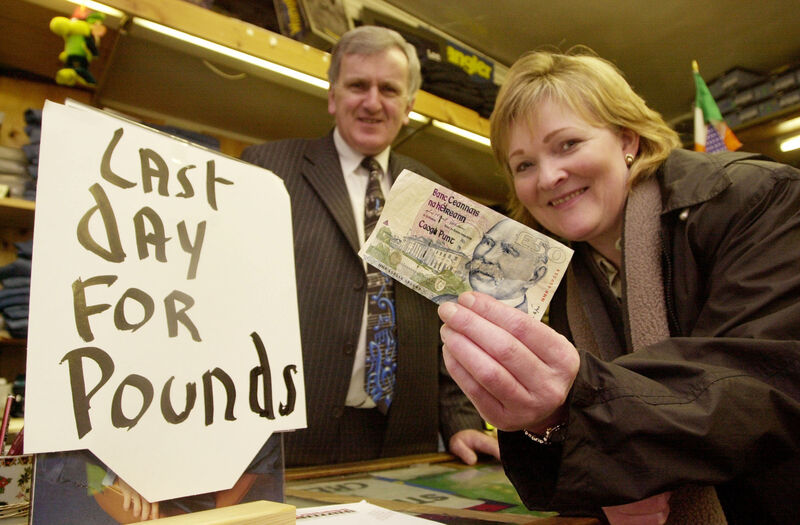
The Central Bank itself goes through roughly 3,000 transactions a year. If you have old punts, or damaged euro notes, you can drop them in.
“We’ll accept them,” says O’Leary. “You have to make an appointment here to bring them in, but we accept them.”
There are certain criteria to determine whether what you bring in is a genuine fit banknote, of course.
It has to be 50% or more intact, but if the bank can piece it together it will, and replace it at face value.
Recycling makes sense when sustainability is an issue for everyone.
The cotton is used for euro notes is sustainable but those notes are shipped all over Europe, with an accompanying environmental impact, and they also use metal ores.
Minting new coins also means metal ores and transport costs, though it’s surprising there’s a need for them.
Since 2002 the Central Bank has issued over 1bn 5c pieces; they can’t all be down the back of the couch.
The bank doesn’t just work with the public to rebuild moth-eaten fivers, by the way.
“If people in an area feel they want to make a query about addressing their local deficiency when it comes to ATMs, for instance, then we can get involved,” says O’Leary.
“It would be great to see people thinking about that and getting in touch about that.
“When you live in Dublin or Cork you’ll find an ATM nearby but in a rural area that’s harder, and there should be a way to advocate for more infrastructure.
“And when we find a deficiency we can ask the banks to put something in. That’s something we’d like people to be aware of.”
此内容由惯性聚合(RSS阅读器)自动聚合整理,仅供阅读参考。 原文来自 — 版权归原作者所有。