


Deirdre* anticipated there might be some obstacles when she started looking at primary schools for her eldest child.
The family live in a rural area, pretty typical of many around the country. Their son Jack* attends pre-school locally. He has joined his local GAA team and made friends there with children who will also be starting junior infants come September.
Close to home, there are eight primary schools, all under Catholic patronage. Jack is not baptised and his family is not planning for him to take part in the Catholic sacraments.
“Neither myself or my husband are religious,” Deirdre said. “We were both raised Catholic, as was the norm, but we’re not religious. Our own wedding was a secular wedding. We just don’t feel it would be right to have him go along with something we don’t fundamentally agree with.”
However, the nearest multi-denominational school — that is a school operating under a non-religious patron where children learn about all faiths and belief systems — is in a town a 15-minute drive away. That’s provided there is no traffic and it’s in the opposite direction for travelling to work on busy school mornings.
His family also wants Jack to go to a school where he has a connection to the area they live in. “In an ideal situation, there would be rural non-denominational schools,” Deirdre said.
Not knowing what to expect, she started to contact principals to see how she could go about opting her child out of religious instruction.
Under Article 44 of the Constitution, and in accordance with Section 30 of the Education Act, 1998, parents have a right to have their children opt out of religious instruction during the school day if they so wish. However, according to the Department of Education, the manner in which a school ensures that the right is upheld remains a matter for the school concerned.
Still a little unsure about broaching the subject, Deirdre contacted the local primary school where she planned to send Jack, as she knew several of his friends would also be attending.
“I wanted to just chat to the principal to see how opting out of religion would work. Its our first time dealing with it.”
'There is no opting out'
She was shocked to be told “there is no opting out”. Over the phone, the school principal told Deirdre as a Catholic school, religion would be engrained in the school day.
“I said ‘surely there is some form of opting out?’ and I was told ‘We can only talk about this in second class [the year in which Catholic children prepare for first Communion]. For the younger years, there is no opting out, they participate in everything else we do’.
“I questioned them, I said ‘does that include the religious programme, and prayers?’ I was told ‘yep. They do everything. They say prayers three times a day, they participate with everyone else in their class with the religious programme, be it colouring in or different stories’."
She said there was no room for compromise, there was no discussion.
"There could be no alternative work. I even went as far as suggesting I could send in my own work for him to do during religion, and I was told this was absurd, there had never been a request like this before. It was a very uncomfortable phone call.”
She later followed up with an email to the school, but it repeated its stance.
This correspondence, which has been seen by the Irish Examiner, included the school principal telling Deirdre in writing that all children from junior infants to first class take part in religion lessons. The school told Deirdre prayers are part of the daily routine, and religion is woven into the school curriculum.
Taken aback, she contacted another local school, under the same diocese, to see about enrolling Jack instead.
“They said there are a couple of kids opted out, there’s no problem with him not participating, he’ll be given alternative work, or taken out for a movement break with other kids if there is support available.
“I’m very grateful, and glad, that we did have an alternative option for him, but I wouldn’t like to think of another parent who only had the option to go to that school.
You have two schools, under the same diocese and a couple of miles apart and it was totally, totally different.
Deirdre made contact with Education Equality, an advocacy group campaigning for "equality in the provision of education for all children, regardless of religion". It told the Irish Examiner her case is not an isolated incident.
The group said it continued to hear from parents who "encounter misinformation and barriers when seeking to exercise their children’s rights".
“No child should be forced to participate in religious instruction against their family’s wishes, and no parent should have to fight to secure a right that is already protected by the Constitution.”
Primary school survey
Deirdre's case is also particularly significant, it added, given the timing of the publication of the Department of Education’s landmark national primary school survey earlier this week.
It was one of the largest of its kind ever undertaken in education, and targeted all eligible households in the country, including both the parents of children in school, and children in pre-school.
Parents were asked a series of closed-ended questions on three aspects of Irish education. Would they prefer single sex or co-ed schools, would they prefer English or Irish to be the language their child is taught in, and whether they would prefer a denominational, that is a religious, patron, or a multi-denominational patron.
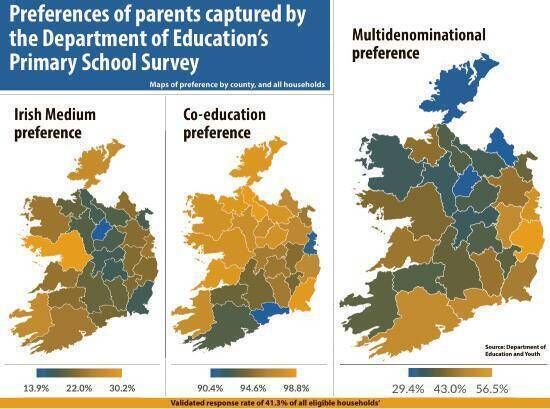
The survey had exceptionally high engagement from parents, with a validated response rate of about 41%.
The vast majority (88%) of Irish primary schools remain under religious patronage, and the vast majority of these are Catholic. At the same time, there are indicators that society has become more secular.
Roman Catholic ceremonies were the most common marriage type in 2014, but were overtaken by civil registrations in 2024, while there was also a 68% rise in the number of humanist ceremonies across the same decade.
Church of Ireland ceremonies accounted for two in every 100 marriages in 2014, while in 2024 these ceremonies accounted for one in every hundred.
The findings from the survey published in full this week capture for the first time the preferences of parents, both now and into the future. It was not a referendum type of vote, whereby a majority rules, but is intended to start discussions between parents and schools, and their respective patron, on what they want from the future direction of their local school.
It found clear cut demand to move away from single sex schools, across the country. It also found about 10% of parents would prefer their child to be educated through Irish.
While individual areas may differ, it does show a demand almost countrywide for more multi-denominational schools currently not met in many communities around the country.
About 40% of parents with children attending religious-run schools, and those who intend to send their child to a denominational school, expressed a preference for multi-denominational education.
However, the number of multi-denominational primary schools remains very low, at 155 out of roughly 3,000 primary schools across the country. Many regions remain without access, particularly in rural areas.
Divestment of religious-run primary schools
It’s been long accepted some religious-run primary schools must divest their patronage to increase the number of multi-denominational schools on offer for parents, therefore increasing choice. However, previous efforts to do so, through a process called reconfiguration, stalled in recent years.
Previous Government targets went unmet, and efforts to divest in certain areas resulted in no changes. Between 2014 and 2020, roughly 20 primary schools divested from the Catholic Church.
Individual schools in different areas will have higher or lower proportions of parents who took part, or who expressed certain preferences. There are 163 school planning areas, covering 1,713 primary schools nationally, where at least 40% of parents who took the survey said they prefer multi-denominational patronage.
Of this, 117 areas had response rates to the survey of 40% or more, covering 1,142 schools. Across a further 56 school planning areas, covering just under 680 schools, this preference for multi-denominational patronage among parents who took the survey ranged from 50% to above 68%. This was the highest percentage in the country, recorded in Greystones, Co Wicklow.
Dingle, Co Kerry, had an overall response rate of more than 53%. More than 50% of the parents who took the survey said they would prefer multi-denominational patronage. There are currently 11 primary schools in the area, each under religious patronage. However, the area's nearest multi-denominational primary school is in Tralee or Killarney.
The findings have been welcomed by each of the primary school patrons, including the Catholic Education Partnership, Educate Together and ETBI, which operates the Community National School model.
It is not clear yet how many schools will transfer their patronage based on the survey. Unlike in previous years, the Department of Education is not targeting a set number of schools to transfer patronage. But for the first time, parents will be able to get a picture on what others in their locality want when it comes to their local school.
It also adds "further urgency to the need for schools to respect the rights of families whose beliefs differ from the school’s religious ethos", according to Education Equality.
Deirdre's case, of opting out, highlights "the urgent need for clear national guidance and oversight to ensure that all schools understand and respect the rights of pupils and parents, regardless of the ethos of the school", it said.
Deirdre said: "In a way, the department allows this. There are no guidelines, the department doesn’t give schools any specific guidelines on how to opt out. There doesn't seem to be a standardised set of guidelines for each school to follow to ensure children are treated equally and respectfully.”
A spokesman for the Department of Education said it would be undertaking a consultation process on the development of best practice guidance for facilitating parental requests for their children to attend school without attending religious instruction.
"Preparatory work on this is currently ongoing. The implementation of best practice at school level can also be supported and monitored through the school inspection regime."
此内容由惯性聚合(RSS阅读器)自动聚合整理,仅供阅读参考。 原文来自 — 版权归原作者所有。