






On May 25, minister for defence Helen McEntee “expressed regret” that a UN Security Council resolution for an EU naval force in the Mediterranean (EU-NAVFOR MED) had lapsed. Without it, there would be no legal basis for Irish troops to participate in the force.
As they withdraw from the Mediterranean after more than a decade, it’s worth recalling the missions Irish troops participated in, and how they evolved from saving lives at sea to facilitating human rights violations and the erosion of international law.
EU missions in the Mediterranean
In October 2013, Italy launched Mare Nostrum in response to 636 deaths at sea in just over a week. It saved 150,000 lives before being wound down a year later and replaced by Operation Triton, led by Frontex — the EU’s Border and Coastguard Agency. Triton had less resources, covered fewer nautical miles, and did not prioritise search and rescue.
In May 2015, as people continued to flee to Europe, the EU launched a military mission called Operation Sophia.
Since the Nice Treaty came into force, the EU has carried out dozens of military missions in Africa, Europe, and West Asia. These missions are conducted under EU mandates but some claim to be implementing UN resolutions to bolster their legitimacy. In fact, they operate on the margins of legality, are entirely outside the UN system, and are not subject to UN scrutiny, oversight, or accountability.
In October, six months after it was launched, Operation Sophia associated itself with a UN resolution pertaining to the trafficking and smuggling of migrants. Because there was initially no UN resolution, Ireland was precluded from joining Operation Sophia.
Instead of doing nothing in the face of mass casualties at sea, a Fine Gael-led government launched Operation Pontus in May 2015, underpinned by a note verbale between Ireland and Italy.
For the first time in the history of the State, the Irish naval service was deployed overseas and carried out eight search-and-rescue operations over a two-year period.
By the time Operation Pontus was wound down, the naval service had saved 17,509 lives, with then president Michael D Higgins calling this “humanitarian response... an example of the very best of our values as a society”.
While the Irish navy was “preserving as much life as possible”, the EU was crafting policies in Brussels that would cause death on the high seas. Pontus wasn’t wound down because there were no more lives to be saved but because humanitarianism was at odds with the EU’s military approach.
In July 2017, the navy shifted focus to “security and interception operations as part of Operation Sophia”.
In 2018, the LÉ James Joyce returned home after 100 days at sea without even saving a single life.
From Sophia to Irini
Operation Sophia was wound down in 2020 and replaced by Operation Irini, which claimed to be implementing a 2016 UN resolution pertaining to an arms embargo on Libya.
Throughout its lifespan, criticism of Operation Sophia was widespread, particularly from legal scholars, the UN High Commissioner for Refugees, and civil society.
They cited the inappropriateness of addressing a humanitarian situation with a military response, while also raising questions about the lack of jurisdiction, the unclear legal framework, and the systematic erosion of human rights law built into the mission’s operational model.
One of the most controversial aspects of operations Sophia and Irini was cooperation with the Libyan coastguard. As well as providing training and equipment, the coordinates of boats in distress were routinely shared, facilitating the perpetration of gross human rights violations.
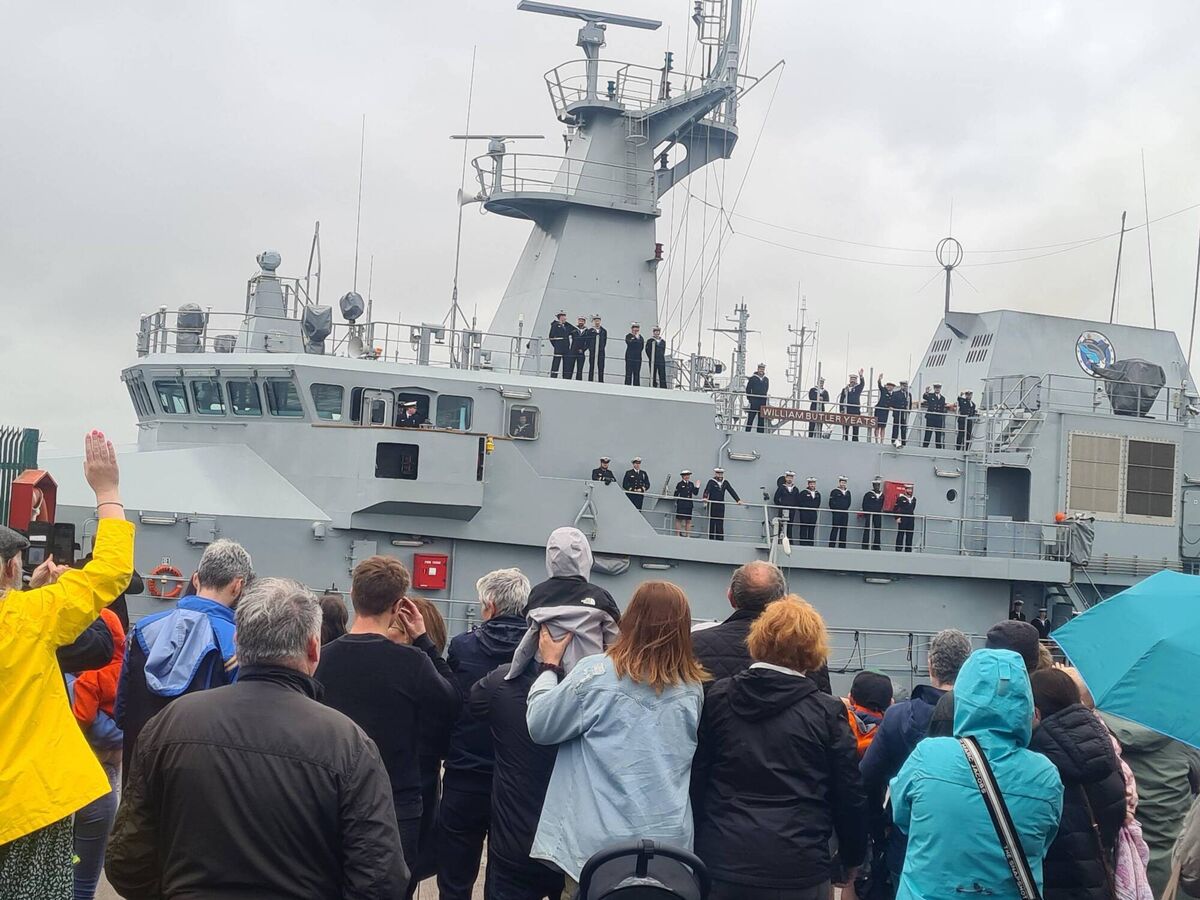
In April 2023, the Dáil approved the deployment of a naval vessel to Operation Irini for 46 days. Then tánaiste Micheál Martin noted that “while capacity building and training of the Libyan coastguard is part of Operation Irini’s mandate, it is not intended that naval service personnel will engage in this activity”. Cooperating with the Libyan coastguard was baked into Irini’s mandate, so it’s difficult to see how Irish personnel could carry out their mission without doing so.
Later that year, investigators commissioned by the UN Human Rights Council documented thousands of cases of “arbitrary detention, murder, torture, rape, enslavement, sexual slavery, extrajudicial killings, and enforced disappearances” and cited “the support given by the EU to the Libyan coastguard” as aiding and abetting some of these crimes.
Despite these accusations, a small number of Irish naval officers were deployed to Operation Irini’s headquarters in Rome until last month, when the UN mandate lapsed.
Triple lock a bare but essential minimum
Though the triple lock is essential, it is a bare minimum, and it did not stop the government from exercising extremely poor judgement by embroiling Ireland in controversial EU military missions vis a vis their association with UN resolutions.
It was only when Operation Irini shifted its focus to “Russian shadow fleet vessels” that the associated UN resolution was allowed to lapse and the triple Lock was engaged.
Instead of celebrating the triple lock as a safeguard that will keep Ireland out of what may become a hostile naval operation against Russia, the government expressed regret and committed to dismantling it without delay.
The pace of change is staggering. Over the past decade, Ireland has gone from saving thousands of lives at sea to participating in missions that aid and abet gross human rights violations and advancing legislation to permit troop deployment to hostile military missions. Instead of sending our troops overseas to save lives, we may soon find they are being deployed to take them.
此内容由惯性聚合(RSS阅读器)自动聚合整理,仅供阅读参考。 原文来自 — 版权归原作者所有。