





So-called protests have erupted across Northern Ireland after a violent knife attack in North Belfast. Hadi Alodid, aged 30, was remanded in custody after appearing in court charged with attempted murder. The victim, Stephen Ogilvie, lost an eye in the attack.
I say so-called because there is nothing about these 'protests’ that suggest this is anything other than an explosive start to Northern Ireland’s infamous riot season.
Every year, residents in primarily loyalist areas of Belfast and other towns across the North are held hostage in their homes, scared to send their kids to school, unable to clock in to work or make a quick run to the shops because masked boys and men roam the streets. They threaten anyone who doesn’t comply with their arbitrary rules with fires, rocks, petrol bombs; violence.
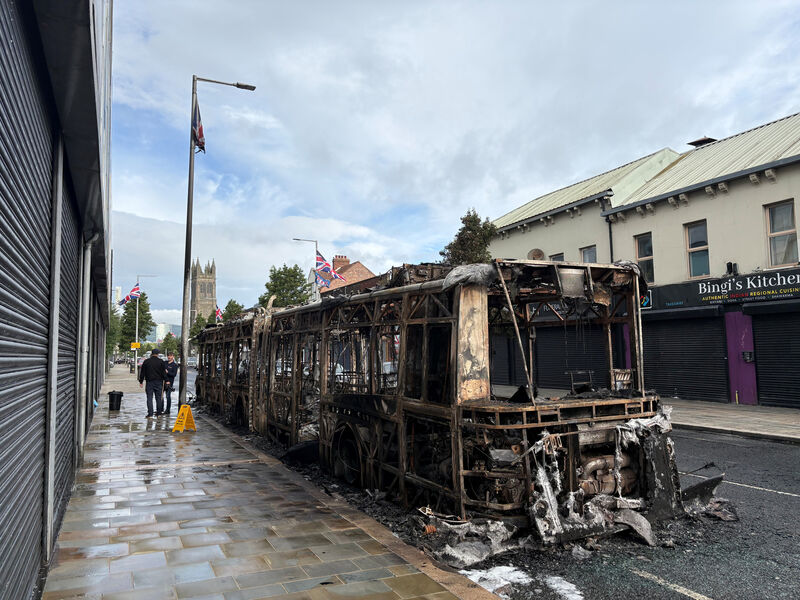
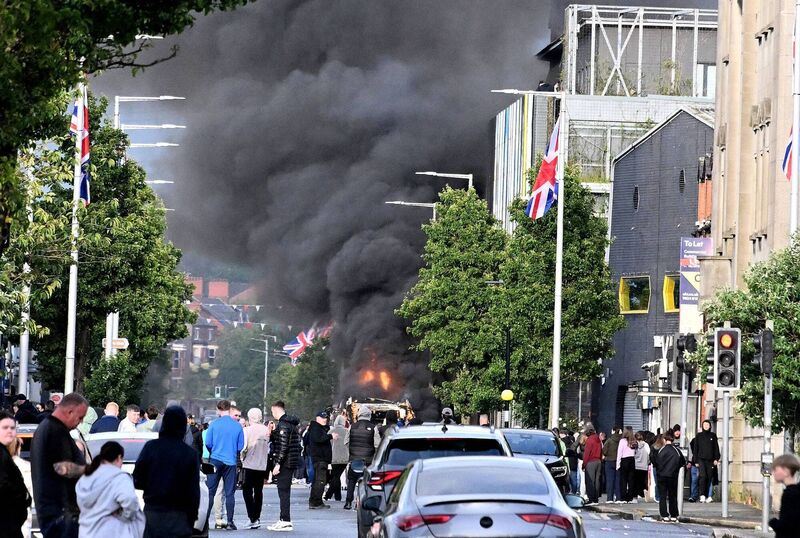
You have likely seen the images that come out of Belfast year on year; civil infrastructure such as buses burned to the ground, windows of family homes broken, women and children fleeing fire-engulfed buildings in the middle of the night. Last year their motivation, they claimed, was protecting women and children, this year, it seems, it’s violence in exchange for violence.
What’s striking about a lot of the videos and images circulating of these riots is that many of the people taking part are teenage children.
In some places, a rite of passage as a teen might be getting picked up by an angry parent while covered in your own vomit after a house party gone wrong, or being caught cosying up to someone at the lockers after school hours, but for these Belfast boys, their rite of passage is throwing their first petrol bomb. These boys grow up on estates and in communities where they are surrounded by images of violence every day, where violence is all they know.
I spent much of my childhood going to my granny’s after school every day in an estate just like this in Newtownards. On my walk home from school, there were murals of masked men, there were guns on gables, there were large empty spaces that, rather than being occupied by a swing park or a football pitch to entertain us, were filled for months of the year with old sofas, tyres, pallets and junk in preparation for the Twelfth of July bonfire.
I remember vividly, receiving a warning from my granny after she saw me with the kids from our street climbing on some old tables that had been placed on the 'bonny' pile ahead of the torching. With no climbing frame, no park, what else were we to do for fun?
It’s hard to imagine that violence could become nothing more than mere entertainment as it does in loyalist communities but these are, as Susan McKay observes in her series of books Northern Protestants — an "unsettled people" on "shifting ground". They are untethered, lost, disillusioned people who have known nothing but violence since their ancestors first arrived in Ireland hundreds of years ago.
Abandoned in the land by a country, England, that wanted and still wants nothing to do with them, they paint their curbs red, white and blue, and fly their flags, UDA, UVF, UFF, etc. to assert themselves in the only way they know how; through fear, intimidation and thuggery.
The men who call themselves ‘community leaders’ — the ones who are organising and circulating plans for these so-called protests — are committed to leading on nothing more than continuing this cycle of violence for the next generation. They don’t care what reason they have for enacting such thuggery, nor do they care much about who the target of their violence is either.
Last summer, we saw the same boys and men taking part in racist lynch mobs, patrolling the same streets they’re now burning, claiming they were doing it to protect women and children.
Gender-based violence
This, despite Northern Ireland being the most dangerous part of the UK for women, where femicide is at sky-high rates, where the PSNI receives a domestic abuse call every 16 minutes and 98% of women have experienced at least one form of gender-based violence.
The very same men who were using the epidemic of violence against women in the statelet to terrorise people of colour last year were later found out to be the very ones perpetrating it: Research found that half of those involved in last year's ‘race riots’ had been arrested for domestic abuse.
In years gone by these loyalists were smashing the windows and burning the homes of Catholics; then it was rival loyalist gangs they were ordering ‘out’, now it’s immigrant families.
So long as there’s loyalism, there’s a target for loyalist violence. It doesn’t matter who you are, what matters is they have a way to express the anger that they feel at the way their lives are playing out.
Growing up surrounded by images of violence every day, knowing only violence as a means of expression is to grow up with no hope, with nothing to lose. No one is more dangerous than an angry man with nothing to lose.

Having nothing to lose means that taking to the streets hidden behind a mask to force businesses to close at 11am, stopping cars on the road to ‘check for immigrants’ and setting fire to homes with children inside can make you feel like you have won. This sense of triumph is short-lived.
Afterwards, back they go to their homes, their phones and their real lives; unmasked, disenfranchised and devoid of hope. And there they sit, waiting for the next excuse to take to the streets, to throw rocks at the police, to feel something.
When violence is a rite of passage and thuggery a currency, when even the police know better than to try and stop you, you can feel untouchable. You can convince yourself you’re throwing petrol bombs for the cause, your elders encouraging you to join the frontline of the threat.
But when the smoke dissipates and the fires go out and you’re on the dock, being given a custodial sentence before your 21st birthday, you’ve become nothing more than a cog in the machine of hatred that is generational loyalism.
The only thing these men and boys are loyal to is violence: Protecting, maintaining, innovating and reappropriating violence for the next generation of boys, who will lose their lives to a culture that requires them to hate everyone who isn’t them.
此内容由惯性聚合(RSS阅读器)自动聚合整理,仅供阅读参考。 原文来自 — 版权归原作者所有。