




When a Government minister says we need to reassess how we handle things after a security crisis, you know there are problems.
Government cohesion
Asked on RTÉ if justice minister Jim O’Callaghan informed her about his intention to request the Defence Forces assist An Garda Síochána in tackling the escalating fuel crisis, defence minister Helen McEntee said: “We need to always make sure we are doing things in the most seamless way. I will say that things at senior level can be improved.”
Ms McEntee, who is also foreign affairs minister, said they now need to “reassess” and “review”, and make sure there is a “seamless engagement and a seamless process at every step and every level”.
Senior sources told the Irish Examiner last week that Mr O’Callaghan’s decision to ask the Defence Forces for assistance ramped up the pressure from protestors.
“We had local gardaí trying to engage with local protestors and their leaders, trying to get them to cooperate and then the minister says the army were, you know, being ‘called in’,” one security source said.
“Everyone knows about the limited capability of the Defence Forces, so we need to find out first what have they got that might help and would they be able and willing.”
Mowag misinformation
As soon as the political announcement was made on Thursday morning, videos circulated of army vehicles on Irish roads — for a totally unrelated matter — with claims they were being sent to deal with protesters.
— Óglaigh na hÉireann (@defenceforces) April 9, 2026The Defence Forces are aware of images circulating of MOWAG Armoured Personnel Carriers in convoy.
We can confirm that these are the personnel of the 128th Infantry Battalion conducting mission readiness exercises ahead of deployment to UNIFIL next month.
Mission Readiness… pic.twitter.com/MGUcJ9KvcQ
Cue the predictable social media posts that the Government was “at war” with its own people.
It all made the already difficult work of local gardaí on the ground more difficult, with no obvious benefit, including no involvement by the army. Their only role was the limited use of military lifting vehicles to move barricades in Whitegate in Cork and Galway Port.
The issue raises real concerns of the Government: Its understanding of the roles and capabilities of the Defence Forces, the need to consult with relevant Cabinet colleagues before deploying military assets in a civil disturbance, and the need for prior discussions between the gardaí before a political decision.
Policing
The actual policing operation to remove the blockades at the critical infrastructure — oil depots at Whitegate Refinery in Cork, Galway Port, and Foynes Port in Limerick — and also O’Connell St, Rosslare Port, and the M50, appeared to be, to borrow Ms McEntee’s phrase, relatively seamless, despite the clear potential for clashes.
Garda Commissioner Justin Kelly declared a “national exceptional event”, which enabled him to temporarily put aside the working time directive, change rosters, and deploy gardaí as required.
Water cannons were scrambled — but not used — with one being sent to Cork City. An estimated 1,500 gardaí were deployed, with Whitegate being the priority.
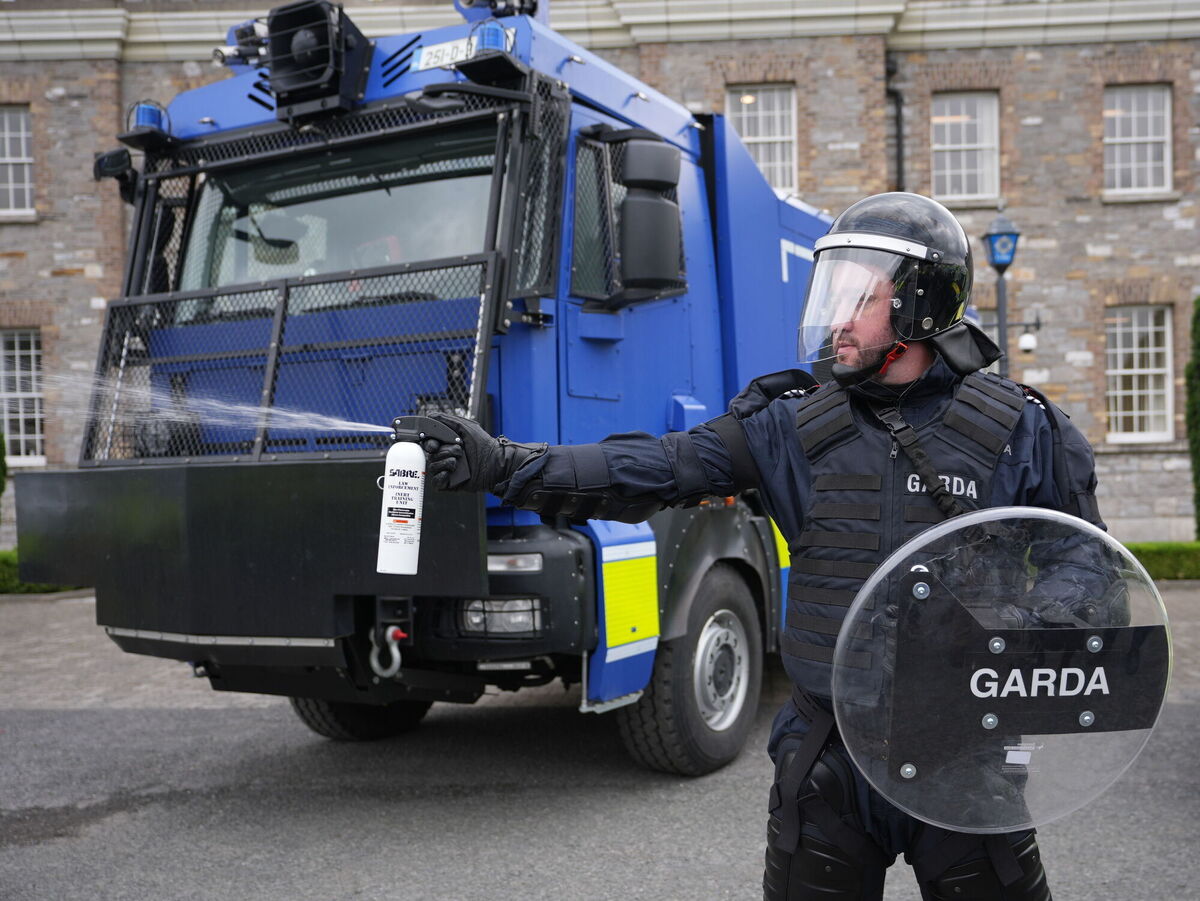
Gardaí succeeded in ending the blockade with a small amount of pepper spray used. Despite some resistance at Galway Port, they managed to clear the access road and, in Dublin’s O’Connell St, secured the area within an hour.
Given the level of force often used by police on the European mainland, the Garda use of force was minimal as well as effective. This is despite incidents, as circulated on social media, of persistent verbal abuse of gardaí by some protestors and far-right activists.
Yesterday, Commissioner Kelly revealed there were attempts to “threaten and intimidate” gardaí during their duty in the protests.
He said he had viewed some of the online material and was “absolutely appalled” — and that the incidents would be fully investigated.
Vulnerabilities
The crisis again showed the public, and politicians, just how vulnerable this State is to global politics and our dependence on imported fossil fuels.
We have heard how vulnerable our critical gas pipelines from Scotland are.
Five years ago, Ireland’s health system was crippled for many months in a cyberattack, by a Russian criminal group with connections to Russian intelligence.
While there is no such sinister connection to the fuel protests, there were certain prominent individuals involved with far-right views, and the broader far-right movement — in Ireland, England, and the US — who eagerly latched on to them.
Irish far-right media channels and activists regularly interviewed protest leaders. Far-right councillors, celebrities, and political groups elbowed their way into events — either on the ground or online, circulating the usual mix of agitation, disinformation, and division.
Whether last week’s events reinvigorates the fractured anti-government/far-right movement in Ireland is unclear. However, there is a reminder to be wary of people claiming to be true representatives of the “people of Ireland”.
Last week sharply reminded security and policing services of just how vulnerable Ireland’s critical infrastructure is.
On security source said: “Dublin Port wasn’t hit [in the protests]. Trucks are in and out of there all the time and really there’s no way of stopping a truck just blocking an exit.”
Ireland's EU presidency
With the EU presidency rapidly approaching, security sources will now review plans to factor in the possibility of a group of people — small or large — using trucks or JCBs to disrupt traffic at Dublin Airport, Baldonnel military airport, Dublin Castle, or Cork Airport.
Sources said hostile states or actors keen to disrupt the EU would have been “looking” at the fuel protests, but said this did not mean they would replicate it.
Other vulnerabilities include the lack of gas or oil storage facilities.
There is also the five-year wait for Ireland’s first national security strategy and the failure to establish and sustain a national security body — as recommended by the Policing Commission in September 2018 — to set out and co-ordinate the roles, responsibilities, and activities of the State’s security services.
此内容由惯性聚合(RSS阅读器)自动聚合整理,仅供阅读参考。 原文来自 — 版权归原作者所有。