





That the latest before the ink was dry will come as little surprise.
The agreement, announced after four rounds of US mediated talks between Israel and Lebanon, stipulated Hezbollah would stop attacking Israel and would be banned from pilot ‘security zones’ in its southern stronghold, which would be run by the Lebanese Armed Forces. Hezbollah, not a party to the Washington talks, rejected the deal outright.
Since 1982, when another US president swore down the phone at another Israeli prime minister, Lebanon has been around this cul-de-sac many times.
Donald Trump claims he spoke to Hezbollah, but the US president is a notoriously unreliable narrator. He is desperately seeking an exit ramp from the US-Israel debacle in Iran, but the Iranians have thrown down a roadblock by linking an Israeli ceasefire in Lebanon to any deal.
That Iran’s leaders are in a position to attach any conditions, much less a command that Mr Trump bring Israel to heel, is indicative of how badly awry his Iranian ‘excursion’ has gone.
Agreements to suspend hostilities are, in any case, meaningless in the current context. Despite the ceasefire in Gaza, Israel continues to inflict deadly strikes in the region. The US-Iranian ceasefire has done little to prevent daily strikes on Iranian ships, ports and facilities, so-called defensive strikes that apparently leave the ceasefire intact.
Iran, meanwhile, continues to lob missiles at its Gulf state neighbours and maintains its chokehold on the global oil supply.
For Lebanon, there is no respite in sight, only an escalation of misery and devastation as Israel ratchets up its onslaught. The scale of destruction caused by the current Israeli incursion has been largely overlooked because of the US-Israeli war in Iran.
Ground and air offensives are being conducted with savage efficiency. Initially, every village and town south of the Litani River was emptied of their Christian and Muslim populations and systemically razed. The occupation has moved northwards; now the villages between the Litani and the Zahrani Rivers are being bombed and crushed by the maws of tanks and bulldozers.
International law demands a proportional response to the rockets Hezbollah continues to fire at targets in northern Israel. With Mr Trump’s support, Benjamin Netanyahu has met Hezbollah’s senseless provocations with the same playbook he used in Gaza: annihilating entire regions, destroying ancient towns, targeting journalists, aid workers and medics, and killing thousands of civilians.
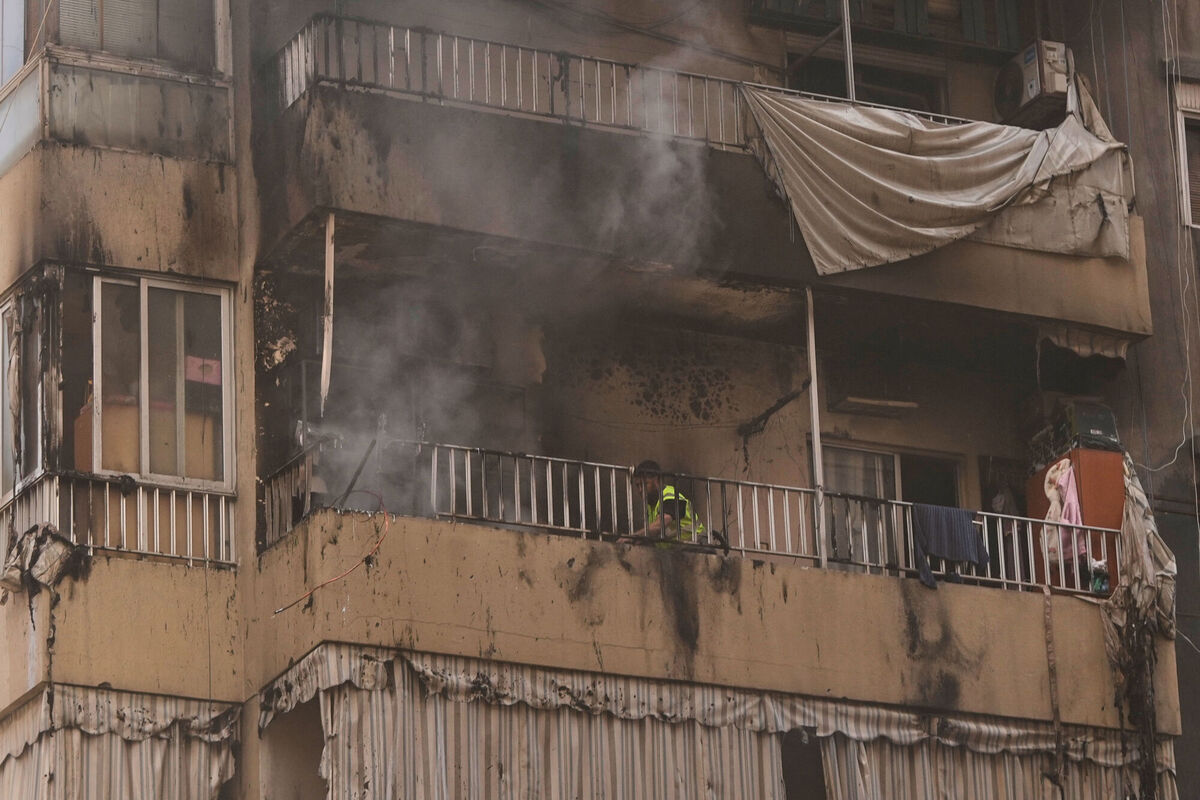
Israel has blown past international humanitarian law principles of distinction and proportionality with the forced displacement of 1.2 million Lebanese civilians, the bombing of Hezbollah-controlled suburbs of Beirut, and the targeting of personnel and installations protected by the laws of war.
The Biblical city of Tyre, one of the world’s oldest continuously populated cities, has been emptied, its inhabitants fleeing on foot as Israeli bombs reduce it to rubble. Nor are the magnificent ruins of the adjacent 9th-century BC Phoenician city, one of Lebanon’s six Unesco-protected heritage sites, immune to Israel’s contempt for the foundational tenets of international humanitarian law and its blatant violation of Lebanese sovereignty.
According to MEP Barry Andrews, who chairs the European Parliament’s aid and has recently visited Lebanon and the West Bank, the scale of Israel’s international humanitarian law breaches is unprecedented. “Europe’s complicity in allowing these breaches to happen without consequences is making the humanitarian response much more difficult,” he says.
Attempts to mitigate the suffering of Lebanon’s displaced populations are thwarted by the emptying of once reliable Western and Gulf state donors. The shuttering of USAID has been accompanied by a new narrative that aid agencies are either partisan or ineffective. Development budgets are being earmarked for defence.
“There’s no doubt that the only thing that will change Israeli policy is trade [sanctions)]," Mr Andrews says. “Nothing else is of any significance really.”
There’s little chance, given the qualified voting majority rules and Germany and Italy’s resistance to sanctioning Israel, that the EU-Israel Association Agreement will be suspended, although internal pressures may yet force Italian prime minister Georgia Meloni to adapt, which would leave Germany isolated as the sole holdout.
EU's most effective weapon
The EU data adequacy agreement with Israel may be the single most effective weapon in Europe’s arsenal when it comes to sanctioning Israel. The agreement allows for the free flow of personal data between the EU and Israel. Suspending it would deal a serious blow to Israel’s tech, finance, education, research and other service industries' ability to do business with the EU.
Unlike the EU-Israel trade agreement, where Germany and Italy between them can thwart a weighted majority vote, the data adequacy agreement could be suspended with the votes of just 15 of the EU’s members.
Mr Andrews claims he has pressed EU commissioner Michael McGrath to take the necessary steps to move towards suspension, but has been stonewalled.
An EU Commission spokesperson said it had "an adequacy decision in place for the safe international data transfers from the EU to Israel since 2011".
"In 2024, the commission evaluated its adequacy decision for Israel in line with the GDPR, and concluded, based on this assessment, that the protection regime was adequate. As with all adequacy decisions, the commission closely monitors the functioning of the decision for Israel," the spokesperson said.
Mr Andrews says Palestinians and Lebanese likewise believe only sanctions, including cultural and sporting boycotts, will yield results. He cited a recent conversation with a Palestinian activist who said they’d "give anything" for just one of the 20 (soon to be 21) packages of sanctions the EU has imposed against Russia over its invasion of Ukraine.
During my years in Beirut, I was astounded by the city’s diversity, vibrancy and tolerance and the resilience and generosity of Lebanese families, who despite their own economic struggles opened their homes and communities to hundreds of thousands of desperate Syrian refugees.
There is arguably no more complex — and no more precarious — democracy anywhere than the one that exists in Lebanon. A coalition of six political groups represent 18 separately recognised religious sects, which have at least dozen separate subsects.
Two thirds of its population are Muslim and one third is Christian, yet Lebanon’s parliament permanently splits its 128 seats evenly between Christian and Muslim groups. The Sunni and Shia populations claim 27 seats each, while the Druze and Alawite sects have eight and two respectively.
The allocation of Christian seats is even more complex, with Maronites claiming 34 seats and the remaining 30 divvied out amongst Greek Orthodox, Greek Catholic, Armenian Orthodox and Catholic, Protestant and another half dozen minorities, including Latin Catholics and the country’s tiny Jewish population sharing one seat.
No official census has been carried out in Lebanon since 1932, largely because it would lead to demands for a corresponding adjustment in representation for the Muslim majority, which snap the gossamer thread from which its democracy hangs.
The levers of power have seized as it’s Christian president, Sunni prime minister and Shiite speaker of parliament vie for control. Hezbollah is the chief beneficiary of this paralysed political system.
While it effectively operates as a state within a state with its own military, social, educational and healthcare infrastructures, it also wields enough power to block legislation and appointments and bring the democratic process to a standstill.
The survival of Lebanon’s volatile democracy, against near insurmountable odds, proves dozens of different ethnic and religious groups can live in relative harmony in the same tiny space, beset as they are by overwhelming challenges; a public infrastructure that is barely worthy of the name, and the further implosion of its economy, education and healthcare systems as a result of the devastating cycle of Hezbollah offensives and Israeli onslaughts.
“Mowing the lawn” is the chilling expression Israel’s political and military leaders have used for decades of periodic and devastating bombardment of Hezbollah strongholds in southern Lebanon.
A decade ago, the futility of this tactic without a strategy was summed up during a conversation with a senior official in the Lebanese Armed Forces who was no fan of Hezbollah, their aggression against Israel or their brutal foray into the Syrian civil war.
“He [Netanyahu] should ask himself ‘what happens when you mow the lawn or prune the tree?’” he said. “It grows back stronger. It bears more fruit.”
此内容由惯性聚合(RSS阅读器)自动聚合整理,仅供阅读参考。 原文来自 — 版权归原作者所有。