











Unsplash

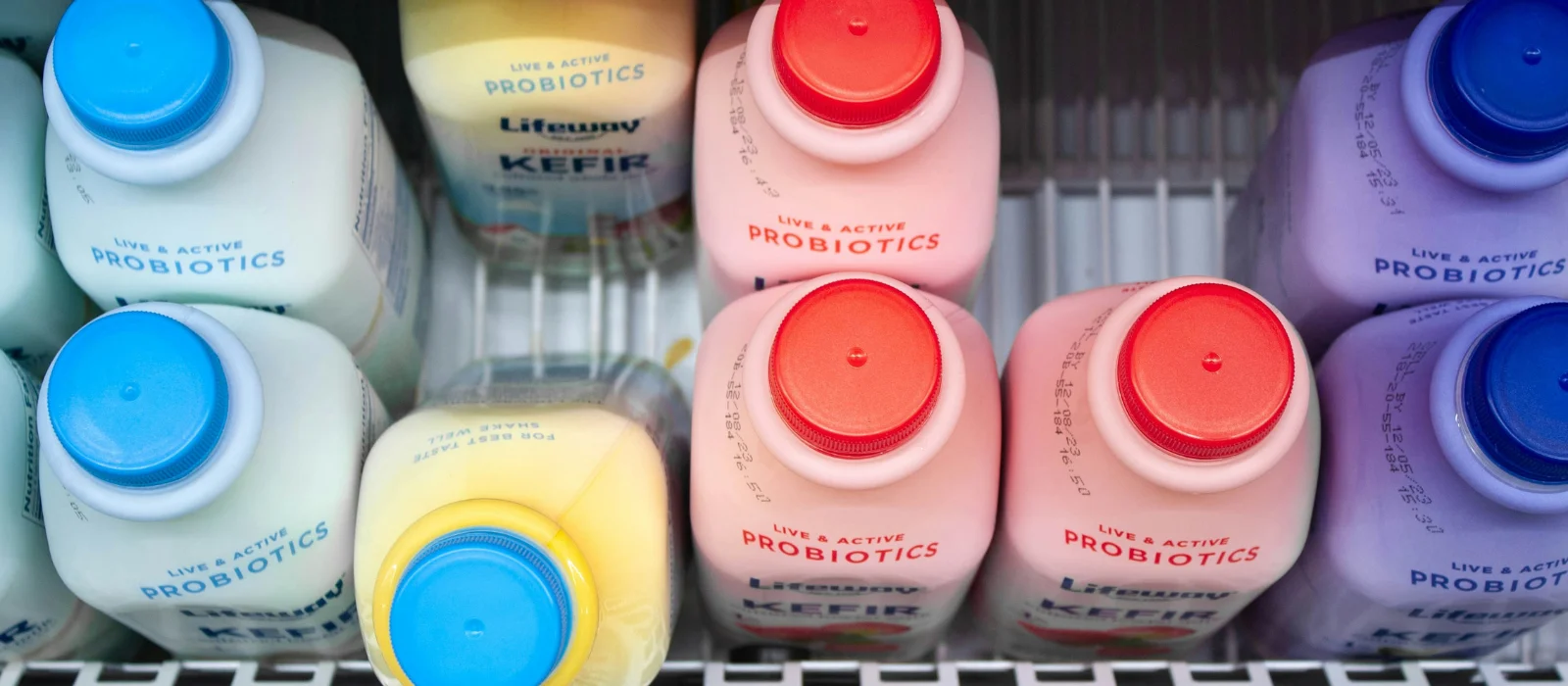
The fermented drink du jour praised for its good bacteria and metabolic health benefits, kefir seems to be the new cool kid on the block as it can be seen lining the shelves at our local supermarkets. Just a fad or will it stand the test of time? We asked leading health coach Elena de Marco.
Kefir is a fermented drink made by adding kefir grains to a liquid, most often milk, but sometimes sugar water. Despite the name, these “grains” aren’t cereal grains at all. They’re small, rubbery clusters that look a bit like cauliflower and are made up of a living community of beneficial bacteria and yeasts.
When they’re added to milk or sugar water, these microbes feed on the sugars in the liquid (such as lactose in milk). As they do this, they produce substances like lactic acid, small amounts of carbon dioxide, and trace amounts of alcohol, along with other compounds. These fermentation by-products are what give kefir its slightly sour taste, light fizz, and thicker texture, and are also why kefir is often discussed in relation to gut health.
Two broad categories matter for the consumer discussion:
Milk kefir:
A fermented dairy drink that is typically higher in protein and contains fermentation by-products formed from milk proteins. It has the strongest human evidence among kefir types for modest benefits to metabolic health. It’s not suitable for everyone, particularly those with milk allergy or dairy intolerance.
Water kefir:
Also known as sugary kefir or tibicos, this is a fermented sugar-water drink, often flavoured with fruit, and naturally dairy-free. It offers a fermented-food option for people who avoid dairy. Its nutritional and microbial content can vary widely, and there is currently less direct human evidence for health effects.

Is kefir a gut-health fad, or a weekly shop essential?
The evidence sits somewhere in between.
What we can say with confidence:
Firstly, fermented foods as a category can modulate immune markers and the microbiome in humans. The best-known example is a Stanford intervention where a fermented-food-rich diet increased microbial diversity and reduced several inflammatory proteins over 10 weeks. Kefir was one of several fermented foods included, so this supports the category, not kefir uniquely.
Secondly, human kefir trials exist, but they’re still relatively small, heterogeneous, and product-specific (milk vs water kefir, lactose-free vs standard, different strains/communities, varying doses and durations). Recent reviews of kefir and the human microbiome repeatedly emphasise the promise but limited causality of kefir to direct health benefits.
Are canned products “worth it” for gut health?
This is where being ruthlessly scientific means focusing on what determines plausibility:
Is it actually “live” at the point of consumption?
For a fermented drink to plausibly act as a live-microbe exposure, viable counts at time of drinking matter more than whether it was once fermented. Many reviews note that probiotic effects (when present) generally require sufficient viable cells, often discussed in the ballpark of 10? to 10? CFU per mL or g (a rule-of-thumb more than a universal threshold, and not kefir-specific).
Science-based take: without batch-level CFU data (ideally at end-of-shelf-life, under real storage conditions), you cannot honestly make strong claims about “gut health impact,” only about “it contains live cultures” if that is reliably true.
Storage conditions and shelf life are not trivial
Even in fermented dairy, microbial populations can change materially across refrigerated storage; viability and community structure are influenced by temperature, acidity, oxygen, and time.
Cans are not inherently “bad” for viability, but you’d want to know: cold chain, time-to-consumption, and whether any post-fermentation heat treatment occurred.
“Water kefir” vs “milk kefir” matters
Water kefir has its own evidence base and production challenges; reviews emphasise variability and that human evidence is thinner than for many dairy fermented foods.
Practical, non-promotional conclusion you can print:
Canned kefir can be a reasonable, convenient way to add fermented foods if it is truly unpasteurised/live at consumption and fits the person’s tolerance/preferences – but it should not be presented as a clinically proven gut intervention unless the manufacturer provides strain/viability data and there are human trials using that (or a demonstrably equivalent) product.

DIY at-home alternatives (and how to keep this scientifically and microbiologically sane)
Option A: Milk kefir (traditional)
- Ferment milk with milk-kefir grains ~12 to 24h at room temp; strain; refrigerate.
- Pros: cheap per serving, protein-rich, often lower lactose after fermentation.
- Cons: variability; requires basic hygiene; not ideal for those avoiding dairy.
Option B: Water kefir
- Ferment sugar-water with water-kefir grains, often with dried fruit/lemon for minerals; then optional second fermentation for carbonation/flavour.
- Pros: dairy-free, easy to flavour.
- Cons: sugar substrate; ethanol can form (usually low but not always negligible); variability can be high. Reviews highlight production challenges and inconsistent composition.
Food safety
- Home fermentation is generally safe when done properly, but contamination risk is real, and traditionally produced kefir can be risky if grains/equipment are contaminated.
- For “how to do this safely,” it’s useful to reference formal guidance. There is public health guidance that explicitly covers critical limits/monitoring points for kefir fermentation (pH drop, process controls).
- People who are severely immunocompromised should be cautious with unpasteurised/live microbial products. Separately, yeasts associated with kefir (taxonomy history includes Candida kefyr / Kluyveromyces marxianus) are discussed in clinical literature as opportunistic pathogens in immunocompromised hosts—this is not “kefir is dangerous,” but it supports a prudent caveat for high-risk groups.