




Introduction
Payment systems process millions of transactions every day. Each transaction involves sensitive financial information such as card numbers, account IDs, and authorization tokens. Because of this, every software deployment carries potential security risk.
At the same time, modern development teams often release new code 15–20 times a day. At that speed, traditional manual security reviews simply cannot keep up with the pace of deployment.
The answer is to automate security at the source: embed checks directly into the CI/CD pipeline so that every code change is examined before it ever reaches production. These automated security gates do not slow teams down – they give engineers the confidence to move faster, because each deployment has already been systematically verified.
This article describes a practical, six- stage pipeline for embedding automated security gates into payment system CI/CD workflows – from pre-commit secrets detection through runtime monitoring – with real – world patterns, minimal code examples, and a phased implementation roadmap.
Why Security Gates Matter
The financial impact of a security incident in a payment environment is severe. The table below summarizes typical incident costs across common vulnerability types.
| Incident Type | Typical Cost | Recovery Time | Compliance Impact |
| PCI- DSS Violation | $50K–$500K/mo | 6–12 months | Fines + forensic audit |
| Card Data Breach | $4M+ average | ~280 days | Class action liability |
| API Vulnerability | $1M–$3.5M | 120–180 days | Mandatory review |
| Secrets Exposure | $2M+ (avg) | Weeks–months | Audit + remediation |
Automated security checks built into the CI/CD pipeline help solve this problem by detecting vulnerabilities early in the development process. When issues are caught during development, they are much easier and cost effective to fix compared to fixing them after a security incident in production.
Teams that adopt automated security gates typically see far fewer critical vulnerabilities reaching production. At the same time, developers gain greater confidence when deploying new releases because security checks are continuously enforced during the pipeline.
Architecture: The Six- Stage Security Pipeline
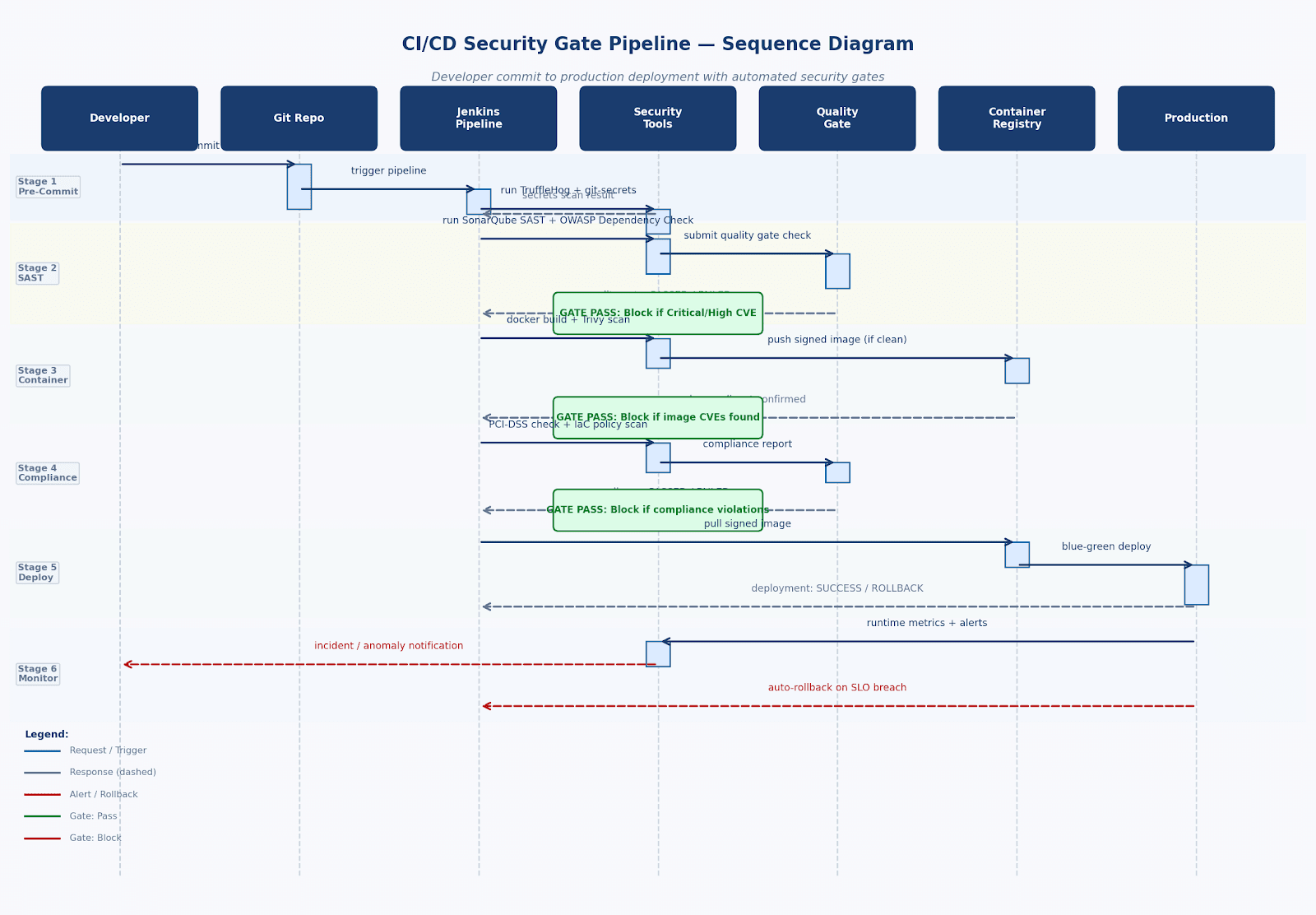
The pipeline embeds automated gates at every CI/CD stage, creating layered defense- in- depth. The sequence diagram below shows how a developer commit flows through all six stages before reaching production.
Stage Overview
- Stage 1 – Pre- Commit Security: Secrets detection scans staged changes before they enter the repository. Any commit containing API keys, tokens, or passwords is automatically blocked.
- Stage 2 – Build & Static Analysis: Static code analysis examines source code for vulnerabilities, code quality violations, and known insecure patterns. A quality gate blocks builds with critical or high- severity findings.
- Stage 3 – Container Security: The Docker image is built and scanned for known vulnerabilities in base image layers and dependencies. Only signed, clean images are pushed to the registry.
- Stage 4 – Dynamic Security Testing: Dynamic Application Security Testing (DAST) is performed on a staging environment where the application is already deployed. The testing tools interact with the live API endpoints and simulate real-world attack scenarios to identify security vulnerabilities before the production.
- Stage 5 – Compliance Check: Automated checks to verify the system meet all security and compliance standards. This includes the correct TLS version is used, no card data is stored or transmitted in plain text, validating that audit logging is properly configured, and checking that the infrastructure follows defined security policies.
- Stage 6 – Production Deployment: Blue- green deployment with continuous runtime monitoring. Automated rollback triggers on SLO breach – no manual intervention required.
Pipeline Configuration
Below is a simplified pipeline configuration showing how security gates are embedded at each stage. Each stage invokes a specific security tool; a non- zero exit code immediately fails the build and blocks progression.
// CI/CD Pipeline - Payment API Security Gates
pipeline {
  stages {
    stage('Secrets Scan') {
      steps { sh 'secrets- scanner . - - only- verified - - fail' }
    }
    stage('Static Analysis') {
      steps {
        sh 'run- sast - - project=payment- api'
        waitForQualityGate abortPipeline: true
      }
    }
    stage('Container Scan') {
      steps {
        sh 'docker build - t payment- api:${GIT_COMMIT} .'
        sh 'container- scanner - - severity HIGH,CRITICAL payment- api:${GIT_COMMIT}'
      }
    }
    stage('Compliance Check') {
      steps { sh './scripts/pci- compliance- check.sh' }
    }
  }
}
Secure Payment Authorization Flow
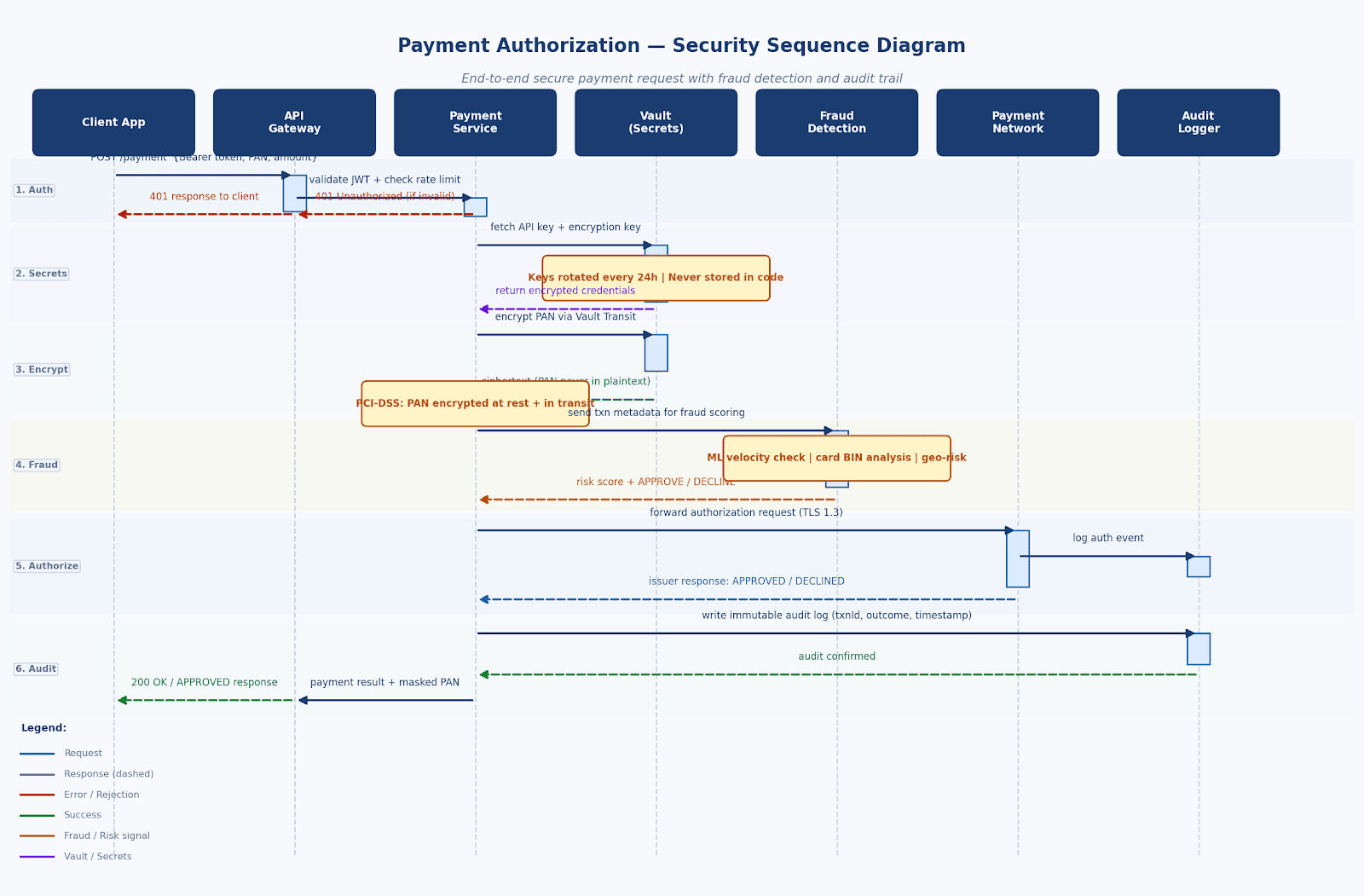
The second sequence diagram illustrates what happens at runtime when a payment request arrives – OAuth token validation, encrypted secret retrieval, card data encryption, fraud scoring, network authorization, and immutable audit logging.
Key Security Controls
- OAuth 2.0 + JWT Validation: Every request must carry a valid Bearer token. The API gateway validates the token signature and expiry before the request proceeds.
- Runtime Secret Management: API keys and encryption keys are fetched from a secrets manager at runtime. Keys rotate every 24 hours and are never stored in source code or configuration files.
- Card Data Encryption: Card numbers are encrypted before any downstream processing. Plaintext card data never appears in logs, traces, or audit records – a hard PCI- DSS requirement.
- ML Fraud Scoring: Transaction metadata – BIN, velocity, geographic risk – is scored in real time. High- risk transactions are declined before reaching the payment network.
- TLS 1.3 Enforcement: All service- to- service communication uses TLS 1.3. Older protocol versions are rejected at the gateway.
- Immutable Audit Trail: Every authorization event – approved or declined – is written to a tamper- evident audit store with a timestamp, transaction ID, and outcome.
Secret Retrieval – Code Pattern
The essential principle: secrets are always fetched from a secrets manager at runtime. They are never hardcoded, never in environment files committed to source control.
// Always fetch credentials from secrets manager at runtime
String apiKey = secretsManager
    .read("payment- gateway/api- key")
    .getValue();

// Encrypt card data before any processing
String encryptedPAN = encryptionService
    .encrypt("payment- key", base64Encode(request.getPAN()));
// Raw card number is never stored or logged
Real- World Scenario: Preventing Secrets Exposure
A payment system was compromised after a developer accidentally committed an API key to a source code repository. Attackers discovered the exposed credential within four hours and used it to execute fraudulent transactions – resulting in a multi- million dollar loss.
The prevention: a pre- commit hook that blocks any staged change containing secret patterns, followed by a deeper automated scan for verified secrets before the push is accepted.
#!/bin/bash  # .git/hooks/pre- commit
# Block commits containing potential secrets
if git diff - - cached | grep - E '(api_key|password|secret|token)='; then
  echo 'ERROR: Potential secret detected - commit blocked'
  exit 1
fi
# Run deep verified secrets scan
secrets- scanner . - - only- verified - - fail || exit 1
echo 'Secrets check passed - commit allowed'
Runtime Monitoring and Alerting
Once code reaches production, observability takes over. A SIEM or log analytics platform monitors real- time transaction streams for anomalies such as card- testing attacks, velocity spikes, and API abuse. The query below illustrates the detection logic:
# Detect card testing and multi- card fraud patterns
index=payment_api sourcetype=authorization
| stats count as total, dc(card_bin) as unique_cards by merchant_id, src_ip
| eval failure_rate = (failed / total) * 100
| where failure_rate > 70 OR unique_cards > 5
| eval alert = if(failure_rate > 70, "CARD_TESTING", "MULTI_CARD_FRAUD")
Alerts are routed to the on- call engineer with full transaction context. If an SLO breach is detected, the pipeline triggers an automated rollback to the last known- good deployment – no human intervention required.
Performance Impact
The full security pipeline adds approximately 11 minutes to each build. Based on analysis across thousands of production builds, this overhead is consistently justified by the volume and severity of issues caught:
| Stage | Time Added | Issues Caught | Value |
| Secrets Detection | 12 sec | High – prevents credential theft | Very High |
| Static Analysis | 2.4 min | Code vulnerabilities + insecure patterns | High |
| Dependency Scan | 1.8 min | Known CVEs in third- party libraries | High |
| Container Scan | 45 sec | Base image and layer vulnerabilities | Medium |
| Compliance Check | 38 sec | PCI- DSS policy violations | High |
Lessons Learned
- Start with soft gates. Begin in warning- only mode. This lets teams tune thresholds and reduce false positives before gates enforce hard blocks. False positive rates can drop from over 40% to under 10% within a few months of tuning.
- Invest in developer education. Security gates only work if engineers understand and trust them. Short weekly sessions on reading and responding to findings dramatically improve developer adoption and satisfaction.
- Automate everything. Manual security reviews create bottlenecks and inconsistency. A well- tuned automated pipeline can process thousands of builds with zero manual security intervention.
- Measure and iterate. Track execution time, findings per stage, and false positive rate. Continuous measurement drives continuous improvement.
- Treat security as a journey. A mature pipeline evolves over months, not days. Start with secrets detection and static analysis. Add container scanning, compliance checks, and dynamic testing as the team gains confidence.
Implementation Roadmap
| Phase | Objective |
| Phase 1 | Start with secret detection and basic static analysis using soft (warning-only) security gates. |
| Phase 2 | Dependency vulnerability scanning + container image scanning |
| Phase 3 | Introduce dynamic security testing (DAST) against staging environments. |
| Phase 4 | Implement PCI-DSS compliance automation and infrastructure policy-as-code checks. |
| Phase 5 | Convert soft security gates into hard blocking gates and add production security monitoring. |
| Phase 6 | Continuously tune the pipeline, review metrics, and provide ongoing team education. |
Conclusion
Security and development velocity are not in conflict – they are complementary when achieved through intelligent automation. An integrated CI/CD security pipeline does not slow teams down; it gives them the confidence to move faster, because every deployment has been systematically verified before it ships.
For payment systems operating under PCI-DSS, the impact of a missed vulnerability can be severe. The six-stage pipeline described in this article – from pre-commit secret detection to runtime monitoring – offers a practical and step-by-step approach that fintech engineering teams can adopt to strengthen security throughout the development lifecycle.
Start small. Instrument early. Measure everything. Security becomes an enabler, not a bottleneck.
