


Researchers say that President Donald Trump’s resurrection of widely maligned fitness testing in schools is “half-baked” and unlikely to move the needle on youth physical activity alone
By Claire Cameron edited by Jeanna Bryner
Carl Iwasaki/Contributor via Getty Images
President Donald Trump’s reinstatement of the Presidential Physical Fitness Award, part of a broader push to return annual physical fitness tests to schools, is unlikely to improve youth health or physical activity, experts say.
“The bottom line is that fitness testing is not going to improve the health and well-being of American youth,” says Avery Faigenbaum, a professor of kinesiology and health sciences at the College of New Jersey, who studies children’s physical health and activity.
“The question is not, ‘Should we fitness test, yes or no?’” he says. “Really, the question is, ‘What systems are in place?’ If we have this data, what systems are in place in our schools, in our communities, to spark a lifelong interest in physical activity?”
If you're enjoying this article, consider supporting our award-winning journalism by subscribing. By purchasing a subscription you are helping to ensure the future of impactful stories about the discoveries and ideas shaping our world today.
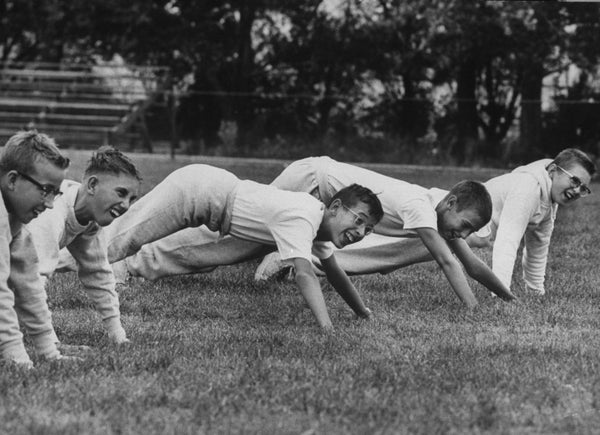
This fitness award is given out to those who excel in the Presidential Fitness Test, which was first introduced to middle and high schools in the late 1950s and then phased out in 2013. That test had kids running sprints, doing push-ups and sit-ups, and completing other physical feats. Previously, kids scoring in the 85th percentile for their gender in each component of the test received the Presidential Physical Fitness Award.
President Trump revived the test in an executive order in 2025—and now his administration is bringing back the award. It’s unclear, though, how exactly the test is being administered or how the awardees will be chosen. According to Secretary of Defense Pete Hegseth, the test is also now being made mandatory for students at 161 schools on U.S. military installations.
“This is not the old Presidential Fitness Test,” says Russel Pate, a professor and director of the Children’s Physical Activity Research Group at the University of South Carolina. Pate previously was on the scientific advisory committee for Fitnessgram, a fitness assessment used in schools. He explains that the new test protocols seem to have been updated and appear more consistent with current research into what is and isn’t appropriate for children. Part of the challenge in fitness testing, he says, is that first, you need to pick the right test, and then, you need to use the test in such a way that it facilitates learning about fitness.
And, he adds, it’s unclear how the scoring for the tests has been set, or how the award will be administered. “Where did these scores come from, and what were the criteria that were applied in selecting those scores?”
“I look at this as sort of half-baked,” Faigenbaum says. On the one hand, Trump’s actions are spotlighting children’s health and fitness at a time when an estimated 20 to 25 percent of U.S. children get the recommended 60 minutes of daily physical activity, he says. Physical activity is crucial for children's well-being; the benefits can include improved academic performance, better brain and heart health, lower risk of metabolic disease and higher likelihood of long-term health and fitness. And there can be some benefits to physical fitness testing, such as gathering data to inform public health policies. But “you can’t test kids into fitness,” he says, adding that the tests can also humiliate children and leave them with negative feelings about exercise that last decades. It’s also possible that some children who do take exercise, such as dance classes, may not perform well on a test because it isn't geared to their preferred activity and strengths.
“Really good teachers can make this a fun experience for children,” he says. “There’s the potential for this to be a positive experience, but in the same breath, there’s the potential for this to be a negative experience and those negative experiences don’t disappear.”
Pate agrees that fitness tests can be beneficial, especially because they can inspire some children to engage in more physical activity. “But I certainly would never argue that even a properly designed and implemented fitness test is by any means the whole answer.”
“We need to give kids, every kid, as many positive experiences with as many different forms of physical activity as we can provide,” he says.
“What motivates [kids] is easy,” Faigenbaum says. “Have fun. Make friends. Learn something new. Full stop.”
If you enjoyed this article, I’d like to ask for your support. Scientific American has served as an advocate for science and industry for 180 years, and right now may be the most critical moment in that two-century history.
I’ve been a Scientific American subscriber since I was 12 years old, and it helped shape the way I look at the world. SciAm always educates and delights me, and inspires a sense of awe for our vast, beautiful universe. I hope it does that for you, too.
If you subscribe to Scientific American, you help ensure that our coverage is centered on meaningful research and discovery; that we have the resources to report on the decisions that threaten labs across the U.S.; and that we support both budding and working scientists at a time when the value of science itself too often goes unrecognized.
In return, you get essential news, captivating podcasts, brilliant infographics, can't-miss newsletters, must-watch videos, challenging games, and the science world's best writing and reporting. You can even gift someone a subscription.
There has never been a more important time for us to stand up and show why science matters. I hope you’ll support us in that mission.
此内容由惯性聚合(RSS阅读器)自动聚合整理,仅供阅读参考。 原文来自 — 版权归原作者所有。