


Tiny plastic particles drifting in Earth’s atmosphere could have a significant warming effect, a new study finds
By Jackie Flynn Mogensen edited by Claire Cameron
Alistair Berg/Getty Images
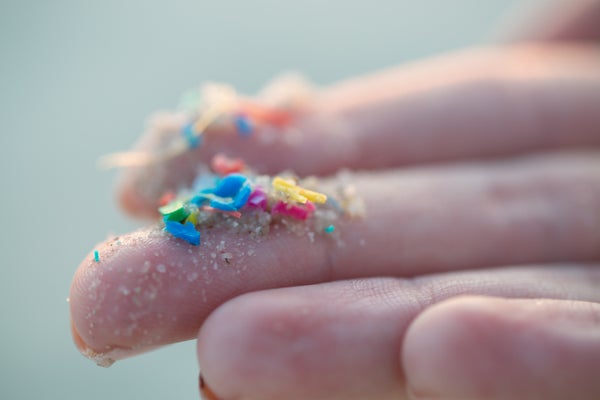
Microplastic particles flowing through Earth’s atmosphere may be quietly driving up global temperatures, a new study suggests.
Microplastics and nanoplastics—tiny bits of broken-down plastic pollution—litter the planet’s rivers, oceans, land and air. But until now, researchers weren’t sure what effect all those plastic particles were having on an already warming climate.
A new study led by researchers at Fudan University in China suggests that the particles may significantly affect warming—for comparison, microplastics’ warming effect equates to about 16 percent of that of black carbon, or soot.
If you're enjoying this article, consider supporting our award-winning journalism by subscribing. By purchasing a subscription you are helping to ensure the future of impactful stories about the discoveries and ideas shaping our world today.
“This article shows a very worrying truth about the dangers of micro- and nanoplastics,” says Steve Allen, a microplastics researcher at the environmental advocacy organization Healthy Earth, who was not involved with the study.
If you’ve ever walked barefoot on asphalt, you know black material absorbs heat. White paint on asphalt, however, reflects it. The same thing happens with airborne microplastics—darker colors warm the atmosphere, while lighter colors help cool it. By analyzing the optical properties of various microplastics in the lab and simulating their effect on a global scale, the new study’s authors estimated that microplastics’ warming abilities outweigh their potential cooling effects—something current climate models don’t account for.
The results were published on Monday in Nature Climate Change.
The findings reveal “a long-overlooked link” between plastics and climate change, said study co-author Hongbo Fu, a researcher at Fudan University in China, at a press conference. Plastics are not just an environmental pollutant. “They can also act as a heating agent in the atmosphere,” he said.
“We still have a lot to learn about exactly how many of these [microplastics] are in the atmosphere and how they’re distributed, both horizontally and vertically,” said Drew Shindell, the study’s senior author and a professor of Earth science at Duke University, at the same press conference. “This is not the final word.”
It’s unclear how many microplastics are actually in the atmosphere. But the study team argues global climate assessments, such as those published by the Intergovernmental Panel on Climate Change (IPCC), need to factor in these particles. “Our work suggest that climate models need to be updated,” Fu said. “IPCC should take notice.”
More broadly, Allen says the results underscore the need to reduce our reliance on plastics—which are often made from the by-products of fossil fuel production.
“What needs to be looked at is the carbon emissions throughout the life cycle of plastic production adding to the total climate change effect,” he says. The “takeaway message” is “that we can reduce climate change by removing plastic from our lives.”
If you enjoyed this article, I’d like to ask for your support. Scientific American has served as an advocate for science and industry for 180 years, and right now may be the most critical moment in that two-century history.
I’ve been a Scientific American subscriber since I was 12 years old, and it helped shape the way I look at the world. SciAm always educates and delights me, and inspires a sense of awe for our vast, beautiful universe. I hope it does that for you, too.
If you subscribe to Scientific American, you help ensure that our coverage is centered on meaningful research and discovery; that we have the resources to report on the decisions that threaten labs across the U.S.; and that we support both budding and working scientists at a time when the value of science itself too often goes unrecognized.
In return, you get essential news, captivating podcasts, brilliant infographics, can't-miss newsletters, must-watch videos, challenging games, and the science world's best writing and reporting. You can even gift someone a subscription.
There has never been a more important time for us to stand up and show why science matters. I hope you’ll support us in that mission.
此内容由惯性聚合(RSS阅读器)自动聚合整理,仅供阅读参考。 原文来自 — 版权归原作者所有。