



惯性聚合 高效追踪和阅读你感兴趣的博客、新闻、科技资讯
阅读原文 在惯性聚合中打开

推荐订阅源

博客园 - 司徒正美
aimingoo的专栏
aimingoo的专栏
MongoDB | Blog
MongoDB | Blog
云风的 BLOG
云风的 BLOG
OSCHINA 社区最新新闻
OSCHINA 社区最新新闻
酷 壳 – CoolShell
酷 壳 – CoolShell
博客园 - 聂微东
Y
Y Combinator Blog
T
Tailwind CSS Blog
奇客Solidot–传递最新科技情报
奇客Solidot–传递最新科技情报
S
SegmentFault 最新的问题
让小产品的独立变现更简单 - ezindie.com
博客园 - 【当耐特】
IntelliJ IDEA : IntelliJ IDEA – the Leading IDE for Professional Development in Java and Kotlin | The JetBrains Blog
J
Java Code Geeks
美团技术团队
Google DeepMind News
博客园_首页
Apple Machine Learning Research
T
The Blog of Author Tim Ferriss

Scientific American

Why lawyers keep citing fake cases invented by AI Earth’s molten outer core is behaving in chaotic, unexpected ways Rare Ebola-causing Bundibugyo virus is uniquely challenging to treat. Here’s why Span wants to turn homes into mini data centers What will happen if the Milky Way and Andromeda galaxies collide? What is E15 fuel? Why higher-ethanol gasoline could raise summer smog levels Bixonimania’—the fake illness that AI fell for SpaceX scrubs launch of Starship V3—the tallest and most powerful rocket ever built Hidden structural features inside Egypt’s Great Pyramid may have helped it withstand earthquakes, new study finds Hantavirus found in shocking number of Pacific Northwest rodents JWST sees partly cloudy skies on a distant, giant exoplanet A new study says you may need 10 hours of exercise a week. Can that really be possible? Scientists discover why gold doesn’t ‘rust’ NOAA predicts quieter Atlantic hurricane season for 2026—but the Pacific is another story Trial of next-gen weight-loss drug retatrutide brings it one step closer to FDA approval AI just solved an 80-year-old ‘Erdős problem,’ and mathematicians are amazed Can math predict the end of humanity? Inside the ‘doomsday argument’ Watch SpaceX launch Starship V3—the tallest and most powerful rocket yet Daddy longlegs are actually bloodthirsty killers—of frogs Startup reveals ‘artificial egg’ to resurrect extinct birds, but scientists say the work misses the point Screen time limits can protect children’s health, U.S. surgeon general advisory says An Ebola outbreak is spreading fast. Should you be worried? These bizarre fossils represent some of the earliest moving, sexually-reproducing life ever discovered Vaccines for Bundibugyo Ebola virus outbreak are being developed, but none are ready yet NASA’s Psyche captures gorgeous Mars crescent photo on way to asteroid The Colorado Avalanche is dominating the NHL—Denver’s high elevation could be the reason NASA’s plan for a nuclear reactor on the moon could change space exploration forever—if it works Did the last common ancestor of humans and apes walk like a gorilla? A new study offers a clue Summerlike heat is breaking records in the East. Here’s why The U.S. just experienced its hottest 12 months on record SpaceX punts Starship V3 launch to May 21 as investigation opens into Starbase worker’s death What it’s like being stuck in a hantavirus quarantine for six weeks ‘Sensational’ proof topples decades-old geometry problem New NASA Hubble image captures a rare, turbulent galaxy Scientists race to develop Ebola drugs as outbreak surges Math Puzzle: Fix the matchstick equation Female beast hunters battled leopards in ancient Rome A field guide to quantum computer qubits June 2026: Science history from 50, 100 and 150 years ago The Riemann hypothesis is a million-dollar math problem hardly anyone is trying to solve Poem: ‘Horseshoe Crab’ Which problems will quantum computers solve—and when? A real quantum leap New high‑resolution map transforms what we know about Roman roads and the Roman Empire Quantum computing is reaching its make-or-break moment NASA dreams of a nuclear power plant on the moon. Here’s why How commercial satellites are changing modern warfare Helion Energy is building a fusion power plant. Can its technology deliver? New ways to keep from losing muscle on Ozempic Readers respond to the February 2026 issue Science Crossword A lamp flickering on and off inspires the math mystery of Thomson's lamp Ebola outbreak triggers U.S. ban on travelers from three African nations How scientists developed a hantavirus PCR test in a weekend Inside the race to develop a hantavirus PCR test Hidden copy of the oldest known poem in the English language leaves researchers ‘speechless’ The world is less prepared for a pandemic than before COVID. Here’s why See a Lincoln Memorial-sized asteroid pass within just 56,000 miles of Earth today Trump administration ousts top NIH infectious disease leaders The programmer whose code underpins the Internet How marijuana rewires the teenage brain Hantavirus cruise ship, PCOS name change, a fish that hides in another animal’s ‘butthole’ Did Homo erectus and Denisovans mate? Tooth proteins hint at ancient trysts This small rodent is at the center of theories about the hantavirus outbreak These ants navigate with a compass tuned to the moon NASA reveals new clues to 2027’s Artemis III, the final test mission before a moon landing Scientists catalog the ‘fractal dimensions’ of more than 130,000 islands Hantavirus can persist in semen for years, but that doesn’t mean it remains contagious A real Mr. Snuffleupagus? Meet the ocean’s strangest new fish species This startup wants to make drugs in orbit. If it succeeds, it could transform the space economy How to arm yourself against hantavirus misinformation Can plants have consciousness? The film Silent Friend reimagines the science Asking AI to explain your medical results? What doctors want you to know Microbe ‘cities’ may solve a key ocean mystery Are astronomers ignoring some of the cosmos? Why Black women are at greater risk for fibroids and endometrial cancer To celebrate Endangered Species Day, meet the scaly-foot snail, the most metal animal in the world U.S. Supreme Court allows mifepristone by mail—for now There’s an 82 percent chance El Niño will ‘emerge soon,’ NWS says ‘Golden rule’ in abstract art just discovered by mathematicians Implantable ‘living materials’ that deliver drugs on demand could help fight infections Doubts grow over theory that bird-watchers' trip to Argentine landfill sparked hantavirus outbreak NASA’s Psyche mission is snapping photos of Mars on its way to an asteroid Can helium-3 create a ‘gold rush’ on the moon? The war in Iran is supercharging an ecological crisis in the Persian Gulf Deep-Earth diamonds reveal trove of never-before-seen minerals Depression scales may not work the same for highly intelligent people 2026 FIFA World Cup players and fans at risk of extreme heat, climate scientists warn Almost half of the objects in Earth's orbit is junk—and that's only the stuff we know about Can hantavirus spread through the air? What we do and don’t know Americans are increasingly open to using psychedelics for medical reasons 59,000-year-old Neanderthal tooth may be oldest evidence of dentistry Radar picks up on bird migration. But how do we tell birds and storms apart? Are attention spans really shrinking? What the science says Baby ‘cosmic fossil’ galaxy brings JWST closer to glimpsing the universe’s first stars Tiny robot drones learn to navigate the world like honeybees WHO: The world is falling short of and even reversing its health targets Quitting weight-loss drugs or a diet can cause weight regain—two strategies could help prevent that Why hantavirus takes so long to show symptoms and what that means for containment Each atom in the universe might be unique Do you need more protein? What science says about high-protein diets
Far side moon photos reveal hidden lunar minerals in brilliant color
2026-05-23 · via Scientific American

Stunning Artemis II photos reveal the moon's hidden colors

An astrophotographer teamed up with Artemis II commander Reid Wiseman to create these stunning new images of the lunar surface
By Andrea Gawrylewski edited by Claire Cameron

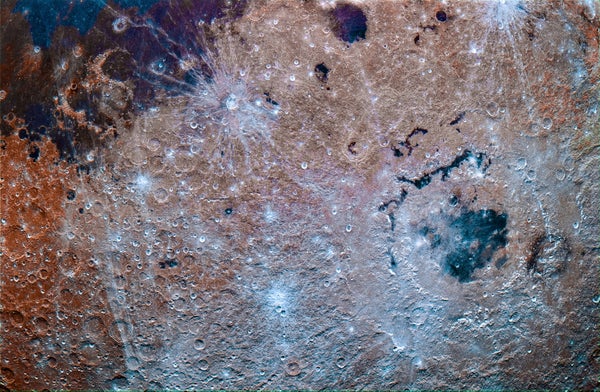
A closeup image of the lunar surface near Mare Orientale shows vibrant hues of purples and blues

The farside of the moon, composed from a stack of about 30 photographs taken by Artemis II mission commander Reid Wiseman with a Nikon Z9.

Andrew McCarthy

Join Our Community of Science Lovers!

NASA astronaut and Artemis II mission commander Reid Wiseman and an astrophotographer have teamed up to create stunning, hypersaturated color images of the moon. The photographs reveal never-before-seen details of its surface.

When NASA’s Artemis II crew made their historic flyby around the farside of the moon in April, they saw from their capsule windows the gray and pocked lunar surface. One of the mission’s objectives was to capture ample photographic data, and throughout and after the spaceflight, NASA released unprecendented views of the moon. Now the image team at the space agency is still sorting through and processing the tens of thousands of images captured during the mission. Many of them are incredible, but they are all a bit gray.

A full gibbous moon with enhanced colors showing a splotch of dark purple in the top right region of the lunar surface

The farside of the moon, color-enhanced to reveal minerals and impact craters.

Andrew McCarthy


On supporting science journalism

If you're enjoying this article, consider supporting our award-winning journalism by subscribing. By purchasing a subscription you are helping to ensure the future of impactful stories about the discoveries and ideas shaping our world today.


Thankfully, cosmic photographer Andrew McCarthy worked with mission commander Wiseman before the launch, teaching the astronaut how to get just the right kind of raw photographs on which he could work magic.

“I thought it would be a really cool opportunity to create photos that were maybe a little less scientific and a little more artistic,” McCarthy says.

McCarthy’s work had already drawn Wiseman’s attention on social media. And in the weeks leading up to the launch, the pair worked together to plan how to capture bursts of photographs from the moon’s far side, sometimes a hundred at a time. “I’m not really thinking in terms of reproducing what my eyes are seeing; I’m looking for hidden details; I’m looking for hidden colors,” McCarthy says.
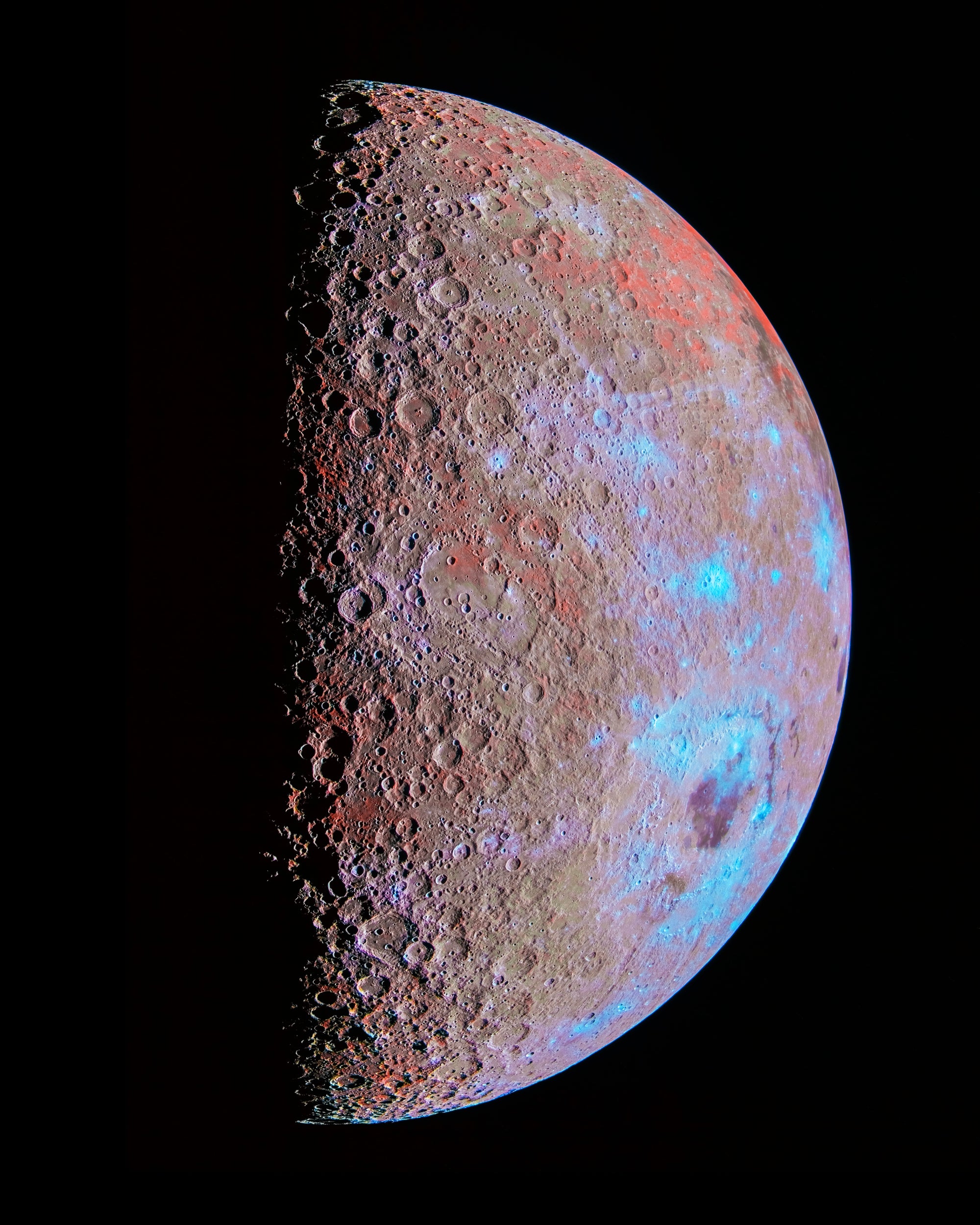
An image of the quarter moon with regions of orange and blue; a strong terminator is visible.

An image of the farside of the moon made up of about 100 photographs with the color enhanced to reveal meteorite craters and mineral composition.

Andrew McCarthy

McCarthy’s hypersaturated images are made by stacking together bursts of photographs taken by Wiseman on the farside of the moon and then balancing the colors and adjusting their relative saturations, which reveals subtle changes in terrain. And the results are downright jaw-dropping.

A photograph of a moving object (the moon) taken from a moving vantage point (the spacecraft) contains a lot of “noise,” meaning there are often many areas that are out of focus or places where details have been lost because the camera had moved in relation to its target. By stacking many photographs together and using computer software to filter out the noise, photographers can achieve a smoother, artifact-free version of the image.
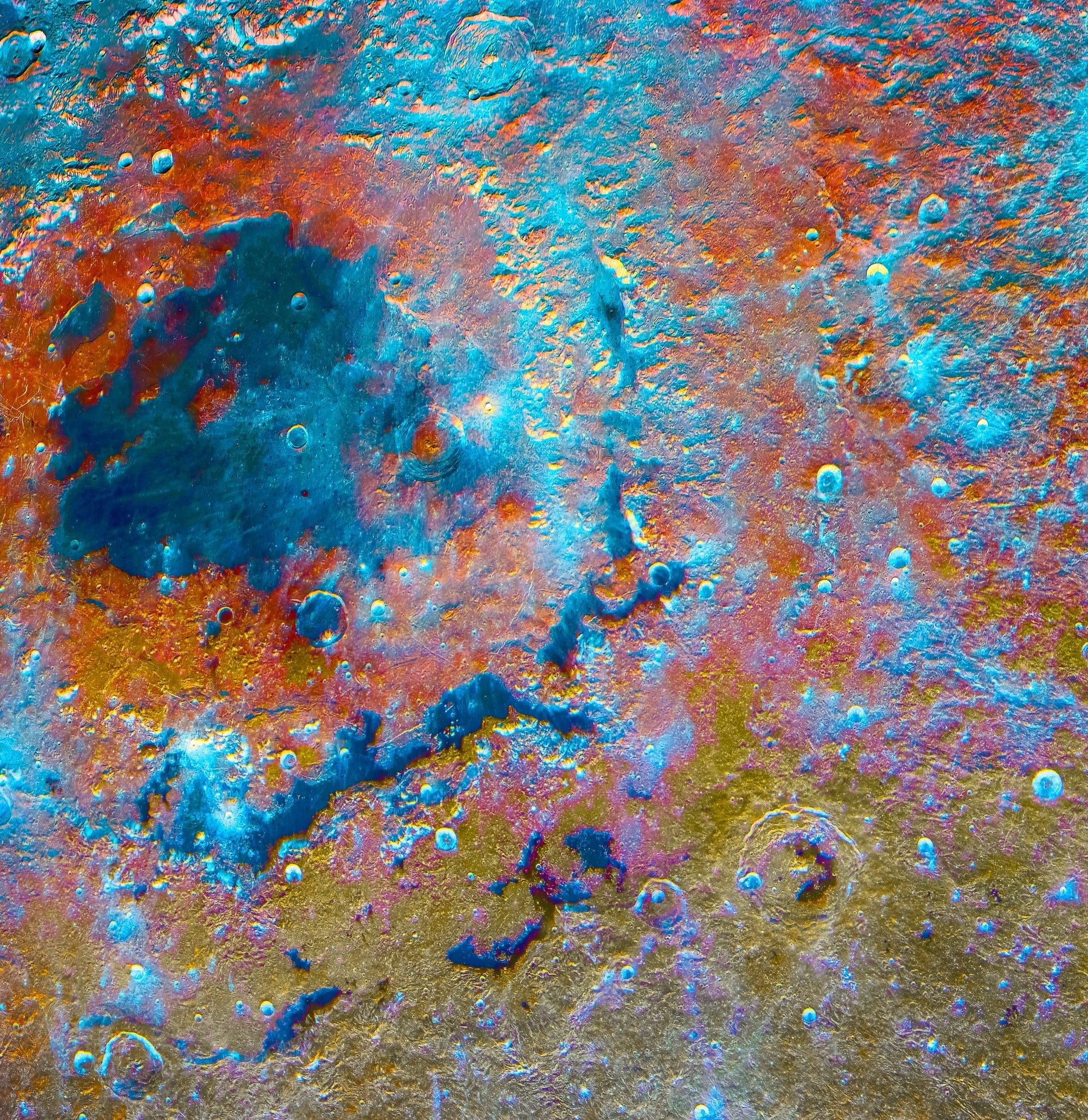
A hypersaturated image of Mare Orientale shows vivid oranges and blues

The lunar surface near Mare Orientale enhanced with hypersaturation of color, revealing minerals such as orange pockets of iron oxide.

Andrew McCarthy

This technique allows the photographer to isolate the color information captured in the image. Amping up the color saturation reveals more information about the moon’s topography: the red that emerges is most likely iron oxide, and blues are titanium-rich basalt, McCarthy says.

“I’m trying to bring those out in order to excite people and help them see our moon as more than just a dusty gray rock..., as the geological gold mine that it is,” he says.

It’s Time to Stand Up for Science

If you enjoyed this article, I’d like to ask for your support. Scientific American has served as an advocate for science and industry for 180 years, and right now may be the most critical moment in that two-century history.

I’ve been a Scientific American subscriber since I was 12 years old, and it helped shape the way I look at the world. SciAm always educates and delights me, and inspires a sense of awe for our vast, beautiful universe. I hope it does that for you, too.

If you subscribe to Scientific American, you help ensure that our coverage is centered on meaningful research and discovery; that we have the resources to report on the decisions that threaten labs across the U.S.; and that we support both budding and working scientists at a time when the value of science itself too often goes unrecognized.

In return, you get essential news, captivating podcasts, brilliant infographics, can't-miss newsletters, must-watch videos, challenging games, and the science world's best writing and reporting. You can even gift someone a subscription.

There has never been a more important time for us to stand up and show why science matters. I hope you’ll support us in that mission.