








Imagine you and I are playing a simple game of chance. We each throw $50 into a pot and start flipping a coin. Heads, you get a point; tails, I get one. The first person to reach 10 points walks away with the full $100. The game gets underway, and the score is currently eight to six in your favor. Suddenly my phone rings: there’s an emergency, and I must leave in a hurry. Now we have a problem. You don’t want to just hand me my $50 back because you’re winning. But I’m reluctant to give you the whole pot because I still have a chance to hit a lucky streak and mount a comeback. What is the fairest way to split the cash?
Known as the “problem of points,” or “problem of the division of the stakes,” this puzzle stumped mathematicians for more than 150 years. And it did so for good reason: probability theory hadn’t been invented when the problem was first posed. Two greats of 17th-century math, Blaise Pascal and Pierre de Fermat, corresponded about the problem in a famous series of letters. They not only discovered the correct way to share the pot but also created the foundations of modern probability theory in the process. To this day, the solution is the basis for risk assessments of all kinds, helping us make smarter bets on everything from buying a stock to insuring a home along a coastline.
In 1494, Italian mathematician Luca Pacioli first took an early crack at the problem of points in his textbook, the title of which translates to Summary of Arithmetic, Geometry, Proportions and Proportionality. He proposed that players should split the pot in proportion to how many points they each have at the time of interruption. In our running example, you have won eight of the 14 flips thus far. According to Pacioli’s solution, you would take eight fourteenths of the pot, which equals about $57.14. I would take the remaining six fourteenths. The solution sounds sensible, but more than 50 years later, Niccolò Fontana “Tartaglia” noticed that it failed in cases where the point ratio between players was extreme. What if the interruption came after a single coin toss? Under Pacioli’s rule, the winner of that one flip would take the entire pot, even though the game was far from decided. This would be clearly unfair—and the problem of points is all about seeking a fair split.
If you're enjoying this article, consider supporting our award-winning journalism by subscribing. By purchasing a subscription you are helping to ensure the future of impactful stories about the discoveries and ideas shaping our world today.
Tartaglia proposed an alternative method. Imagine that, in our hypothetical game, you’re ahead by two flips. You have one fifth of the 10 flips needed to win. Because that’s one fifth closer to the goal, Tartaglia reasoned that you should get your full stake back and take one fifth of my stake: the original $50 you put in plus one fifth of my $50, for a total of $60. This new approach seems to operate more equitably, especially at the extremes. Now if the game got interrupted after one flip, then the winner of that flip would take only one tenth of their opponent’s stake instead of all of it. While Pacioli’s method rewards the winning player based on the size of their lead relative to the number of flips thus far, Tartaglia’s method rewards them based on the size of their lead relative to the total length of the game. Tartaglia doubted his own innovation, though, writing, “In whatever way the division is made there will be cause for litigation.” He believed that no perfect mathematical solution existed and that the problem was designed to cause arguments. It turns out he was at least right to doubt his own solution. Imagine that one player had 199 points and that the other had 190 points during a game with a goal of 200 points. Tartaglia would award the first player only nine two-hundredths of their opponent’s stake, or $2.25, even though their opponent would need 10 tails in a row to win. The first player’s measly payout hardly seems to reflect their overwhelming likelihood of winning at that stage of the game.
The debate went nowhere until the mid-17th century, when a French gambler and intellectual socialite enlisted the help of mathematician Blaise Pascal. Pascal immediately saw that the solution lay not in the score at the time of interruption but in the future possibilities of the score, and he wrote to his friend and fellow mathematician Pierre de Fermat to help him prove it. Their correspondence yielded two completely unique approaches to the problem. Amazingly, their disparate approaches always arrived at the same solution. This convergence sealed their confidence in their results, and mathematicians now agree that they had found the fairest way to divide the stakes.
Fermat’s solution was to look at all possible continuations of the game after the point at which it was interrupted and count the number of those continuations that result in a win for each player. A fair percentage of the total pot awarded to a player should be the percentage of possible futures in which that player wins the game. Take our recent example game’s score of eight to six with a goal of 10 points; Fermat would notice that the game must end within five coin flips. If the first player won one flip and the second won three, then they would be tied at nine to nine, and the game would end on the next flip. If the game stopped at this point, Fermat’s method for dividing the pot would list all possible outcomes of those five coin flips and then tally the ones that amassed 10 points for each player. In some of those possible futures a player will win in fewer than five flips, but that’s okay: we can imagine that if the game ends early, the players flip the coin a few extra times just to make the accounting easier. The figure below reveals the answer to our puzzle. The first player wins in 26 out of the 32 possible continuations of the game, so they are due 26 / 32 = 81.25 percent of the pot, or $81.25.
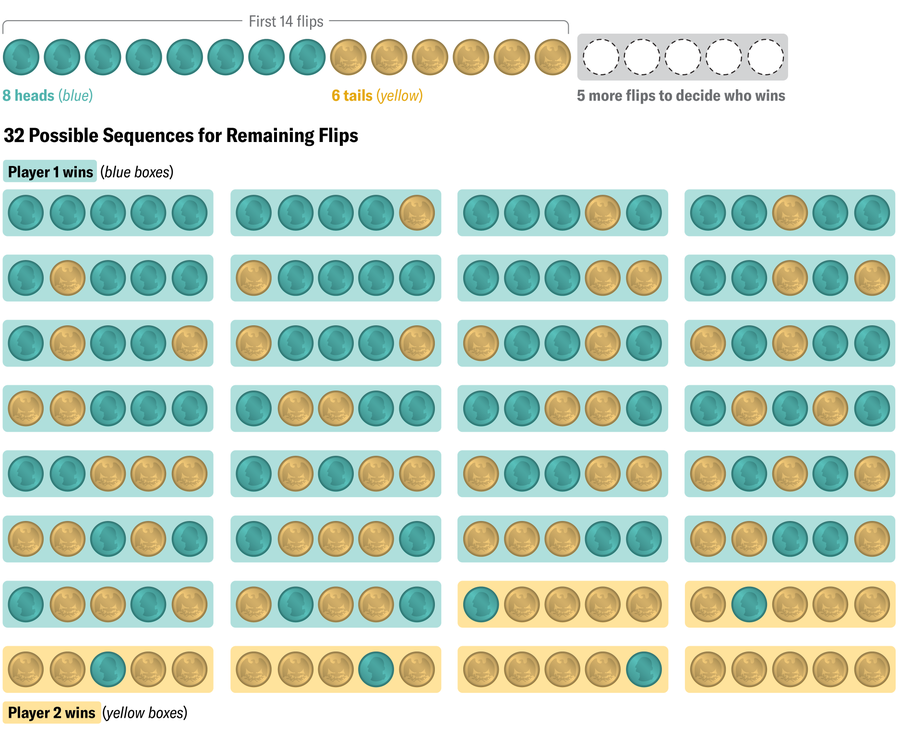
Amanda Montañez
Fermat’s solution, though elegant, suffered from one major drawback: What if there were too many possible continuations to list? Even if only 20 flips remain in our game, we would have to consider more than a million imaginary futures to uncover a fair split. Pascal offered a genius answer and, in the process, provided the earliest reasoning on what would become the concept of expected value, which remains a fundamental pillar of modern probability theory.
Pascal’s method begins with an uncontroversial claim: if the game is tied at the time of interruption, then the two players should split the pot equally. If the score were nine to nine when the interruption happened, then each player would take $50 back. Now we work backward from there. If the score were nine to eight in favor of the first player, Pascal’s approach would ask what would happen after one more flip. There would be a 50 percent chance that the player in the lead would win that coin flip, reach 10 points and take the entire pot. On the other hand, there would be a 50 percent chance that the other player would win the flip and tie the game at nine to nine, which would mean they should split the pot. The first player’s winnings would average out to:
50 percent of $100 + 50 percent of $50 = $75
So if the game is interrupted at a nine-to-eight score, then the first player should take $75. We can apply this type of reasoning recursively to work out the appropriate split for any situation.
The key is to look at what your fair winnings would be if one more heads’ flip came up and what they would be if one more tails’ flip came up. You then find the average of those two possibilities. With a nine-to-seven score, the first player should take $87.50: one more heads would earn them $100, and one more tails would earn them $75 because that would be the nine-to-eight case we just analyzed. With a nine-to-six score, they’d take $93.75. An eight-to-seven score would bestow $68.75, the average of their fair take on a nine-to-seven score with their fair take on an eight-to-eight score. And finally, with an eight-to-six score, the first player should take: 50 percent of $93.75 + 50 percent of $68.75 = $81.25
This is exactly the same solution as Fermat’s method. Both Fermat and Pascal had the same insight: a fair split depends on the possible futures, and you should weigh each possible future by its likelihood of occurring. Today we recognize these equations as expected values, or weighted averages of all possible future outcomes. Fermat listed these future outcomes exhaustively, considering each possible way the next five coin flips could land. Pascal devised a clever way to work backward: you calculate the fair split when you have five coin flips to go based on the fair splits with four coin flips to go, which you in turn calculate based on three flips to go, and so on.
The concept of expected value didn’t stay confined to 17th-century parlor games. It is the mathematical engine that drives almost all modern risk assessment. When an actuary prices a life insurance premium, a Wall Street analyst evaluates a stock portfolio or a gambler weighs the risks of a wager, they are performing the exact same calculation. They multiply the financial effect of every possible scenario by its probability and then find the sum of those outcomes to quantify the worth of a decision. Uncertainty is inescapable, and we owe much of our current technological stature to our ability to confront it with rigor. For millennia, mathematicians treated problems of chance with unsystematic guesswork. Pascal and Fermat’s correspondence replaced that guesswork with a framework. While we still can’t predict the future, we at least know how to price it.
此内容由惯性聚合(RSS阅读器)自动聚合整理,仅供阅读参考。 原文来自 — 版权归原作者所有。