







What shape is the universe? This question is far more intriguing and truly unresolved than any debate over the shape of our planet, despite the claims of flat-Earthers.
We occupy only a tiny space within a gigantic cosmos. Our vantage point is limited. Nevertheless, cosmologists are now fairly certain that our universe is flat.
But that doesn’t explain the exact shape of space. It could extend infinitely along the three spatial dimensions or resemble a three-dimensional generalization of a donut’s surface—or take on even wilder forms. The mathematics of flat space is astonishingly versatile, and new research is upending the traditional thinking about the layout of our cosmos.
If you're enjoying this article, consider supporting our award-winning journalism by subscribing. By purchasing a subscription you are helping to ensure the future of impactful stories about the discoveries and ideas shaping our world today.
Carl Friedrich Gauss, a German astronomer who lived in the late 1700s and early 1800s, was one of the first mathematicians to study geometry in curved spaces. He knew, for example, that the sum of the angles of a triangle in a plane is 180 degrees and that it is greater on a sphere. On spherical surfaces, such as that of Earth, an equilateral triangle can consist of three right angles, for instance. Other geometries, such as the shape of a Pringles chip, can have angle sums of less than 180 degrees.
The same principle applies not only to triangles on 2D surfaces but also in 3D space. Depending on the curvature of space, the sum of the angles can vary. Gauss may have seen the triangle as a good starting point for investigating the shape of the universe, though this is debated. He is said to have measured the distances between three German mountain peaks (Hohenhagen, Brocken and Inselberg) and determined their angles. His result: the sum was close enough to 180 degrees that it suggested that there was a flat plane between the mountain peaks.
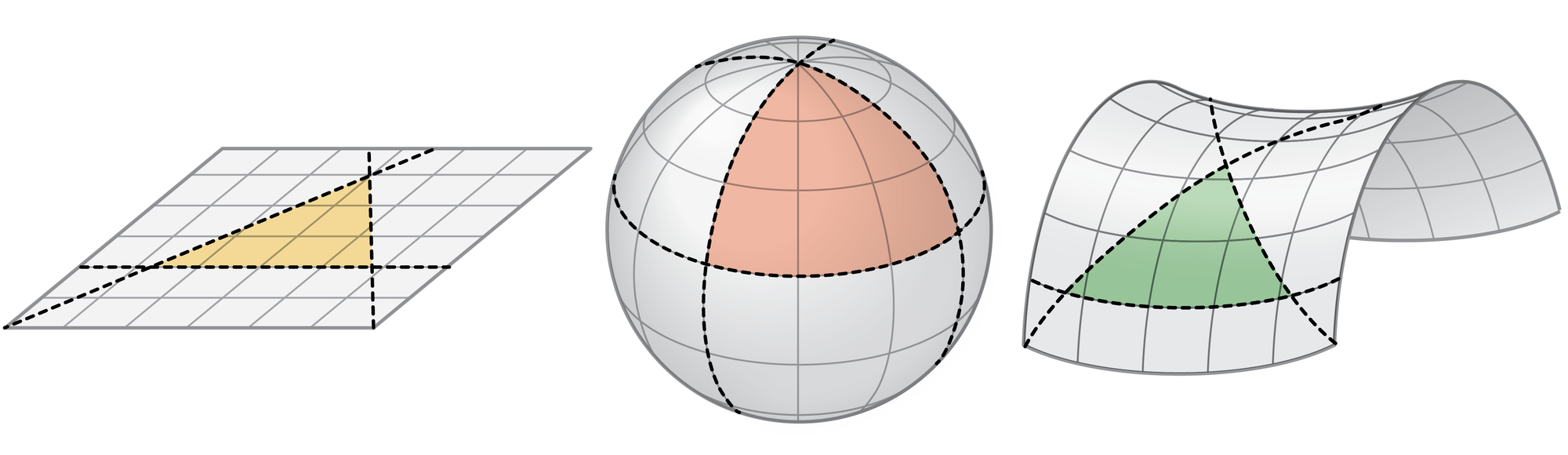
Depending on the curvature of space, the sum of the angles of a triangle can be equal to (yellow), greater than (pink) or less than (green) 180 degrees.
Amanda Montañez
Unfortunately, although the triangle method is helpful for thinking about the curvature of space, it’s not going to answer the question of whether our universe is curved or flat. The cosmos is gigantic. Even if Gauss or another astronomer used a large telescope, triangulating the distances between stars wouldn’t work. Stars within our own or in neighboring galaxies are too close to us, measured against the vast scale of the universe. Furthermore, we must take into account that the observed objects are moving and that, as a result of gravity, the light traveling to us follows partially curved paths.
But experts can use other tricks to deduce the shape of our universe. For example, they look deep into the past—all the way to the oldest radiation, dating back to around 13.8 billion years ago.
Exactly how our universe originated is still unclear. Fortunately the precise details are not necessary to deduce its shape. Much can already be worked out from the oldest light that reaches us: the cosmic microwave background.
When our universe was very young, it consisted of very hot, dense matter. The building blocks of atomic nuclei, quarks and gluons, floated around loosely in a kind of primordial soup. The medium was so dense that photons could not move freely within it.
As the universe expanded, it cooled; gradually the first atomic nuclei and eventually atoms formed. As a result, the universe became transparent: photons could move freely. And this light, which originated around 370,000 years after the big bang, is what we can observe.
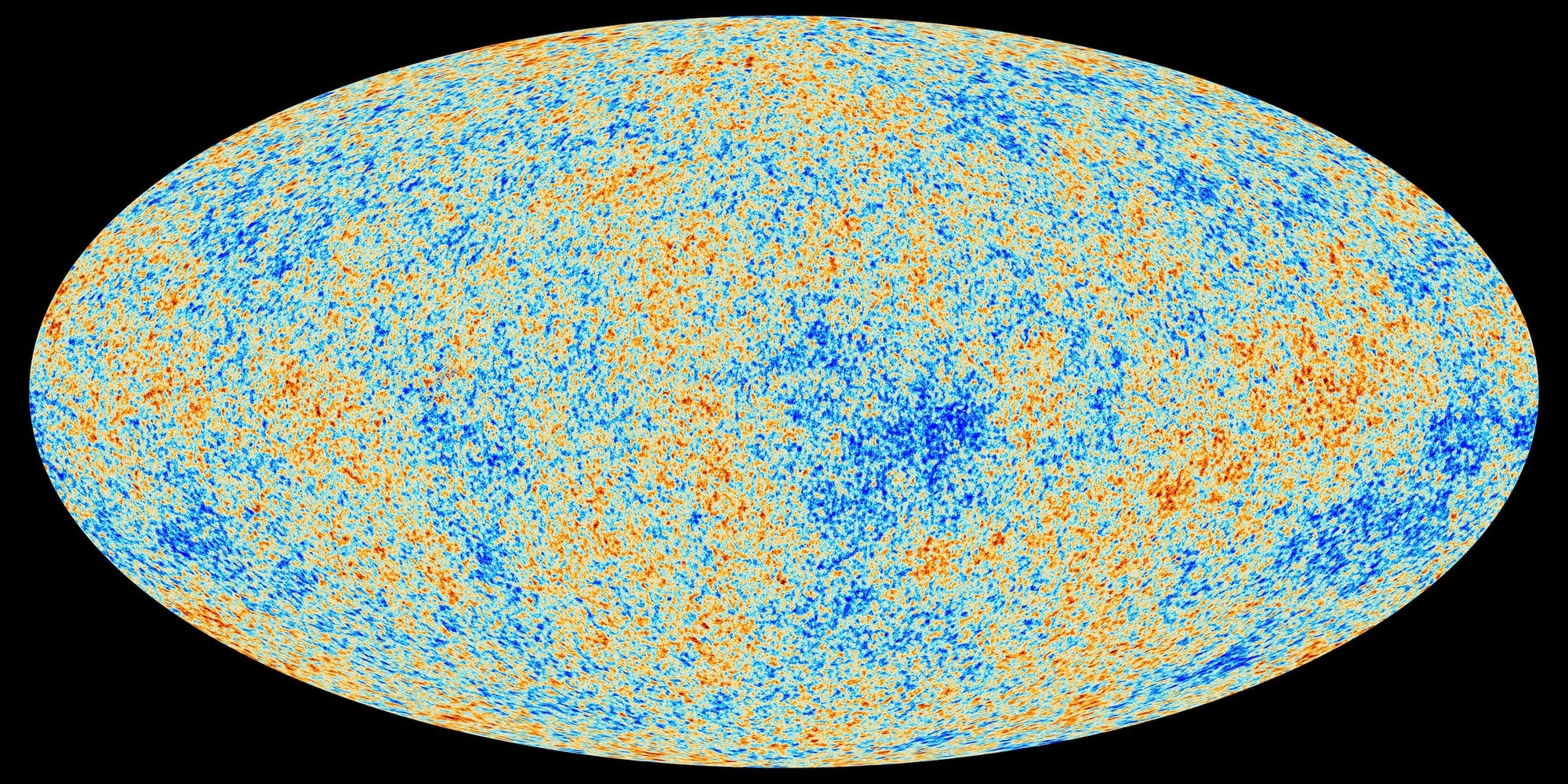
In this image depicting the Planck satellite’s measures of the cosmic microwave background, red areas represent regions that are warmer than the average temperature, and blue areas represent colder regions.
The signal that reaches us from that time is surprisingly uniformly distributed across the sky, no matter where the detectors are pointed. This means that matter must have been very evenly distributed at this early stage. This observation leads to the cosmological principle: the universe must be homogeneous and isotropic. In other words, matter in the cosmos is uniformly distributed, in the same way in all directions. From Einstein’s equations of general relativity, it then follows that the curvature of space is constant on large scales.
This significantly restricts the possible geometry of the cosmos. If the curvature is constant, then three different cases can be distinguished:
No curvature: in this case, you have a Euclidean geometry, as on a flat surface.
Positive curvature: this corresponds to a spherical geometry, similar to that on a sphere.
Negative curvature: the geometry is hyperbolic, like a Pringles chip.
To determine which of the three cases is realized in the universe, one can again use cosmic microwave radiation. It is almost homogeneous, but not quite: there are tiny fluctuations within it that provide a clue to the geometry of the universe.
The small fluctuations in microwave radiation result from tiny density differences in the hot, bubbling primordial soup. And we can calculate how strong these fluctuations were in the early universe: the largest correspond to the greatest distance the density waves could travel.
These density fluctuations are also visible in our sky, specifically in the cosmic background. How large they appear depends on the geometry of the universe: If the universe is positively curved, the density fluctuations should appear larger than they actually are. With negative curvature, they should appear smaller. And without curvature, they should correspond exactly to the theoretical value (much as the angles of a triangle in flat space will sum to 180 degrees). According to measurements by cosmologists, this last scenario applies to our universe.
Density fluctuation measurements, along with other cosmological data, suggest that our universe is flat. But that still doesn’t mean we know the true shape of our universe.
Because curved 3D spaces are difficult to visualize, we can start with 2D examples. If our universe were 2D and flat, most people would imagine a flat surface. But that’s not the only 2D shape with flat geometry. Another example is the surface of a torus, which resembles a bagel or donut.
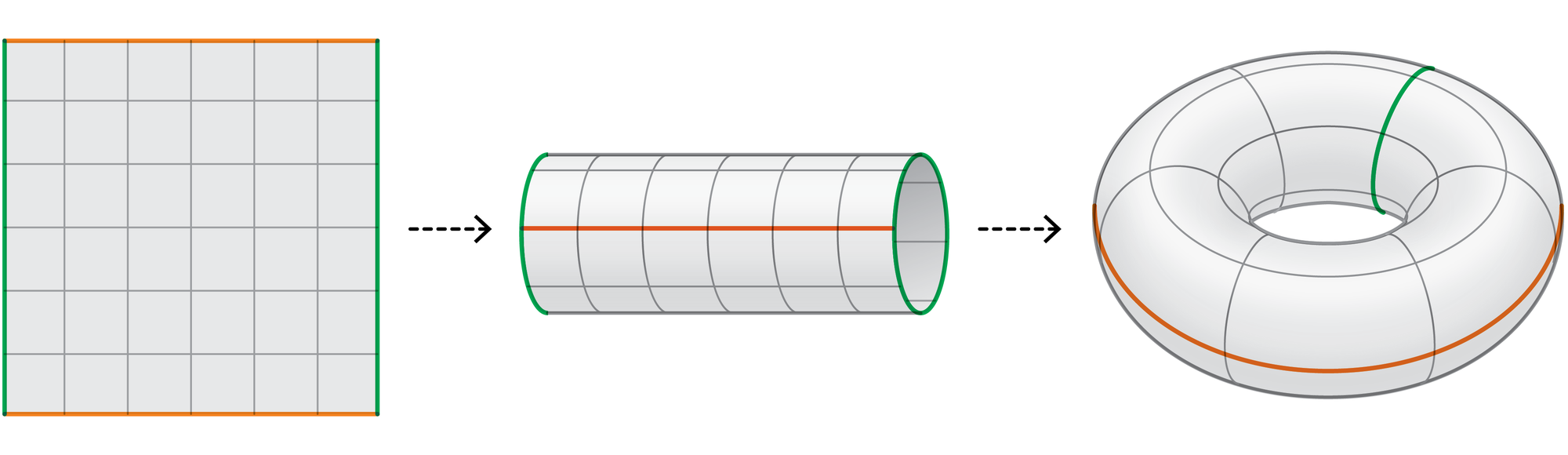
You can imagine creating a torus from a flat material by rolling it so the ends meet and then twisting the resulting tube into a ring.
Amanda Montañez
A bagel looks curved, but in a crucial sense, it isn’t. You could, in theory, form a torus by taking a flat (and exceptionally stretchy) sheet of paper and gluing the opposite sides together to create a cylinder. You could then twist this sheet so the open cylinder ends meet, creating a hollow ring or torus.
In fact, there are three other variations of a flat space in two dimensions: a cylinder, a Möbius strip and a Klein bottle.
In three dimensions, the possibilities are even more diverse. In 1934 mathematician Werner Nowacki proved that there are 18 different flat 3D shapes. If our universe is truly flat, then it has one of these 18 shapes.
We can rule out some candidates because eight of the 18 are “nonorientable.” If you were to fly a rocket through a nonorientable universe, you would eventually return to your starting point, but in a mirrored form: your right would now be left, and vice versa. According to experts, such universes contradict the laws of physics.
That leaves 10 different forms that the universe can have:
An infinitely extended 3D space with x, y and z axes.
A 3D generalization of the torus: in this case, one can imagine gluing together the opposite faces of a cube.
A half-twist torus: same as #2, but one pair of surfaces is twisted by 180 degrees, like a Möbius strip.
A quarter-twist torus: same as #2, but a pair of surfaces is joined by twisting them by 90 degrees.
A third-twist prism: instead of looking at the faces of a cube, one can also use a six-sided prism. Here, opposite faces are also glued together, but one face is rotated by 120 degrees.
A sixth-twist prism: same as #5, but one side is rotated by 60 degrees.
A shape called a Hantzsche-Wendt manifold that consists of two cubes stacked on top of each other, with the faces of the cubes joined together in a complex way.
A space consisting of infinitely many flat planes that can be twisted relative to each other.
A space consisting of an infinitely tall “chimney”: four surfaces arranged as the sides of a parallelogram. Opposite surfaces are glued together.
Same as #9, but one of the pairs of surfaces is rotated by 180 degrees.
All of these shapes share the same flat geometry but each possess their own unique characteristics. Experts can therefore search for clues and evidence of these features to determine the precise shape of the universe using increasingly detailed cosmological data.
Many of these candidates for the shape of the universe are compact, meaning they do not extend outward infinitely. Instead a striking characteristic that they share is repetition. In a torus-shaped universe, for example, light from our Earth would eventually reach Earth again, so we would see our reflection.
That said, our universe is gigantic, and light travels at a finite speed. This means that even if the light from our solar system or galaxy were to reach us again someday, we most likely wouldn’t recognize the image. This is because its shape at that time would probably bear little resemblance to our current surroundings. Furthermore, our cosmos might be so vast that light simply hasn’t had enough time to traverse it.
But there could be other clues if we are living in a compact universe. The shape of the cosmos influences, among other things, how matter and light interacted in the early universe. And this should be reflected in the cosmic microwave background radiation. Researchers have searched for repeating structures within it, such as identical circular arrangements that would indicate a compact universe. To do this, they had to make some geometric considerations: because we receive the microwave radiation on the spherical Earth, the signal has the shape of a spherical surface. Our universe could have a more complex shape, however—and traces of this should be reflected in the spherical data we receive.
When experts searched for identical circular structures in cosmic microwave background radiation data during the 2000s and 2010s, they found nothing. Therefore, most cosmologists assumed that the universe had a fairly simple structure: it would be flat and extend infinitely in all three spatial dimensions. Research into the shape of the universe stalled because of a lack of new evidence—until the Collaboration for Observations, Models and Predictions of Anomalies and Cosmic Topology (COMPACT) was launched in 2022.
Researchers in the collaboration are comparing the latest data on the cosmological microwave background radiation with the various possible shapes of the universe. They have discovered that the lack of evidence for identical circular structures in the cosmic microwave background is far less restrictive than previously thought. In fact, it is quite plausible that we would not identify any of these structures in a compact universe. Furthermore, the experts are working on identifying other features in cosmological data that would point to complex shapes for the universe. The COMPACT team is still analyzing the data and developing suitable models. Exciting new results are expected in the coming months and years.
All of this means that the universe could be far more complex than previously thought. And the question of the shape of our cosmos is not merely academic. The topology of spacetime was likely determined by the quantum processes that occurred shortly after the big bang. Therefore, if we knew more precisely about the shape of the universe, we could learn more about the complex processes at its beginning—or so the hope goes.
This article originally appeared in Spektrum der Wissenschaft and was reproduced with permission. It was translated from the original German version with the assistance of artificial intelligence and reviewed by our editors.
此内容由惯性聚合(RSS阅读器)自动聚合整理,仅供阅读参考。 原文来自 — 版权归原作者所有。